
How to Assemble a Shed Kit: Your Complete Roadmap
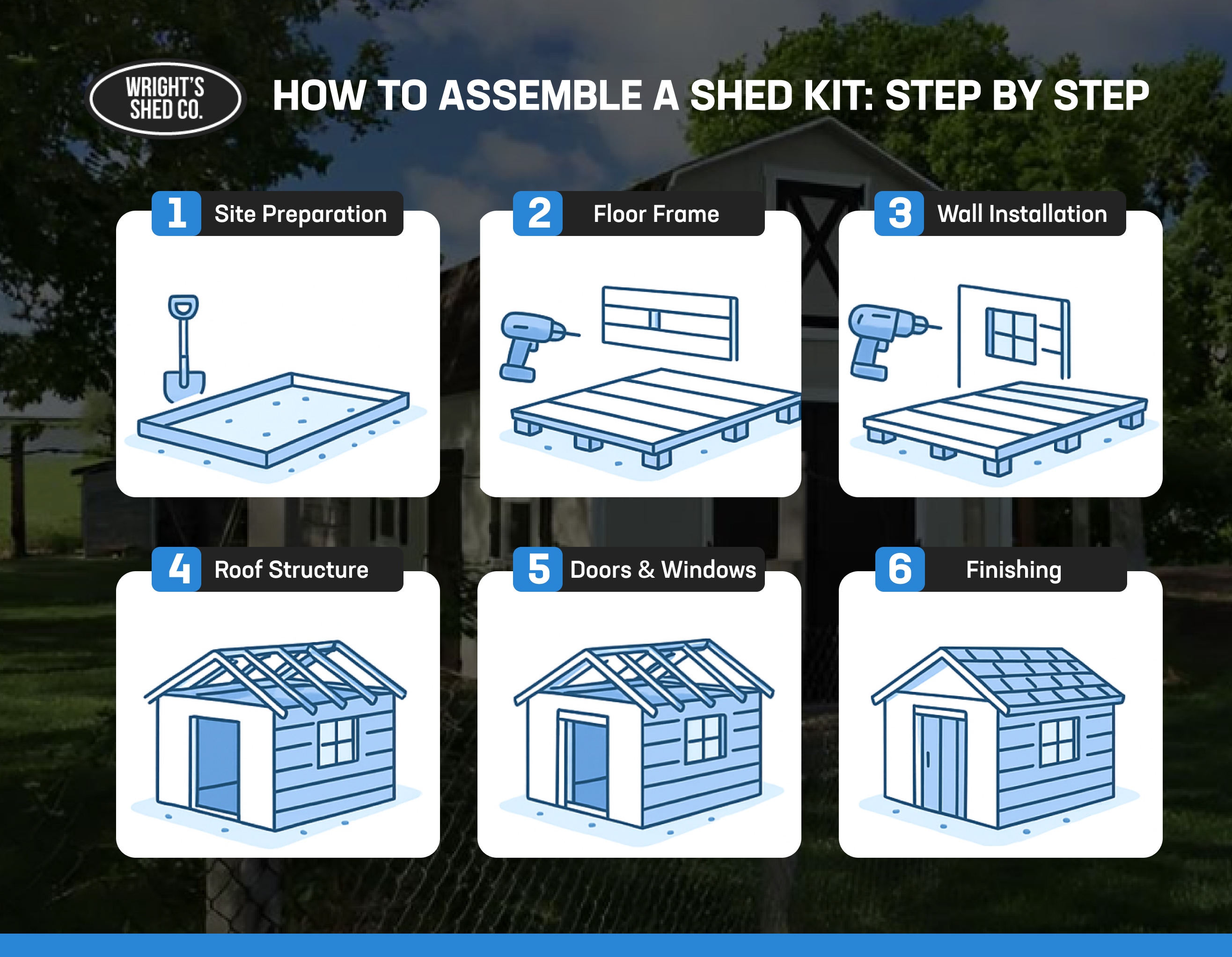
Learning how to assemble a shed kit is simpler than you might think, but it requires the right preparation and approach. Here’s the quick roadmap:
- Prepare the Site – Level and clear your foundation area.
- Build the Floor – Assemble the base frame and install floor sheathing.
- Erect the Walls – Lift and secure pre-built wall panels.
- Install the Roof – Space and attach roof trusses, then add sheathing.
- Add Doors and Windows – Hang pre-built components and seal gaps.
- Finish Strong – Install roofing, trim, and anchor the shed.
With a quality shed kit, two people can typically assemble a 10’x10′ shed in about 8 hours. The key is following the instructions and taking your time, especially with the foundation. An unlevel base will haunt you throughout the build—walls won’t align, doors won’t close properly, and the roof won’t sit right. Spend extra time here, and everything else flows smoothly.
Modern shed kits have come a long way. Wright’s Shed Co. kits include pre-built wall panels, pre-cut treated lumber bases, and pre-assembled roof trusses, which means much of the challenging work is already done. You’re assembling precision components that fit together like a well-designed puzzle.
Before You Begin: Planning and Preparation
The truth about how to assemble a shed kit is that success starts before you pick up a hammer. Proper planning, site selection, and tool gathering will save you days of frustration. Trust us on this one.
Choosing Your Wright’s Shed Co. Shed Kit: What to Know
Our DIY Shed Kits are designed to do the hard stuff at the factory so you can focus on assembly. Every kit includes:
- Pre-built 2×4 walls with siding already attached.
- A pre-cut 2×6 pressure-treated wood base sized for your model.
- Pre-assembled roof trusses with steel plates, no complex angle cuts needed.
We use LP SmartSide panel siding with a 50-year factory warranty because it resists moisture and rot, holding up to the weather extremes in Utah, Idaho, Iowa, and Nebraska. Our most popular DIY options include the Vineyard, Orchard, and Farm sheds, plus specialized Lean-To Sheds and Chicken Coop kits.
Assembly time varies. A standard 10’x10′ shed typically takes two people about 8 hours. Larger models might take a full weekend. Ready to find your fit? Explore our DIY Shed Kits to compare sizes and styles.
Essential Tools and Materials
Your kit includes the shed components, but you’ll need to supply the tools. Start with safety gear like safety glasses and work gloves.
Essential tools include:
- Cordless drill/driver
- Hammer and tape measure
- 4-foot level
- Step ladder (6-8 feet)
- Circular or reciprocating saw
- Framing square and caulk gun
Materials you’ll need to supply:
- Shingles, roofing felt, and drip edge
- Exterior paint or stain (two coats of acrylic latex paint are required for the warranty)
- Exterior-grade caulk
- Fasteners (galvanized nails, framing nails, roofing nails)
Before you start, unbox everything and check the components against your manual. This 20-minute step prevents major delays later.
Foundation Preparation: Expert Advice from Wright’s Shed Co.
We cannot overstate this: a level, stable foundation is the most critical part of your shed build. An unlevel base creates a cascade of problems, from misaligned walls to doors that bind. Start with a solid foundation, and everything else clicks into place.
While Wright’s Shed Co. doesn’t build foundations, we provide expert guidance based on 27 years of experience.
- Site Selection: Choose the most level spot in your yard with good drainage. Avoid low spots where water pools. Clear at least 4-6 feet of space around the perimeter for assembly.
- Check Local Rules: Before digging, call your local building department about permits and setback requirements. This varies widely across Utah, Idaho, Iowa, and Nebraska.
- Foundation Options: A gravel pad offers excellent drainage. A concrete slab is the most durable but also most permanent. Treated wood runners on concrete blocks work well for uneven ground.
Our shed kits include a complete floor system with a pre-cut pressure-treated base and 3/4-inch tongue and groove OSB sheathing. This integrated floor is designed to work seamlessly with your chosen foundation, keeping the structure square and protected from moisture.
How to Assemble a Shed Kit: The Main Build
With your site prepared, it’s time for the exciting part: watching your Wright’s Shed Co. kit come to life. The main build follows a logical sequence: floor, walls, roof, then doors and windows. Each step builds on the last, which is why a perfect foundation is so critical.
Step 1: Assembling the Base Frame and Floor

Your shed floor is the structural base that keeps everything square. Start by laying out the pre-cut 2×6 pressure-treated perimeter boards on your foundation. Connect the corners, then install the floor joists, spacing them 16 inches on-center.
Now for the moment of truth: squaring the frame. Measure the diagonal distance from corner to corner, then measure the other diagonal. The two measurements must be identical. Gently adjust the frame until they match. This step is non-negotiable for a successful build.
Finally, install the 3/4″ tongue and groove OSB floor sheathing, securing it to the joists with galvanized nails. Do one last level check before moving on.
Step 2: Erecting the Walls

This is where having a partner becomes essential. Our pre-built wall panels arrive with framing and LP SmartSide siding already attached, saving you hours of work.
- Position the first wall (a gable wall is a good start) so its bottom plate aligns with the floor edge.
- Secure the wall to the floor sheathing with galvanized nails while your partner holds it steady.
- Brace the wall immediately with a diagonal 2×4 to prevent tipping.
- Continue around the perimeter, installing each wall and nailing the corners together.
- Check for plumb constantly with your level to ensure every wall is perfectly vertical.
For walls with door openings, carefully cut the 2×4 board at the bottom of the opening flush with the floor to create your threshold.
Step 3: Installing the Roof Structure
Our pre-built roof trusses eliminate the most challenging part of roof framing. You’re simply positioning and securing engineered components.
With a partner, lift each truss onto the top plates of the walls, following the spacing marks you made earlier (typically 16-24 inches on-center). Secure the trusses by toenailing 3″ framing nails through the truss into the wall’s top plate.
Once all trusses are in place, install the OSB roof sheathing panels, starting from the bottom edge and working up. Nail the sheathing to every truss, staggering the seams for strength and maintaining a consistent overhang.

Step 4: Installing Doors and Windows
Our kits include pre-hung doors and windows for straightforward installation. Before placing a window, apply a bead of exterior-grade caulk around the opening for a weather-tight seal. Slide the window in and secure it with screws.
Door installation requires more precision. Use shims, especially on the hinge side, to get the door perfectly plumb and level before fastening it to the frame. This ensures it will open and close smoothly for years. Install all hardware and test every door and window to confirm they operate without sticking.
Finishing Touches and Long-Term Care
Now that the main structure is complete, you’re in the final stretch of learning how to assemble a shed kit. These finishing touches are what protect your shed from the elements and give it a professional look. Don’t rush this part, it’s your shed’s armor against the weather.
Step 5: Roofing and Trim
This is the most critical weatherproofing step. A properly installed roof system determines how long your shed will last.
- Install Drip Edge: This metal flashing directs water away from the roof edges. Install it on the eaves (lower edges) first, then the gables (sloped sides).
- Add Underlayment: Lay 30-lb. asphalt roofing felt over the sheathing, overlapping each row by 3 inches as you work your way up the roof.
- Install Shingles: Start with a starter course along the bottom edge. For the main rows, stagger the cuts to create an offset pattern and secure each shingle with four roofing nails.
- Finish with a Ridge Cap: Fold ridge cap shingles over the peak to seal the roof’s highest point.
Install the exterior trim around the corners, roof edges (fascia), and doors and windows. Finally, caulk every seam where trim meets siding and around all frames. This is required to validate your 50-year siding warranty and is your best defense against water intrusion.
Step 6: Anchoring and Final Checks
A shed that isn’t anchored is vulnerable to high winds. Your anchoring method depends on your foundation, use concrete anchors for a slab or ground anchors for a gravel pad. Add truss screws from inside the shed, driving them through the top plate into each roof truss for extra uplift resistance.
Do a final walkthrough, tightening any loose fasteners and confirming that doors and windows operate smoothly. Clear away all tools and debris, and take a moment to appreciate what you’ve built.
Post-Assembly Maintenance for Longevity
Your Wright’s Shed Co. kit is built with premium materials, but proper maintenance is key to protecting your investment.
- Paint or Stain Promptly: To validate your 50-year LP SmartSide warranty, you must apply two coats of quality exterior acrylic latex paint or stain within 30 days of assembly. Pay special attention to all exposed edges.
- Inspect Regularly: A few times a year, check that the shed is still level, inspect the roof for damage, and look for cracking caulk that needs to be reapplied.
- Ensure Good Airflow: Keep vegetation trimmed at least two feet away from the shed and ensure the vents under the floor are not blocked. This prevents condensation, mold, and rot.

Frequently Asked Questions about How to Assemble a Shed Kit
How long does it take to assemble a Wright’s Shed Co. shed kit?
A standard 10’x10′ kit typically takes two people about 8 hours. Larger or more complex sheds can take 2-3 days. Your final time will depend on your preparation, skill level, and pace.
Can one person assemble a shed kit?
It’s not recommended. Lifting and positioning pre-built wall panels and roof trusses requires two people for safety and efficiency. Teamwork makes the process smoother, safer, and more enjoyable.
What is the most important step in shed assembly?
Without question, it’s building a perfectly level and square foundation. An unlevel base creates a domino effect of problems, from misaligned walls and a crooked roof to doors that won’t close properly.
Your Guide to How to Assemble a Shed Kit: A Final Word
You’ve made it through the entire journey of how to assemble a shed kit, from planning to the final coat of paint. Building your own shed is more than a project; it’s creating something useful and lasting with your own hands.
The smoothest builds always start with the best preparation. Taking the time to create a perfectly level foundation and organizing your parts beforehand makes all the difference. At Wright’s Shed Co., we’ve spent over two decades refining our kits with pre-built components to make your assembly as straightforward as possible.
Our local expertise matters. We choose materials like LP SmartSide paneling with its 50-year factory warranty specifically to withstand the weather in Utah, Idaho, Iowa, and Nebraska.
By building it yourself, you’re making a valuable investment in your property and gaining the satisfaction of a job well done.
Ready to get started? Get a free estimate on your dream shed today!