
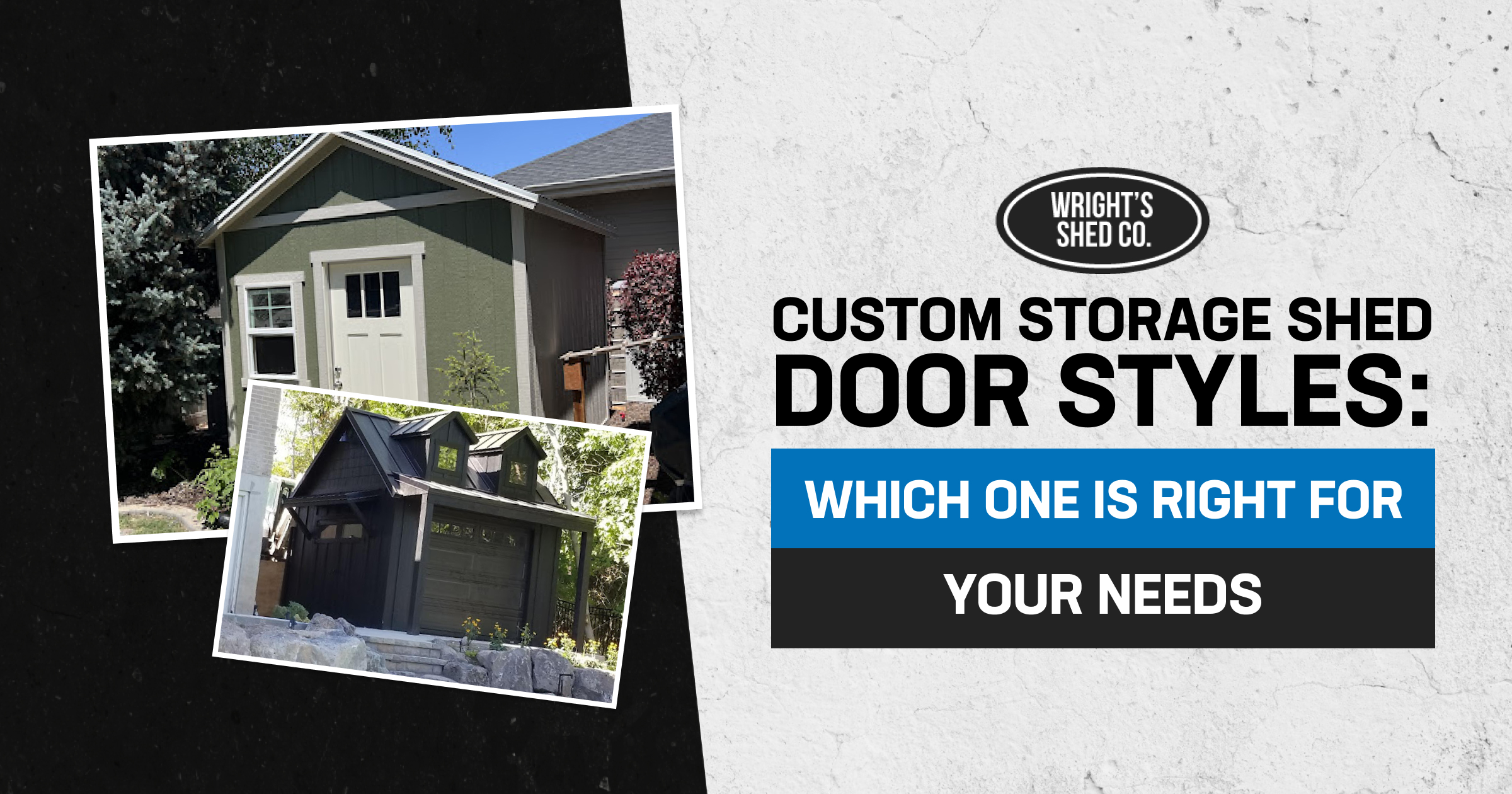
Custom Storage Shed Door Styles: A Complete Buyer’s Guide
Custom storage shed door styles directly determine how useful your shed will be every single day. Choose wrong, and you fight a narrow opening every time you haul equipment in or out. Choose right, and the shed pays for itself in convenience for decades.
Before picking a size or style, consider these core factors:
- What you’re storing: tools, mowers, ATVs, or workspace gear
- How much swing clearance do you have in front of the shed
- Whether you need a ramp to roll equipment in and out
- Security requirements for high-value equipment
- Aesthetic match with your home and yard
This guide breaks down every door type Wright’s Shed Co. offers so you can make the right call before you configure your build.

Single Swinging Door: Best for Everyday Tool Storage
A single swinging door is the standard entry point on most shed builds. Wright’s Shed Co. includes a 4’x6′ single door as a baseline on every build, notably larger than what most other builders include at no added cost.
This door style works well when your primary use case is foot traffic and hand-carried items: garden tools, bins, small equipment, lawn chemicals, and similar items.
When a single door is the right call:
- You’re storing tools, bags, and bins—not riding equipment
- Your lot has limited space in front of the shed for the door swing
- You want the simplest, lowest-maintenance entry option
- Budget is a priority, and the opening is adequate for your needs
The 4’x6′ single door provides a clear opening width that handles most wheelbarrows, push mowers, and large storage containers without issue.
Pro Tip: If you plan to store a custom storage shed with loft, a single door may limit how you move bulky items in and out. Consider upgrading to a double door when loft shelving means you’ll be moving more up top.
Double Doors: Best for Ride-On Mowers and Wide Equipment
Double doors open the full width of the entry, removing the center post that a single door leaves in place. This matters enormously when you’re driving in a riding mower, zero-turn, or ATV.
Wright’s Shed Co. offers a 6′ double door and an 8′ double door as upgrade options. For context: a typical residential riding mower with a 48″ deck measures roughly 52–60″ wide when the discharge chute is extended. An 8′ double door gives you that extra buffer so you’re not white-knuckling the entry on every pass.
When double doors are the right call:
- You own a ride-on mower, zero-turn, or garden tractor
- You need to move wheelbarrows, ATV trailers, or other wide loads
- You store tools and heavy equipment that require full-width access
- You plan to add a ramp for rolling equipment directly into the shed
Pairing double doors with a shed ramp is one of the most practical combinations you can build. The ramp eliminates the floor step threshold; double doors eliminate the width restriction. Together, they make loading and unloading effortless.
Pro Tip: Size your double door opening at least 6–12 inches wider than your widest piece of equipment. Clearance on paper looks fine; clearance in practice, when you’re maneuvering on a slope with a bagger attached, is a different story.
Sliding Doors: Best for Tight Spaces with No Swing Clearance
A sliding door travels along a track parallel to the shed wall rather than swinging outward. This makes it the right choice when you can’t afford the arc of a swing door, for example, when the shed sits close to a fence, garage wall, or tight property line.
Wright’s Shed Co. offers sliding door options, including a 4’x6′ sliding door with a 3′ opening and a 6’x6′ sliding door with a 5′ opening, both with a brush guard to protect the door frame from scraping equipment.
When sliding doors make sense:
- You have limited clearance directly in front of the door
- You live in a climate where outswing doors get blocked by snow or debris
- You want a cleaner barn-style aesthetic on the exterior
One trade-off: sliding doors don’t seal as tightly as a hinged swinging door. They’re less effective at keeping out drafts, pests, and fine debris. If security or insulation are priorities, a swinging door with a keyed latch is the stronger choice.
French Doors: Aesthetics and Function for Hobby Sheds

French doors bring a residential, finished look to a shed build. They consist of two hinged panels that meet at the center, typically featuring glass panes that allow natural light into the interior.
Wright’s Shed Co. offers a steel or fiberglass door with half glass, which gives you the light-admitting benefit of a French-style door without sacrificing the structural integrity of a fully glazed panel.
When French doors make sense:
- Your shed doubles as a garden studio, craft space, or she-shed
- Natural light inside the shed matters for how you use the space
- You want the shed exterior to complement a well-landscaped backyard
- The shed is in a visible location where curb appeal is a real factor
French doors are not ideal for equipment-heavy storage. The glass panels can chip or crack when equipment bumps the door, and the center meeting point creates a threshold that’s harder to roll equipment across. For that reason, French-style options work best on sheds where foot traffic is the primary use.
Man Door (Personnel Door): The Right Choice for Workshop and Insulated Builds
A man door, also called a personnel door, is a full-height steel or fiberglass residential-style door built into the shed wall. Unlike the barn-style doors most sheds use, a man door opens and closes like an interior house door, complete with a deadbolt-ready frame, weatherstripping, and solid insulation value.
Wright’s Shed Co. offers steel and fiberglass personnel doors, including a half-glass variant. These doors are the right fit when:
- You’re building a dedicated workshop or hobby space
- The shed will be insulated and climate-conditioned
- You want a lockable, weather-tight entry that functions like a home door
- The build includes electrical wiring and you want a secure perimeter
A steel or fiberglass door also provides meaningfully higher resistance to forced entry than a standard barn-style wood door. If you’re storing high-value tools, equipment, or running a home business out of the shed, this is the door to specify.
Pro Tip: If your shed doubles as a workshop, consider adding a separate personnel door on a side wall in addition to your main double door. This lets you enter and exit quickly without swinging open the full double-door entry every time, a genuine quality-of-life improvement over months of daily use.
Door Width Guide: What Fits Through Each Size
Choosing the right door width comes down to measuring your largest piece of equipment and adding clearance. Here’s a practical reference:
| Door Option | Clear Opening Width | Best Fit |
|---|---|---|
| 4’x6′ Single Door (standard) | ~48″ | Push mowers, wheelbarrows, foot traffic |
| 6′ Double Door | ~72″ | Riding mowers up to 52″ wide |
| 8′ Double Door | ~96″ | Zero-turns, ATVs, wide garden tractors |
| Roll-Up Door (8’x7′) | ~96″ | Large equipment, drive-in access |
| Sliding Door 4’x6′ | ~36″ | Compact access, space-constrained sites |
| Sliding Door 6’x6′ | ~60″ | Mid-width equipment, tight side clearances |
General rule: add a minimum of 6 inches of clearance on each side of your equipment’s widest point. For equipment with attachments—baggers, spreaders, snow blowers—measure with the attachment in place, not just the base machine.
Security Considerations by Door Type
Not every door style offers the same level of protection. Here’s how the main options compare when security is a priority:
Keyed latch (standard on all Wright builds): Every shed from Wright’s Shed Co. includes a keyed latch entry as a baseline. This is a significant step above the basic barrel bolt you’ll find on most production sheds.
Steel and fiberglass personnel doors: These offer the highest resistance to forced entry of any shed door option. Steel skins resist prying; fiberglass resists rot, swelling, and weather damage that can compromise a wood door’s frame integrity over time.
Double doors: The center point where two door panels meet is a potential weak point. A quality center bolt that pins to the floor and header eliminates this vulnerability. Specify one when ordering.
Sliding doors: The least secure option. Most sliding door tracks can be lifted or forced. If you’re using a sliding door, supplement it with a secondary padlock hasp on the interior.
For a full breakdown of how to harden your shed against theft, visit Wright’s resource on custom storage shed security features.
How Wright Sheds Builds Its Custom Storage Shed Doors
Wright’s Shed Co. constructs every door with a steel frame as a standard feature, not an upgrade. This matters because most production shed builders use wood-framed doors that warp, swell, and sag over time, especially in climates with freeze-thaw cycles like Utah, Idaho, Iowa, and Nebraska.
Here’s what comes standard on every Wright Sheds door:
- Steel-framed construction: resists racking, warping, and seasonal movement
- Decorative black hinges: heavy-duty and visually finished
- Keyed latch entry: functional security out of the box
- 4’x6′ minimum opening: larger than most competitors’ standard door
Upgrade paths include 6′ and 8′ double doors, steel or fiberglass personnel doors, half-glass variants for natural light, sliding doors for space-constrained sites, roll-up doors for maximum drive-in access, and non-electric garage doors for true garage-style function.
All doors are configurable in Wright’s 3D shed designer before your build begins. You see the door proportionally on the shed model before committing to a configuration, which eliminates the common mistake of choosing a door that looks wrong on the finished structure.
Wright’s Shed Co. has built custom sheds across Utah, Idaho, Iowa, and Nebraska since 1997. Their approach treats every custom shed door option as a functional decision grounded in how you actually use the building, not just an aesthetic add-on.

Frequently Asked Questions about Custom Storage Shed Door Styles
What is the standard door size on a storage shed?
Wright’s Shed Co. includes a 4’x6′ single door on every build at no added cost — wider than most competitors’ standard. Upgrade options go up to an 8′ double door.
What size shed door do I need for a riding mower?
A minimum 6′ double door is recommended for most riding mowers. For zero-turns or mowers with baggers, an 8′ double door gives the clearance you need without maneuvering stress.
Are sliding shed doors secure?
Sliding doors offer less security than hinged doors with keyed latches. If you use a sliding door, add a padlock hasp on the interior to compensate for the weaker track-mounted closure.
What’s the difference between a man door and a regular shed door?
A personnel door is a full-height residential-style door with weatherstripping and a deadbolt-ready frame. It’s suited for insulated workshops. A standard shed door is a barn-style hinged panel sized for equipment access.
Can I add a window to my shed door?
Yes. Wright’s Shed Co. offers a steel or fiberglass door with half glass, and a glass-in-door add-on per panel. This adds natural light to the interior without sacrificing the structural integrity of a solid door.
Choosing Your Custom Storage Shed Door Style With Wright Sheds
Custom storage shed door styles are not a minor detail, they define what you can store, how safely you can move equipment in and out, and how the shed functions for the next 20+ years. Every door Wright’s Shed Co. installs starts with a steel frame, keyed latch, and an opening larger than the industry standard. From there, you customize from a full range of options — double doors, sliding doors, personnel doors, roll-up doors, and half-glass variants — to match exactly how you plan to use the building.
According to the International Association of Home Inspectors, a properly sized and secured shed door is one of the most overlooked elements in outbuilding design. Getting it right at the planning stage costs nothing. Retrofitting a door opening after the build is expensive and disruptive.
Configure your door, see it in context, and finalize your build before committing to anything.
Design Your Shed in the 3D Builder