
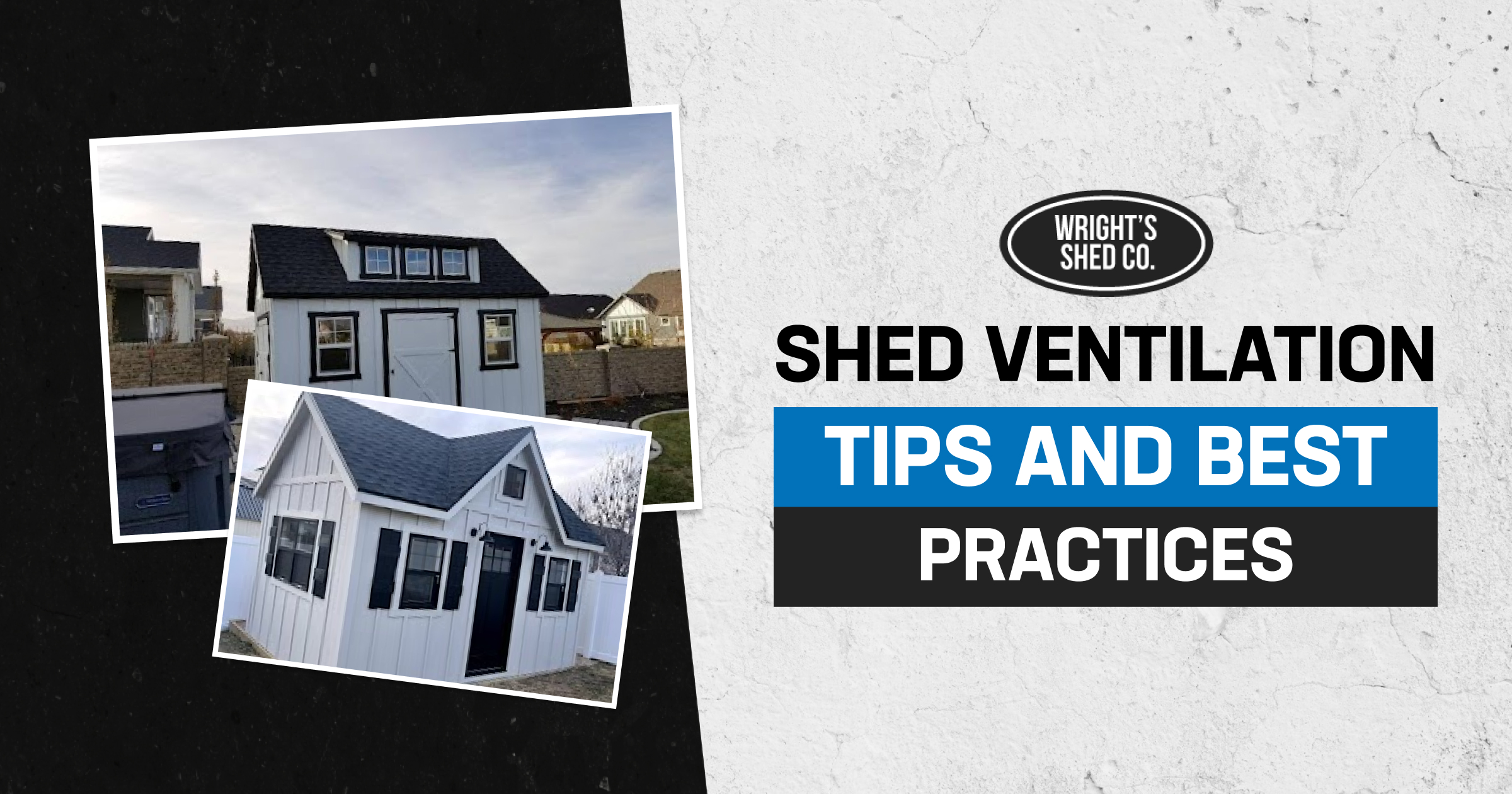
Custom Storage Shed Ventilation Tips and Best Practices
Following the right custom storage shed ventilation tips and best practices is the single most overlooked step in shed ownership. You can build a beautiful, solid structure with quality materials, and still watch your power tools rust, your seed bags mold, and your wood warp within a couple of seasons if airflow is ignored. Heat and moisture are relentless. Ventilation is what keeps them in check.
Most shed owners think about locks, flooring, and paint. Very few think about what happens to the air trapped inside when temperatures swing 60 degrees between morning and afternoon, as they routinely do across Utah and Nebraska. The result is condensation, mold growth, and structural decay that shortens the life of everything inside the shed, and the shed itself.
This guide walks through every practical aspect of shed ventilation, including vent types, sizing formulas, how ventilation and insulation work as partners, and the warning signs that your current setup is not doing the job.
Why Ventilation Is Non-Negotiable in Utah and Nebraska Climates

Utah and Nebraska share something that makes shed ventilation a real engineering concern rather than an afterthought: extreme seasonal temperature swings. Utah sees summer temperatures regularly exceeding 100°F, while Great Plains winters in Nebraska bring moisture-heavy snow and freeze-thaw cycles that are brutal on enclosed structures.
When a shed heats up during the day and cools rapidly at night, water vapor inside the structure condenses on framing, siding, and stored items. Do this repeatedly across 52 weeks, and you get:
- Mold and mildew on wood surfaces and stored goods
- Rusting on metal tools, hardware, and equipment
- Warping and splitting of wood shelves, doors, and framing
- Pest attraction, since many insects seek out humid, undisturbed spaces
- Degradation of fertilizers, paints, and chemicals sensitive to heat
If you store tools and equipment in your shed, moisture is your highest long-term cost. A well-ventilated shed protects that investment on autopilot.
Types of Shed Ventilation
Not all vents are created equal. Each type handles airflow differently, and the best shed ventilation systems combine two or more of the following options to create proper air exchange.
Ridge Vents
Installed along the peak of the roof. Hot air rises and exits here continuously. Most effective when paired with a low intake vent. Wright’s Shed Co. offers ridge venting at $12 per linear foot.
Gable Vents
Placed in the triangular wall end at the peak. They work well for cross-ventilation when installed on opposite walls. Decorative options are available that blend with shed aesthetics.
Soffit Vents
Located under the eave overhang. They pull cool fresh air in at the bottom while hot air exits at the ridge or gable above. Creates a steady convective loop.
Turbine Vents
Wind-powered spinning vents that actively pull air out of the shed. Especially effective in windy climates like Nebraska. Wright’s Shed Co. offers turbines as an add-on at $90 each.
Windows
Operable windows on opposite walls create cross-ventilation you can control. Double-paned windows also limit condensation on the glass itself during cold snaps.
Wall Vents
Simple passive vents are installed in the siding near the roofline or floor. Wright’s pricing starts at $20 for standard wall vents and $70 for translucent options.
For most Utah and Nebraska storage sheds, the recommended starting combination is a ridge vent or turbine vent at the top, with wall vents or soffit vents near the base. This creates a stack effect where hot air rises and exits while cooler outside air replaces it from below.
How Much Ventilation Does a Shed Need?
There is a practical rule of thumb widely used in residential construction and directly applicable to storage sheds. It comes from guidance published by organizations like the U.S. Department of Energy:
The 1:150 Rule
1 sq ft of net free vent area for every 150 sq ft of floor space.
Example: A 10×16 shed (160 sq ft) needs roughly 1.1 sq ft of total vent area, ideally split 50/50 between low intake and high exhaust vents.
| Shed Size | Floor Sq Ft | Min. Vent Area Needed | Suggested Setup |
|---|---|---|---|
| 8×10 | 80 sq ft | ~0.53 sq ft | 1 wall vent + 1 gable vent |
| 10×12 | 120 sq ft | ~0.80 sq ft | 2 wall vents + ridge vent |
| 10×16 | 160 sq ft | ~1.07 sq ft | 2 wall vents + ridge vent + 1 window |
| 12×20 | 240 sq ft | ~1.60 sq ft | Ridge vent + soffit vents + turbine or gable vents |
| 12×32 | 384 sq ft | ~2.56 sq ft | Full ridge vent run + soffit vents + 2 turbines or powered fan |
These numbers represent minimums. If your shed sits in direct sun, stores heat-sensitive items, or sits in a valley where air tends to stagnate, add 20 to 30 percent more vent capacity. When planning an insulated custom storage shed, the ventilation calculation remains the same but becomes even more critical, since insulation traps heat unless exhaust paths are provided.

Ventilation vs. Insulation: Working Together, Not Against Each Other
There is a common misconception that insulating a shed means sealing it up tightly, which would make ventilation unnecessary or even counterproductive. This is backwards. Insulation and ventilation serve different functions, and both are needed in any climate with temperature extremes.
What Insulation Does
- Slows heat transfer through walls and ceiling
- Keeps interior cooler in summer, warmer in winter
- Reduces condensation on inner wall surfaces
- Protects temperature-sensitive stored items
What Ventilation Does
- Removes trapped moisture vapor before it condenses
- Refreshes stale air and prevents odor buildup
- Equalizes pressure and reduces structural stress
- Works continuously even when the shed is closed
Think of insulation as the thermal buffer and ventilation as the pressure release valve. If you insulate without venting, moisture vapor that enters through the door, through items stored inside, or through the slab has nowhere to go. It condenses inside the wall cavity, wets the insulation, and starts a slow rot.
If you are considering insulating your shed on a budget, plan your vent locations before you start. Adding vents after insulation is already installed is a messy, expensive retrofit.
“An insulated, unventilated shed is like a thermos with no lid. The temperature stabilizes, but everything trapped inside eventually breaks down.”
Signs Your Shed Has a Ventilation Problem
Sometimes the issue shows up before you notice any structural damage. Here are the most common early indicators that airflow inside your shed is not working the way it should:
- Condensation on tools or metal surfaces in the morning, even when it hasn’t rained. This is the clearest sign of trapped moisture overnight.
- A musty smell when you open the shed door. Mold colonies form quickly in damp, enclosed spaces and can be active before they are visible.
- Warping wood or swollen door frames. Wood expands when it repeatedly absorbs and releases moisture. A door that sticks is often a ventilation problem, not a hardware one.
- More insects than expected. Centipedes, silverfish, and certain beetles strongly prefer humid environments. A sudden uptick suggests trapped moisture.
- Interior temperature that stays hot long after sunset. Proper ridge and wall ventilation should allow the interior to cool quickly once the sun drops. If it stays warm into the evening, hot air is trapped.
- Rust on hinges, hardware, or stored tools despite no direct water exposure. Airborne moisture is enough to oxidize metal over time.
If you are seeing two or more of these signs, the solution is not to dehumidify the interior with a plug-in unit. That treats the symptom. The fix is to create proper airflow so moisture never builds up in the first place.
This is especially important for anyone using their shed as a workshop or hobby space where tools and finishes are stored long-term.
How Wright Sheds Are Built to Handle Airflow
Wright’s Shed Co. has been building custom sheds since 1997, and every structural decision made in that time reflects what works in real-world Utah and Nebraska conditions. The standard build already includes features that support better natural airflow:
- Wall height on the Orchard and Farm sheds reaches 8 feet, which gives hot air more vertical distance to rise before exiting, improving the stack effect without any mechanical assistance.
- LP SmartSide panel siding is treated against fungal decay, which matters because mold attacks wood siding from the outside in humid conditions, and resistance at the surface level slows that process.
- Double-paned AMSCO or Alpine windows reduce condensation on the glass, which is a common moisture source inside sheds that owners often overlook.
- Roof sheathing with architectural-grade shingles and a proper drip edge on the entire perimeter prevents water infiltration that would compound any interior humidity problem.
- Add-on vent options include wall vents ($20 standard, $50 decorative), translucent vents ($70), roof vents ($50), turbines ($90), and ridge venting priced per linear foot at $12 — so ventilation can be designed right at the time of order, not bolted on later.
If you are ordering a custom Orchard shed or any other style, the team at Wright’s can walk you through the right vent combination for your specific size and site. For larger structures like the Farm shed, which can reach 12×32 feet, a full ridge vent run paired with turbines is a practical and cost-effective choice that requires zero electricity to operate.
For general guidance on passive ventilation principles in residential structures, the Building Science Corporation’s resources on vapor management are an excellent reference that applies directly to shed construction.
Frequently Asked Questions about Custom Storage Shed Ventilation Tips and Best Practices
Does a shed need ventilation if it has a concrete floor?
Yes. Concrete is porous and releases moisture vapor, especially in the first few years after a pour. A concrete slab can contribute significantly to interior humidity even in a well-sealed shed. Ventilation handles vapor from below as effectively as it handles heat from the roof.
Can I just leave the door cracked for ventilation?
It provides temporary airflow but is not a reliable solution. It also creates a security and weather risk. Permanent passive vents work around the clock without any action on your part, and they don’t let rain blow in or give easy access to pests and intruders.
What is the difference between a turbine vent and a roof vent?
A standard roof vent is a fixed static opening covered with a cap that prevents rain entry. A turbine vent has spinning fins that use wind energy to actively pull air out of the shed, increasing exhaust volume in breezy conditions. Turbines outperform static vents in most outdoor environments but require occasional lubrication over time.
Will adding vents make my shed colder in winter?
Minimally, and the tradeoff is worth it. Passive vents with small net free areas do not exchange enough air volume to meaningfully reduce winter temperatures. If temperature control is a priority, pair proper venting with insulation in the walls and ceiling. The two work together.
How do I know if my existing shed vents are blocked?
Hold a thin strip of tissue or a stick of incense near the vent on a still day. If there is no movement whatsoever, the vent may be blocked by debris, bird nests, or settled insulation. Exterior gable and roof vents should be inspected each spring, particularly in Nebraska where cottonwood and elm seeds can clog screens quickly.
Do Wright’s Shed Co. sheds come with vents included?
Ventilation is available as a customizable add-on at the time of order. Wright’s Shed Co. offers wall vents, decorative vents, translucent vents, roof vents, turbines, and ridge venting by the linear foot. Because ventilation needs depend on shed size, location, and use, their team helps configure the right combination for each build.

Custom Storage Shed Ventilation Tips: The Bottom Line
Custom storage shed ventilation tips and best practices come down to one core principle: air must be able to move in and out of your shed continuously. Without that exchange, heat and moisture accumulate, and everything inside, including the shed structure itself, pays the price over time.
The formula is not complicated. Measure your floor space, apply the 1:150 rule to find your minimum vent area, choose a combination of intake and exhaust vents that creates a stack effect, and if you are adding insulation, plan the vents first. For sheds in Utah or Nebraska specifically, where temperature swings are dramatic and moisture cycles are real, skipping this step is expensive in the long run.
Wright’s Shed Co. builds every shed with materials and wall heights that support good airflow, and their vent add-on menu makes it easy to configure the right ventilation system at the time of order. Whether you are protecting hand tools in a compact Vineyard shed or running a full workshop out of a 12-foot-wide Farm shed, the principles in this guide apply directly.
If you have questions about which vent setup makes sense for your specific build, reach out to the Wright’s Shed Co. team. They have been answering these questions in person at their Utah and Nebraska locations for over two decades.