
Learning how to choose a custom shed builder in Utah or Nebraska is a decision that outlasts the sales conversation by decades, not months. A cheap quote can look appealing until the siding warps, the roof leaks, or the promised warranty turns out to be paper-thin. Wright’s Shed Co. has built sheds on customers’ properties since 1997, and we’ve seen firsthand what separates a shed that lasts from one that needs replacing in five years.
If you’re ready to see options, you can browse our custom sheds and start narrowing down a size and model.
Quick Answer: A trustworthy shed builder documents its materials (LP SmartSide siding, GAF Timberline shingles), separates its materials warranty from its craftsmanship warranty, builds on your property rather than trucking in a pre-built unit, and has a real, verifiable track record. Compare any quote against these four points instead of the bottom-line price alone.
Key Takeaways
• Wright’s Shed Co. has built sheds on-site in Utah and Nebraska since 1997.
• Standard materials include LP SmartSide siding and GAF Timberline shingles, not upcharges.
• Materials warranties (up to 50 years) and craftsmanship warranties (up to 8 years, model-specific) are different things.
• On-site installation is included with every shed we build, unlike a drop-off kit.
• Utah starting prices run from about $1,809 for a DIY kit to $3,418 for an 8×8 Farm shed; Nebraska pricing runs lower on most sizes.
Why Your Choice of Shed Builder Matters
The builder you hire determines whether your shed still stands solid in fifteen years or starts sagging, leaking, and rotting well before then. A shed’s structure is mostly hidden once it’s A shed’s structure is mostly hidden once it’s finished, since framing spacing, base material, and fastener quality don’t show up in a walkthrough, but they decide how the building performs through freeze-thaw cycles, wind, and snow load.
Quality differences that look minor at signing often become expensive years later. Thinner siding panels absorb moisture faster and warp at the seams. Wider stud spacing flexes more under wind load and lets walls rack out of square. A shed set directly on the ground without a proper base rots from the bottom up within a few seasons.
The true cost of a cheap build rarely shows up on the invoice. It shows up in a re-roofing job five years early, a floor that needs replacing, or a warranty claim the original seller no longer honors because the company changed hands or stopped answering the phone. A well-documented, permitted build also holds up better if you ever need it recognized in a home appraisal, since inspectors and appraisers look for verifiable construction standards, not just square footage. Comparing builders on price alone hides these long-term costs.
Local Custom Shed Builder vs. Big-Box and Online Kit Sellers
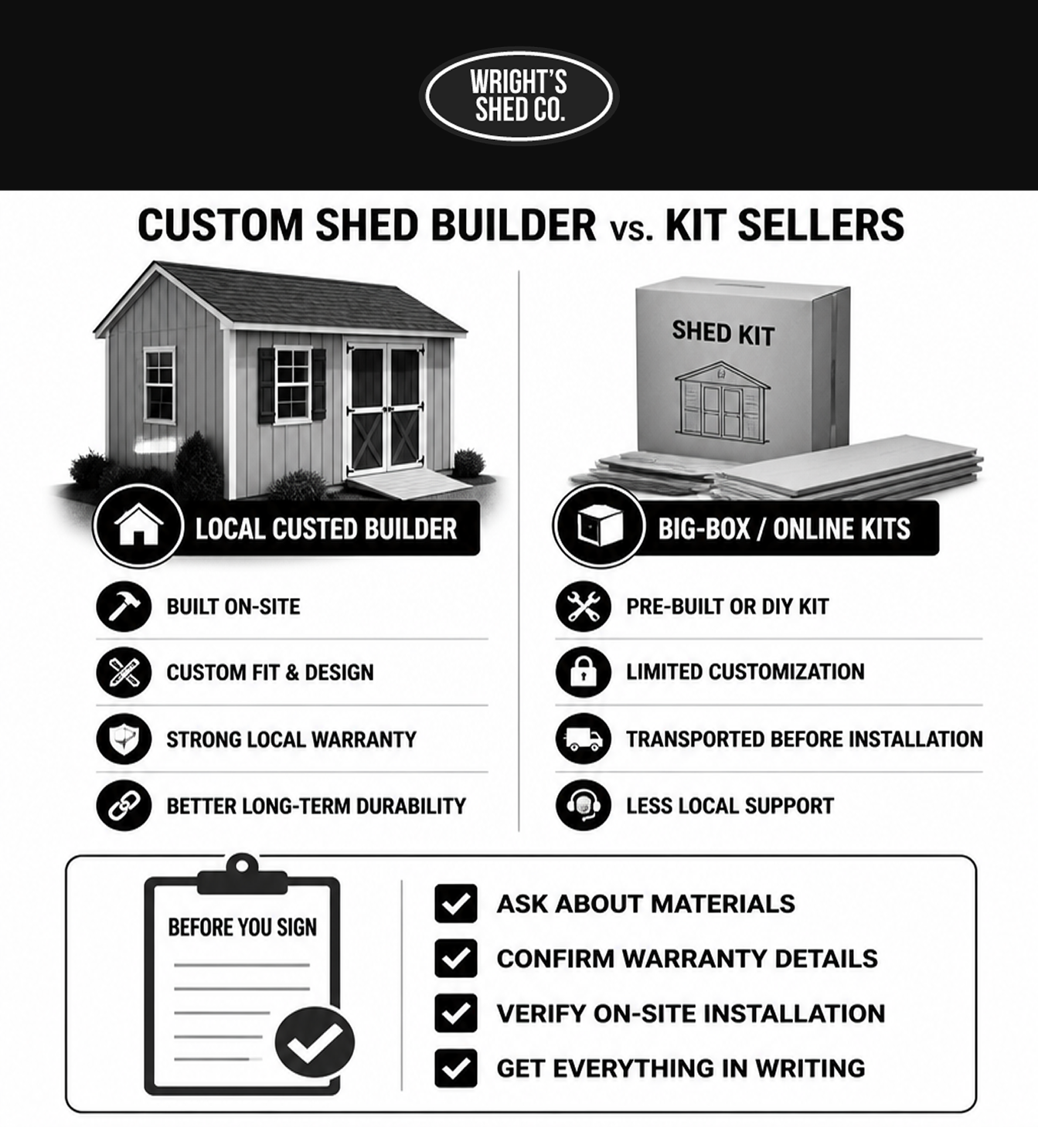
A local custom builder builds your shed on your property to fit your yard, while big-box stores and online sellers usually ship a pre-built unit on a flatbed truck or drop off a kit for you to assemble. Both approaches can work, but they solve different problems.
A shed built on-site is leveled and assembled directly on your ground, not squeezed through a gate or craned over a fence after being built somewhere else. That affects fit, since a custom builder can adjust the size, door placement, and roof style to your actual space instead of a factory template. It also affects longevity, since a unit trucked in already assembled has been through more stress before it ever reaches your yard.
Customization is the clearest difference. A local builder can add windows, a porch, extra headroom, or a different roof pitch to one of its base models, such as our most popular Orchard model with its 6/12 roof and 8-foot walls. A stock pre-built shed usually comes in fixed sizes with limited add-ons.
Service and accountability matter just as much. A local company with a physical address and a multi-year track record is easier to hold to a warranty claim than an online seller with no local presence. Ask where the company is based, whether it builds on-site, and who handles warranty service before you compare prices.
Key Questions to Ask Any Shed Builder Before You Sign
Ask about materials, warranty terms, and on-site build practices before you sign anything, because a verbal promise from a salesperson is not a contract term. A written quote should spell out every material by name, not just the shed size and price.
At a minimum, ask a builder to answer these in writing:
• What brand and grade of siding is standard, and is it an upcharge or included?
• What shingle brand and warranty term come standard on the roof?
• What are the stud spacing and framing lumber size?
• Is the shed built on your property, or delivered pre-built or as a kit?
• What is the craftsmanship warranty length, and does it differ by model?
• Are the materials warranty and the craftsmanship warranty the same thing, or separate?
• Who handles a warranty claim five years from now if something fails?
Vague, reassuring-but-unspecific answers are a warning sign. “Premium materials” without a brand name, or “lifetime warranty” without a written term, is marketing language, not a commitment. A builder who answers with specific product names and exact warranty years, in writing, is giving you something you can hold them to.
For a longer, more detailed list of questions to bring to a builder consultation, see our full question checklist.
Materials and Construction Standards to Look For
Every standard build should specify its siding brand, roofing brand, framing spec, and base material by name, not vague terms like “quality materials.” On our builds, the standard siding is LP SmartSide engineered wood panel siding with the SmartGuard treatment, and the standard roofing is GAF Timberline architectural shingles. Neither is an upgrade; both come standard on every shed we build.
Framing, Siding, and Base Materials That Signal Quality
Wall framing matters more than most buyers realize. Our sheds use 2×4 framing at 16 inches on center with double top plates, a spacing standard that keeps walls straighter and more wind-resistant than the wider stud spacing used on some cheaper builds. The base matters just as much: our sheds sit on a pressure-treated wood or galvanized steel base with 3/4 in. tongue-and-groove OSB flooring, not directly on skids or gravel.
LP SmartSide siding uses an engineered wood process with wax, resin, and zinc borate treatment for resistance to fungal decay and termites, which is part of why LP backs the product with its own factory warranty. See LP’s explanation of its SmartSide siding warranty for full terms. GAF Timberline shingles are similarly backed by the manufacturer, with the Timberline line carrying its own wind and manufacturing defect coverage. See GAF’s Timberline shingles product page for full specs.
When you compare quotes, ask each builder to name their siding and shingle brand outright. A builder who can’t name a brand usually can’t back the material with a manufacturer warranty either. For a closer look at what separates a shed that holds up from one that doesn’t, see our guide to durable shed materials and construction.
| Build Element | Wright’s Shed Co. Standard | What a Budget Build Often Uses |
| Siding | LP SmartSide, SmartGuard treated | Thin OSB or unrated composite panel |
| Roofing | GAF Timberline architectural shingles | Basic 3-tab or unbranded shingles |
| Wall framing | 2×4 at 16 inches on center, double top plate | Wider stud spacing, single top plate |
| Base | Pressure-treated wood or steel base, 3/4 in. T&G OSB floor | Skids or gravel with no sub-floor system |
How the Installation Process Affects Shed Quality
Many buyers compare siding, roofing, and pricing but overlook how the shed is actually built. Installation methods can affect long-term durability just as much as the materials themselves.
When a shed is built on-site, each wall is framed, squared, and secured on your prepared foundation rather than transported as a finished structure. That reduces the stress that can occur when large pre-built sheds are moved over uneven roads or lifted by cranes. It also allows the crew to make small adjustments for ground conditions, ensuring doors, windows, and roof lines stay properly aligned.
Ask every builder how they prepare the site before construction begins. A reputable company should explain how they level the building area, install the base, verify measurements, and protect the structure from moisture. Even premium materials perform poorly if they’re installed on an uneven foundation.
A quality installation also includes a final walkthrough to confirm doors operate correctly, windows seal properly, and all hardware is securely installed before the project is complete.
Understanding Shed Warranties Before You Buy
A shed typically carries two separate warranties, a materials warranty from the manufacturer and a craftsmanship warranty from the builder, and confusing the two is the easiest way to overestimate your coverage. A 50-year number on a brochure usually refers to the siding manufacturer’s material warranty, not how long the builder stands behind the structure itself.
Manufacturer Warranties vs. Builder Craftsmanship Warranties
On a Wright’s shed, LP SmartSide siding carries LP’s own 5/50 Year Limited Factory Warranty, and GAF Timberline shingles carry GAF’s Limited Lifetime Factory Warranty. Those are manufacturer commitments tied to the material itself, not to us as the builder.
Separately, Wright’s Limited Warranty covers craftsmanship and structure, and the length depends on the model:
| Model | Craftsmanship Warranty | Utah Starting Price |
| Vineyard | 5 years | $2,117 |
| Orchard | 8 years | $2,300 |
| Farm | 8 years | $3,418 (8×8) |
| Lean-To | 8 years | $2,327 |
| DIY Kit | None | $1,809 |
Utah starting prices are shown above; Nebraska pricing runs lower on most sizes. On-site installation is included on every shed except DIY kits, which ship for self-assembly and carry no craftsmanship warranty. OSB shed flooring and add-on porches, decks, posts, and railing are not covered under the craftsmanship warranty with any model.
When a builder quotes “up to 50 years” without separating materials from craftsmanship, ask them directly which number applies to their own workmanship. That’s the number that matters if a wall settles or a door frame shifts. Full terms are on our warranty page.
Reading Reviews and Checking a Builder’s Reputation
Genuine reviews reveal patterns a sales conversation won’t, especially around warranty follow-through and how a company handles problems after the check clears. Look past the star rating and read a handful of reviews written more than a year after installation, since those comments tell you how the shed and the company held up over time, not just how the sales visit went.
Red flags in online feedback include a pattern of unanswered complaints, reviews that mention a warranty claim being denied or ignored, or a company with barely any reviews despite claiming years in business. A builder with a real local presence usually has reviews that mention specific crews, specific models, or specific job sites, not generic praise. Checking more than one platform, such as Google and the Better Business Bureau, gives a fuller picture than relying on testimonials curated for a single website.
We’ve built sheds on customers’ properties for decades, with a strong track record of five-star reviews to show for it. You can read through our recent customer reviews before you request a quote, and compare what other builders’ reviews say about the same issues: material quality, warranty response, and whether the crew showed up when promised.
Experience and Track Record
Years in business matter because a shed’s warranty is only as good as the company that’s still around to honor it. A builder that has operated in the same market for two decades has a track record you can verify: permits pulled, past customers you can find, and a physical location you can visit.
Why Years in Business and On-Site Builds Matter
We’ve been building sheds on-site for over two decades, operating out of two physical locations in Kaysville, Utah and Greenwood, Nebraska. That history means the craftsmanship warranty on a shed built today is backed by a company with a long, continuous track record, not a startup or a reseller. You can read more about Wright’s Shed Co.’s 20+ years of experience on our about page.
Seeing real builds and display models in person is worth the trip before you sign anything. A showroom lot lets you check siding texture, door hardware, window quality, and interior finish firsthand, instead of judging from photos on a website.
Choosing the Right Shed Builder in Utah and Nebraska
Choosing the right shed builder in Utah or Nebraska starts with a company that knows the local permit process, not just a national sales script. Permit thresholds for accessory structures vary by city and county, so a builder with local experience should walk you through what your specific municipality requires before your shed is delivered. For more on how this works, see our shed permit help guide.
Model residential building codes commonly exempt many small detached accessory structures from a permit. The exact size threshold and any local amendments depend entirely on where you live. See the International Code Council’s building code resources for how these model codes work and get adopted locally. Never trust a builder who states a universal square-footage rule as fact. A builder should ask about your address and check with your local building department, not recite a number that may not apply to your city.
Local knowledge also covers HOA rules, setback requirements, and site access, all of which a Utah or Nebraska-based crew with two decades of local jobs has likely already run into. For a broader breakdown of what different types of shed builders offer, see our shed builders guide. Starting the conversation is simple: request a quote, walk through the model options, and ask the questions from this guide before you commit.
Frequently Asked Questions
How do I find a good shed builder near me?
Look for a company with a physical local address, a multi-year track record, and named material brands in writing. Ask for reviews specific to your area and confirm they build on-site rather than ship a pre-built unit or drop-off kit.
What questions should I ask a shed builder?
Ask about siding and shingle brand, framing spec, base material, whether the shed is built on-site, and the exact craftsmanship warranty length by model.
Is a local custom builder better than a big-box or online shed seller?
A local custom builder can adjust size, add windows or a porch, and build directly on your property, while big-box and online sellers usually offer fixed sizes delivered pre-built or as a kit. Which is better depends on how much customization and on-site fit matter to your yard and use case.
What warranty is normal for a custom shed?
Materials warranties from manufacturers like LP and GAF commonly run for decades, while a builder’s own craftsmanship warranty is typically shorter, often five to eight years depending on the model. Always ask a builder to state both separately, in writing.
Do I need a permit for a custom shed in Utah or Nebraska?
It depends on your city or county; there is no single statewide rule that applies to every property. A reputable local builder checks your specific permit requirements as part of the quoting process rather than quoting a generic threshold.
Choosing a Shed Builder With Confidence
Choosing a shed builder comes down to four checkable things: named materials, a written craftsmanship warranty separate from the manufacturer’s, an on-site build process, and a real local track record. Any builder who can’t answer those points in writing is asking you to take their word for it, which isn’t a warranty.
We’ve built sheds on customers’ properties in Utah and Nebraska since 1997, using LP SmartSide siding and GAF Timberline shingles as standard on every build, with on-site installation included. Compare our specs and warranty terms against any quote you’re considering.
Ready to see what a custom shed looks like on your property? Design Your Shed with our free 3D tool, or get a free quote, and we’ll walk you through materials, warranty terms, and on-site installation for your specific yard.