
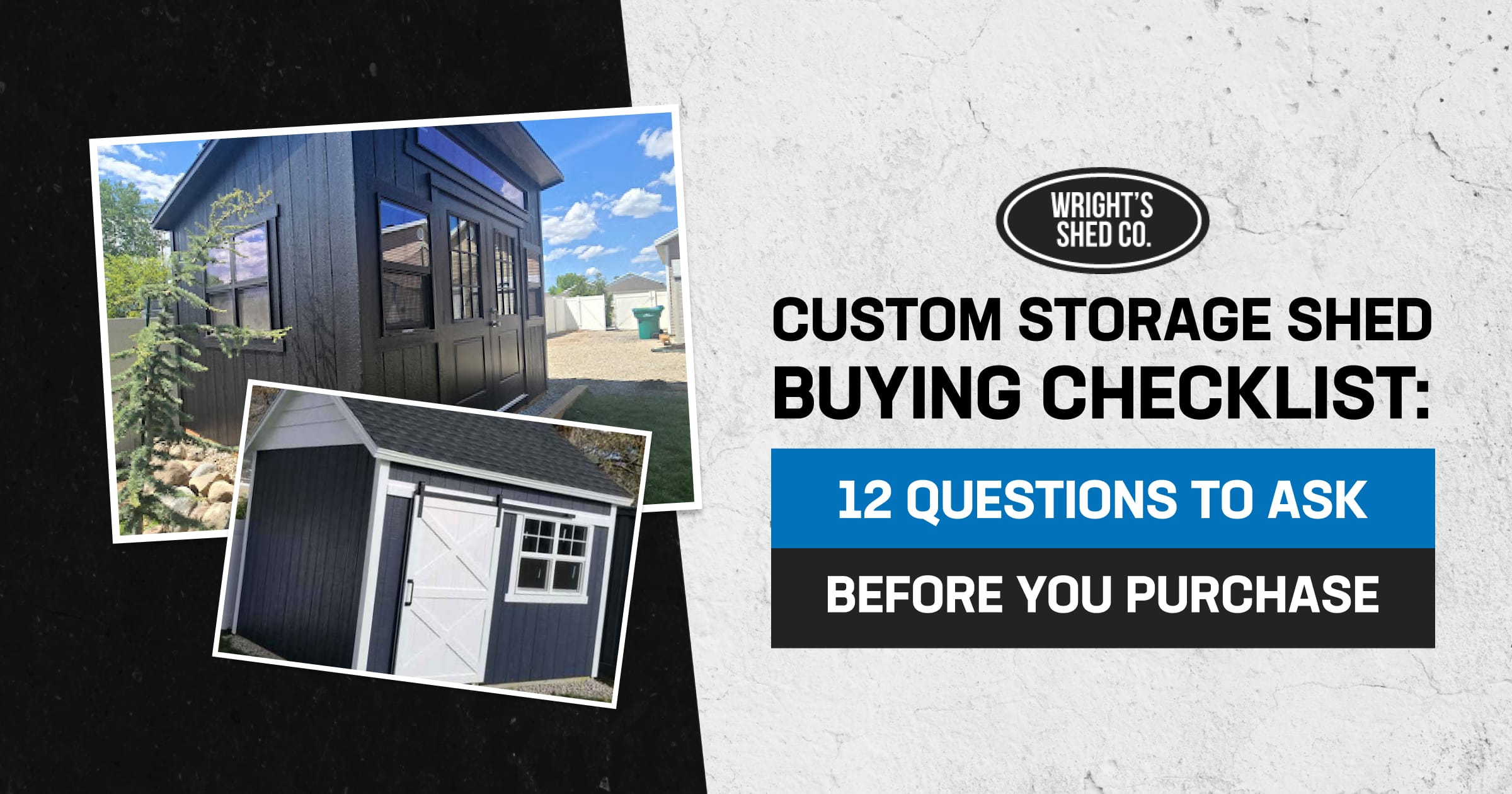
Custom Storage Shed Buying Checklist: What to Ask Before You Buy
A solid custom storage shed buying checklist separates buyers who end up with the right structure from those who spend years regretting a hasty decision. Before committing to any builder, you need clear answers across six categories:
- Size and layout fit for your actual needs
- Materials and build quality standards
- Customization options available to you
- Installation process and site preparation
- Warranty coverage and post-sale support
- Local permits and HOA regulations
Most buyers focus only on price. The ones who ask the right questions first get a shed that holds its value, serves its purpose, and never becomes a problem.
Questions About Size and Layout

How much space do you actually need, today and five years from now?
Start by listing every item you plan to store. Lay them out physically if you can, then calculate the square footage. Most buyers underestimate by 20 to 30 percent. A shed that feels spacious on delivery day fills up fast once you add seasonal gear, tools, and equipment.
For reference, a 10×12 works well for basic lawn equipment and garden tools. A 12×20 or larger suits workshops, bulk storage, or anything that involves moving equipment in and out regularly. Consider the range of tools and equipment you plan to store, and size up accordingly.
Pro Tip: Measure the tallest item you plan to store — a riding mower, ATV, or tall shelving unit — and confirm the shed’s interior height and door clearance match. A standard door opening that seems adequate can become a bottleneck the first time you try to bring in larger equipment.
What roof style fits your storage needs?
Roof style affects more than appearance. A standard gable roof, like Wright Sheds’ Vineyard model, suits flat storage. A higher-pitch roof, like the Orchard or Farm style, adds significant overhead capacity. The Farm Shed’s Gambrel roof, for example, maximizes vertical space in the same footprint — valuable if you store tall equipment or need overhead loft storage.
Questions About Materials and Build Quality
What materials are used in the framing, siding, flooring, and roof?
This is where cheap sheds reveal themselves. Ask for specifics, not just general descriptions. Quality framing uses 2×4 studs spaced 16 inches on center. Walls should feature double top plates for rigidity. Floors should use 3/4-inch tongue-and-groove OSB — the same specification found in most new home construction.
For siding, LP SmartSide engineered wood offers significant advantages over basic plywood or T1-11. It carries a manufacturer’s warranty, resists fungal decay, and holds paint far better over time. For roofing, architectural shingles outperform 3-tab shingles in both durability and appearance. Builders worth considering use architectural shingles with strong manufacturer ratings as their standard, not an upgrade.
What does the base or foundation system consist of?
Ask whether the builder uses pressure-treated wood skids or galvanized steel. Both are appropriate for different conditions. Pressure-treated wood resists moisture and insect damage effectively. Galvanized steel provides comparable durability with less susceptibility to rot. The floor sheathing on top should be 3/4-inch tongue-and-groove, not thinner alternatives that flex under load.
Pro Tip: A concrete pad is not required for most quality sheds, but site levelness matters considerably. Ask your builder what tolerance they work within and what happens if your site is out of level. Wright Sheds, for example, builds on a pressure-treated or galvanized base that doesn’t require concrete. but leveling the ground first is essential for a long-lasting installation.

Questions About Customization Options
Can you match the shed’s appearance to your home?
Color, trim, door style, and window placement should all be configurable. A quality builder offers multiple siding colors, trim options, and roofline styles so the finished structure looks intentional — not like an afterthought parked in your backyard.
Ask specifically about door configuration. Steel-framed doors with decorative hardware are a meaningful upgrade over basic wood. Keyed entry adds real-world security. Window placement affects natural light and ventilation. These aren’t cosmetic details; they affect how functional the shed is every day.
What add-ons and extras are available?
Standard sheds leave a lot of potential on the table. Ask about loft storage, shelving, ramps for rolling equipment in and out, extra windows, skylights, and electrical prep. Review the builder’s extras and add-on options before finalizing your design so you don’t pay for modifications after the fact.
Questions About Installation and Site Prep
Is the shed built on-site or delivered pre-assembled?
These two approaches have real differences in what’s possible. Pre-assembled delivery requires adequate access clearance — gate width, overhead clearance, and approach angle all matter. If your property has limited access, on-site assembly may be the only viable option.
Wright Sheds pre-fabricates components in their shop and assembles them on your property. This approach allows installation in tight spaces while still moving quickly. Most sheds are completed in a single day. Read more about how to prepare your backyard before your installation date to avoid delays.
What site preparation is required before installation?
At minimum, the ground should be as level as possible. Ask your builder what tolerance they work within, and confirm whether leveling is included in the quoted price. For most sites, a 2 to 4 inch gravel base is the recommended foundation approach — it drains well, prevents ground contact with the base, and doesn’t require a permit.
If you’re considering a concrete pad, discuss the implications with your builder before pouring. Specific dimensions and level tolerance are critical. Bolting directly to concrete can introduce moisture risk if the dimensions aren’t exact.

Questions About Warranty and Support
What warranty covers the shed, and who backs it?
There are two separate warranty questions to ask. First: what manufacturer warranties apply to the materials? LP SmartSide siding, for example, carries its own manufacturer’s warranty against defects. GAF architectural shingles carry long-term coverage as well. Second: what does the builder themselves warranty about the structure and workmanship?
These are different commitments. Material warranties cover the components. Builder warranties cover how those components were installed and how the structure performs. A reputable shed company stands behind both. Wright Sheds offers up to 8 years on their Orchard, Lean-To, and Farm Style Sheds — in addition to material manufacturer warranties that can extend to 50 years on certain components.
Is there a down payment required, and what are the payment terms?
Ask upfront whether a deposit is required to place an order, and what the refund policy is if there’s a delay. Some builders require significant deposits before a nail is driven. Wright Sheds does not require payment until the building is completed and the customer is satisfied — a meaningful difference when you’re committing to a multi-thousand dollar purchase.
Questions About Permits and Local Regulations
Does your shed require a building permit?
According to the International Code Council, most municipalities follow building codes that exempt accessory structures under a certain square footage from permit requirements — commonly 200 square feet or less. However, this varies by jurisdiction, and garages almost always require a permit regardless of size.
Contact your local city or county planning department before you finalize your order. Ask about: maximum structure height, setback requirements from property lines and fences, and HOA covenants if applicable. Getting the answers in advance is far less costly than receiving a correction notice after installation. Wright Sheds’ FAQ page addresses common permit questions to help you start that conversation.
Does your HOA have rules about sheds?
Homeowners associations often restrict shed placement, color, and visibility from the street. Some require committee approval before construction. Get those requirements in writing before you design your shed. A builder who offers color and style flexibility — like matching trim to your existing home — will have a much easier time helping you pass HOA review.
Red Flags to Watch for When Comparing Shed Builders
Not all shed companies operate the same way. These warning signs are worth watching for during the shopping process.
Vague answers about materials. A builder who can’t specify the stud spacing, floor sheathing thickness, or siding brand is using that vagueness to hide corners being cut.
No builder warranty. A manufacturer warranty on materials does not cover workmanship. If the builder won’t stand behind their installation with their own warranty, that tells you something.
Large deposits required before work begins. Standard practice for quality builders is to collect payment only after the customer is satisfied. Requiring a large upfront deposit shifts all the risk to you.
Subcontracted installation teams. Ask directly who builds and installs the shed. Some companies sell sheds but subcontract the labor to third parties. This introduces inconsistency in how the job is done. Companies that use their own crews maintain direct accountability.
No physical location or showroom. A builder with no location to visit makes it difficult to inspect construction quality before you buy. Visiting a display shed in person remains the most reliable way to evaluate materials and craftsmanship.
How Wright Sheds Answers Every Question on This Custom Storage Shed Buying Checklist
Wright’s Shed Co. has been building custom storage sheds since 1997. Over that time, they’ve refined a construction standard that treats upgrades as the baseline rather than the exception. Every shed ships with 2×4 framing at 16 inches on center, double top plates on all walls, LP SmartSide panel siding, 3/4-inch tongue-and-groove flooring, architectural shingles, and steel-framed doors with a keyed latch. These aren’t premium add-ons. They’re the starting point.
When you compare the cost of a custom shed versus self-storage alternatives, the value calculation shifts substantially when the structure is built to last 20 or 30 years rather than requiring replacement in 10.
Wright Sheds offers four primary shed styles — the Vineyard, Orchard, Farm, and Lean-To — each configurable in color, trim, door layout, and extras. Their 3D online shed designer lets you see the finished product before committing. Installation is handled by their own crews, not subcontractors. Payment is collected after completion. Builder warranties cover the Orchard, Lean-To, and Farm models for up to 8 years, with material warranties extending considerably longer on key components.
The company currently serves customers in Utah, Idaho, Iowa, and Nebraska. Read what customers say on their verified reviews page before making your decision.

Frequently Asked Questions about Custom Storage Shed Buying Checklist
How big of a storage shed do I need?
Size depends on what you’re storing. A 10×12 handles basic lawn and garden tools. Go 12×16 or larger for riding equipment, workshop use, or bulk storage. Always size up — most buyers run out of space within two years.
Do I need a permit for a storage shed?
Most jurisdictions don’t require permits for sheds under 200 sq ft, but rules vary. Contact your local city planning office and your HOA before ordering. Garages almost always require a permit.
What is the best material for a storage shed?
LP SmartSide engineered wood siding with a pressure-treated or galvanized base is the top choice for durability. It resists rot, insects, and moisture. Pair it with architectural shingles for a roof that outlasts 3-tab alternatives by years.
How much does a custom shed cost?
Custom storage sheds typically range from around $2,000 to well over $10,000 depending on size, style, and add-ons. The key question is total cost of ownership — a well-built shed lasts decades and requires minimal maintenance.
What foundation does a storage shed need?
A level surface with 2 to 4 inches of compacted gravel is the standard recommendation. Concrete is not required if the shed has a quality pressure-treated or galvanized base system. Leveling the site before installation is critical.
Your Custom Storage Shed Buying Checklist: Next Steps
This custom storage shed buying checklist gives you every question that separates a confident purchase from a regrettable one. Ask about framing specs and siding warranties. Confirm the installation process and who does the work. Check permits before you design. And evaluate the builder’s own warranty, not just the materials they use.
The right shed isn’t the cheapest one. It’s the one built correctly, by a crew accountable for the result, with materials that perform for decades. That’s the standard Wright Sheds has applied since 1997.