
Knowing how to secure a shed from theft starts with making the building harder to break into and the contents harder to steal. Lawn mowers, power tools, bicycles, and other equipment can add up to thousands of dollars, making a poorly secured shed for equipment an easy target. The right combination of door hardware, window placement, lighting, and visibility can help deter intruders and protect what you keep inside.
The most effective shed security plan uses several layers of protection. Start with a sturdy door, a hasp secured through the framing, and a strong padlock. Then reduce visibility into the shed, add motion-activated lighting where appropriate, and secure valuable equipment inside. At Wright’s Shed Co., we have built sheds since 1997, with security considerations that can be addressed during the design and installation process. Every built style includes a steel-framed, key-latched door and on-site installation. Before choosing upgrades, consider your stored equipment, property layout, and budget to determine which security features make the most sense.
A few points most shed security advice leaves out:
- A hasp is only as strong as the wood behind it. Screws that bite into siding alone pull free with one pry bar. Bolts that pass through the door frame or a wall stud do not.
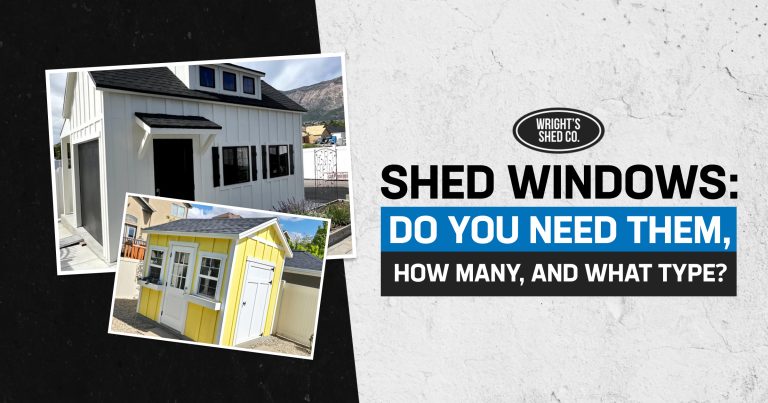
- Transom windows mounted high on a wall bring in daylight without giving anyone a view of your mower.
- Our warranty excludes broken door handles and broken keys, and we keep no spare keys. Store your spare somewhere a thief would not look, and never inside the shed.
- Placement is free. A door that faces your kitchen window does more work than most gadgets you can buy later.
What Is the Most Effective Way to Secure a Shed?
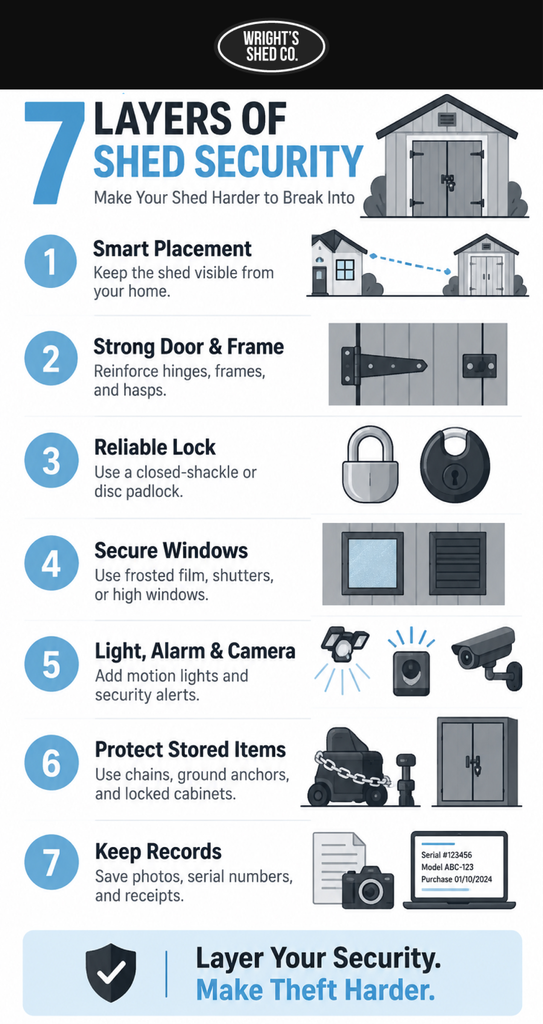
The most effective way to secure a shed is to stack several layers, so a thief has to beat each one in turn: visibility, a strong door and frame, a good lock, limited sight lines and secured contents. No single product does all of that. A $60 padlock on a hasp held by short screws fails at the screws. A steel door with a window full of power tools invites someone to try anyway.
Each layer below costs little on its own. Together they turn a quick job into a slow, noisy, and visible one. Most thieves will move on to an easier yard.
| Security layer | What it does | Common tools |
| Placement and visibility | Makes a thief feel watched | Open sight lines, door facing the house, gravel pad |
| Door and frame | Resists prying and kicking | Steel-framed door, through-bolted hasp, secured hinges |
| Lock | Resists cutting and shimming | Closed-shackle padlock, disc padlock, keypad lock |
| Windows | Removes the reason to break in | High transoms, frosted film, shutters, no glass in the door |
| Light, alarm and camera | Raises the cost of staying | Motion light, battery alarm, cellular or Wi-Fi camera |
| Inside the shed | Slows the haul if entry happens | Chains, ground anchors, locked cabinets, loft storage |
| Records | Speeds recovery and claims | Photos, serial numbers, receipts |
Where Should You Place a Shed to Deter Thieves?
Place the shed where you and your neighbors can see its door, ideally from a kitchen or living room window, and away from back gates and alleys that offer a hidden approach. A thief wants cover and time. A visible door takes both away.
Look at your yard from the outside first. Walk the alley or the back fence line and ask where you would go if you wanted to work unseen. That spot is the wrong place for the door. Turn the door toward the house instead, even if the back of the shed then faces the fence.
Trim shrubs and low branches near the building. The Takoma Park Police Department’s shed security tips note that tools taken from an unlocked shed can be used to break into the house itself. That is one more reason to keep the shed in plain view and the approach open.
A gravel pad helps here too. It gives the base good drainage and site leveling, and it crunches underfoot. Placement also has to meet your setback requirements and accessory structure rules. Those vary by city and county across Utah, Idaho, Nebraska, and Iowa, so confirm the spot with your local building department before you commit.
Because our crews build on site rather than drop off a finished box, the door can face whichever way you choose. Tight side yards and narrow gates do not dictate the layout. Barbara H., one of our customers, said she was surprised the crew built her shed right in front of her. She also noted they kept her involved through the build. That is the moment to settle door orientation, window height, and where the hasp will land.
How Do Doors, Hasps and Hinges Affect Shed Security?
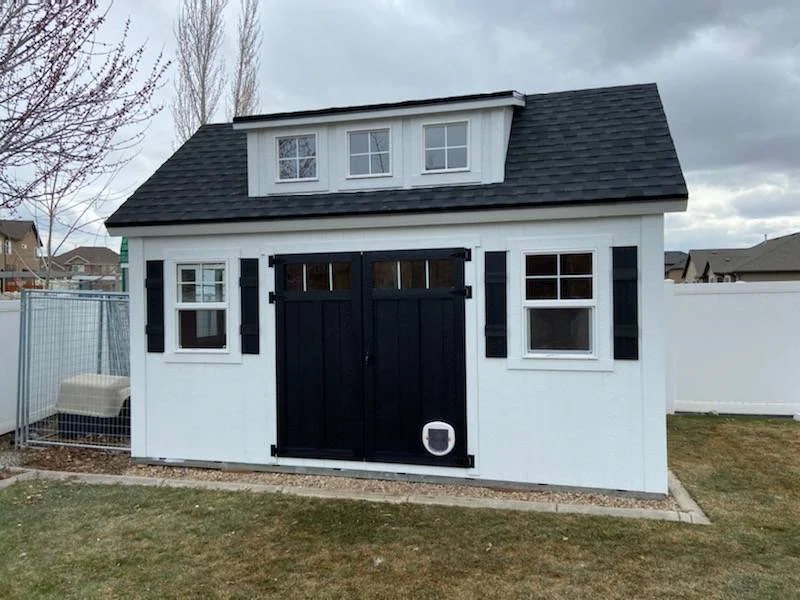
The door is where nearly every shed break-in starts, so its frame, hasp, and hinges matter more than the brand of padlock hanging on it. A thief rarely cuts a good lock. He pries the hardware off, pops the hinge pins, or flexes the door until the latch lets go.
What Comes Standard on a Wright’s Shed Co. Door
Every built style from Wright’s Shed Co. ships with the same door specification. Here is what that includes and why each piece matters for security.
- Steel-framed door, 4’x6′. A steel frame resists the twisting a pry bar puts on a wood-only door.
- LP SmartSide exterior. The same engineered panel siding used on the walls, so the door does not become a weak, mismatched panel.
- Key-latched handle. This keeps the door closed and stops casual opening. For real theft resistance, add a hasp and padlock.
- Diamond-plate metal threshold. It protects the bottom edge where wheeled equipment rolls in and out.
- Framing around the opening. Walls use 2×4 framing on 16-inch centers with double top plates, which gives solid wood to bolt hardware into.
Mount the hasp so its bolts pass through the door frame on one side and a stud on the other. Use carriage bolts with the nuts on the inside, so nothing can be unscrewed from outside. Pick a hasp that covers its own fasteners when it is closed.
Hinges are the other weak point. Exposed screws can be backed out in seconds. Swap one screw per leaf for a carriage bolt, or use one-way security screws. If you plan to add hardware, tell us when you order so we can talk through where the framing sits.
Shed Door Security Upgrades and Their Utah Prices
A solid steel or fiberglass slab is the biggest single door upgrade. These figures come from our Utah shed extras and upgrades page.
| Door option | Utah price | Security note |
| Standard 4’x6′ steel-framed door | Included | Key-latched; add a hasp and padlock |
| Steel or fiberglass door | $450 | Solid slab, harder to pry or flex |
| Steel or fiberglass door with half glass | $650 | Brighter inside, but the glass offers a view in |
| Double steel or fiberglass doors | $1,400 | Wide opening; lock both leaves |
| Roll-up door, 8’x7′ | $950 | Wide access; add an inside slide bolt |
| Non-electric garage door, 8’x7′ | $1,100 | Lock the handle or track from inside |
| Glass in door | $75 | Skip it if security is the priority |
Base shed prices exclude every extra, including doors, windows, and vents. Nebraska and Iowa buyers should check the Nebraska price table or call our Greenwood, Nebraska warehouse for local extras pricing.
What Is the Best Lock for a Shed Door?
The best lock for most shed doors is a closed-shackle or disc padlock on a heavy hasp, because the shrouded shackle leaves almost no room for bolt cutters or a pry bar. An open-shackle padlock is cheaper, but its exposed loop is the easiest thing in the yard to cut.
| Lock type | Strength | Weak point | Best fit |
| Open-shackle padlock | Low to medium | Exposed shackle cuts easily | Low-value storage |
| Closed-shackle padlock | High | Only as strong as the hasp | Most sheds |
| Disc padlock | High | Needs a matching hasp | Tool and equipment sheds |
| Standard key latch | Low | Not a theft barrier alone | Daily open and close |
| Keypad or smart lock | Medium to high | Batteries and weather exposure | Shared family access |
Look for a hardened steel body and shackle and a weather cover over the keyway. Utah, Idaho, Nebraska and Iowa winters are hard on locks. Water gets into a keyway, freezes, and seizes the cylinder. A cover and a shot of graphite lubricant each fall prevent most of that.
Smart locks and keypads are handy when several people need access. Cold drains batteries faster, though, so pick a model with a physical key backup. Keep the backup key in the house, not under a paver by the door.
Are Shed Windows a Security Risk?
Shed windows are a security risk only when they let someone see what is inside or reach a latch, and both problems are solved by where the window goes and what covers it. A window at eye level next to the door advertises the contents. The same window placed high on the far wall mostly shows the sky.
Transom Windows: Light Without a View Inside
A transom window sits high on the wall, above eye level. It lights the workbench and shelving but gives a passerby no line of sight to the floor. In Utah, our transoms run $125 to $302 depending on width. The lean-to shed suits this well. Its front wall rises to 9 feet, which leaves plenty of room for a high row of glass.
If you want a standard window, a 2’x2′ window is $205 in Utah. Our windows are AMSCO or Alpine double-paned units. Add frosted privacy film so light comes in, but shapes do not show. Shutters, at $80 per window in Utah, can close the window off completely when you are away. Fixed windows can also be screwed shut from inside.
One honest note: window cracking, fogging and chipping are not covered under any of our warranties. A broken pane from a break-in attempt is a repair cost or an insurance question, not a warranty claim.
Should You Put Lights, Cameras or an Alarm on a Shed?
Yes, a motion light over the shed door is one of the cheapest deterrents available, and a camera or alarm adds noise and proof on top of it. Light takes away the cover of darkness. A camera gives you footage if something still goes missing.
If the shed already has power, a hardwired motion fixture is the cleanest option. Running new power to a shed usually needs an electrical permit, and the rules vary by municipality. Check with your local building department before any trenching or wiring. For sheds without power, solar motion lights work well and need no permit in most places, though you should still confirm locally.
Point any camera at the door, not the whole yard. A clear shot of the hasp and the approach path is worth more than a wide view of the lawn. Many home Wi-Fi networks reach a shed 50 feet from the house. Test the signal at the shed wall before you buy.
Alarms and Cellular Cameras for Remote Sheds
Sheds on acreage, at a cabin, or far from the house need a different setup. A battery door-contact alarm costs little and makes a loud siren when the door opens. A cellular camera sends clips over a phone network, so it works where Wi-Fi does not reach. Expect a monthly data plan with most models.
Cold weather matters here as well. Lithium batteries hold up better than alkaline ones in Nebraska and Idaho winters. A small solar panel can keep a camera charged through short winter days.
How Do You Protect Tools Stored Inside a Shed?
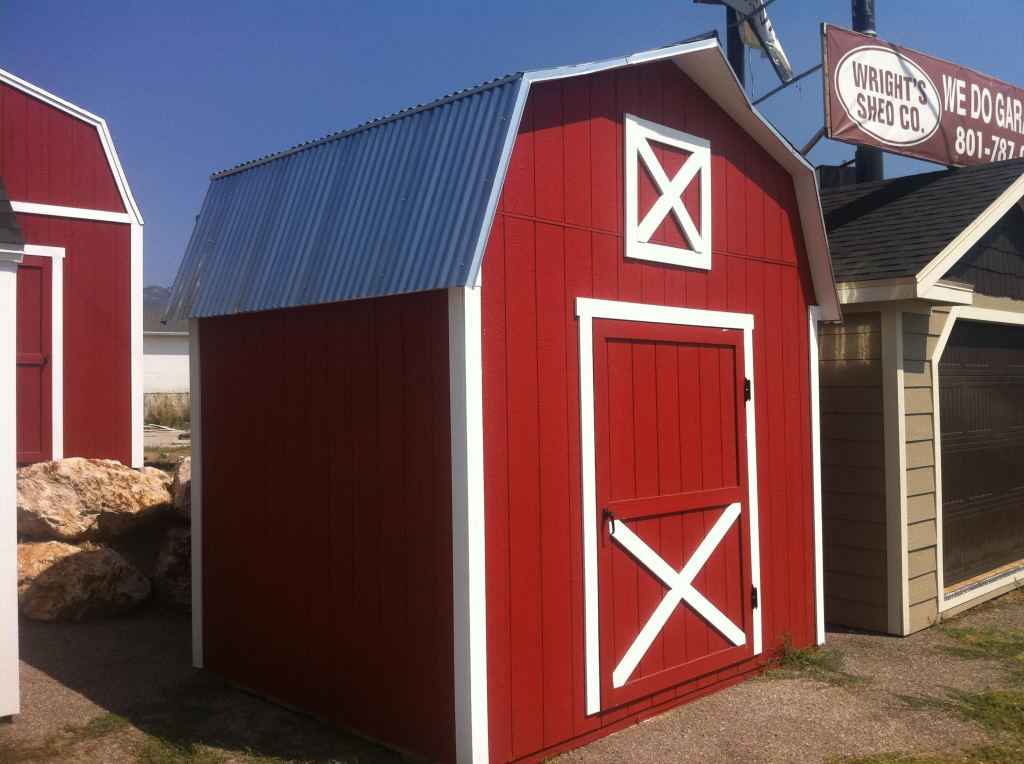
Protect tools inside a shed by assuming the door will someday be opened: chain large equipment to a fixed point, lock small power tools in a cabinet, and keep valuables out of sight of the door and windows. This is the layer that turns a break-in into a short, empty-handed visit.
Bolt a ground anchor through the floor into the base framing, not into the 3/4-inch tongue-and-groove OSB floor alone. Run a hardened chain from the anchor through mower decks, bike frames, and generator handles. Pull the key or the spark plug wire on riding mowers so they cannot be driven off.
Overhead storage helps more than most people expect. Items in a loft sit above the line of sight from the door. In Utah, a loft is $8.00 per square foot and a 16-inch shelf is $5.50 per linear foot. The Farm shed’s gambrel roof exists to maximize volume above head height, which makes it the strongest choice when you want valuables stored high and out of view.
Lock ladders inside the shed or chain them to a wall. A loose ladder in the yard is an easy way up to a second-floor window. A short routine at the end of each day keeps every layer working:
- Close and lock the door every time you walk away, even for a few minutes.
- Chain the mower, bikes, and any generator to the ground anchor.
- Lock battery packs and small power tools in a cabinet, or carry them into the house.
- Pull the curtain, close the shutters, or check that the window film is intact.
- Confirm the motion light still triggers when you walk past it.
Does Anchoring a Shed Help Prevent Theft?
Anchoring a shed helps against theft mainly by stopping a smaller building from being tipped or slid to get at the floor, and by keeping the structure square so the door keeps closing tightly. A door that drifts out of line leaves a gap a pry bar can use.
The right anchor depends on what sits under the shed. Auger anchors with steel straps suit gravel pads and soil. Anchor bolts suit a concrete slab. Concrete piers suit sloped sites. Our bases use pressure-treated wood or a galvanized steel base, and each anchors differently, so match the hardware to the base.
Frost heave is the hidden problem in our markets. Anchors set above the local frost line can lift and shift through freeze-thaw cycles. That movement racks the frame and throws the door out of alignment. Your local building department can tell you the frost depth for your area.
Anchoring is not a guarantee against weather. Our warranty explicitly excludes wind, natural disasters, and poor foundation, and we publish no wind rating. Some cities require anchoring for sheds over a certain size, while others do not. Requirements vary by municipality, so confirm with your local building department before you install.
Why Should You Record Your Tools Before Anything Goes Missing?
Recording your tools before a theft matters because police and insurers both work from serial numbers, photos and receipts, and almost nobody can rebuild that list from memory after a loss. It takes about an hour once and a few minutes each time you buy something new.
Photograph each item with its serial plate visible. Note the brand, model and purchase date. The home inventory checklist from the Ohio Department of Insurance specifically reminds homeowners to include storage buildings and the garage, along with serial numbers and purchase dates.
Keep a copy away from the shed and away from the house if you can. The Maine Bureau of Insurance guidance on taking a home inventory notes that a written list of your belongings makes it easier to file a claim after damage or theft. Engrave or mark tools with an ID as well. Marked tools are harder to resell and easier to return.
Coverage for a shed and its contents depends on your own policy. Some policies treat the building and the tools inside under different sections, with separate limits. Call your insurer, ask how a detached shed and its contents are covered, and ask whether theft from an outbuilding has any special limits. This is general information, not insurance advice.
Why Shed Security Starts at the Build, Not the Hardware Store
A strong padlock cannot fix a weak door frame, so the most useful security decisions happen when the shed is designed, not after it is full of gear. Hardware bolts into wood. If the wood around the door is thin, the best lock in the store just fails at a different spot.
That is why we would rather explain a spec than make a promise. Our walls use 2×4 framing on 16-inch centers with double top plates. Trusses are joined with steel plates, except on the Lean-To, which uses 2×6 wood trusses. Siding is LP SmartSide panel with 4-inch Miratec trim. The door is steel-framed with a diamond-plate threshold. Those details give your hasp, hinges and anchors something solid to grab.
Before you buy from anyone, ask a few checkable questions. What is the door frame made of? Where do the studs fall beside the opening? Can windows go high on the wall? Can the door face the house? A builder who answers with specs is one you can hold to them. You can see finished doors and window layouts in our photo gallery of completed sheds.
The honest counterpoint: if your shed holds a rake, a hose and a few bags of potting soil, you do not need a $450 steel door. A closed-shackle padlock, a through-bolted hasp and a motion light are enough. Spend on upgrades only when the contents justify it. If you need to store a vehicle or large equipment in Nebraska or Iowa, a detached garage may serve you better. Detached garages are available in Nebraska and Iowa only.
We have been at this for 29 years, with more than 6,000+ sheds built and 664+ five-star reviews. Brothers Dan and Chad Wright founded the company in 1997 and still own and run it, as our story explains. You can read our customer reviews to see what buyers say about the crews and the finished work.
What Does Our Warranty Cover on Shed Doors and Hardware?
Our door warranty is 2 years limited on the Vineyard, Orchard, Farm and Lean-To, and it applies only when the building is painted within 30 days of installation, with proof of paint purchase and completion, and only to the original purchaser. A warranty covers material defects. It is not theft insurance, so treat break-in damage as a question for your insurer first.
| Style | Structure | Doors |
| Vineyard | 5 years limited | 2 years limited |
| Orchard | 8 years limited | 2 years limited |
| Farm | 8 years limited | 2 years limited |
| Lean-To | 8 years limited | 2 years limited |
| Detached Garage (Nebraska and Iowa only) | 8 years limited | 2 years limited |
Every warranty above carries the same conditions. All paintable exterior surfaces must be painted within 30 days of installation, or the warranty is not valid. Material defects must be reported within 30 days of installation. Claims must be submitted within 30 days of the issue appearing. Coverage stays with the original purchaser and does not transfer. If you choose two-tone paint, it adds 10% of cost.
Several exclusions apply directly to security. Broken door handles and broken keys are not covered, and we do not keep spare keys. Window cracking, fogging, and chipping are not covered. Wind and poor foundation damage are excluded as well.
Our required maintenance list also overlaps with good security habits. It asks owners not to leave doors open and unattended, and to keep lawn equipment away from the exterior. Caulking regularly, repainting every 3 to 5 years, and keeping irrigation off the building round out the list. Read the full warranty terms before you buy, not after.
Frequently Asked Questions about Shed Security
How do I make my shed more secure?
Layer your defenses. Turn the door toward the house, bolt a heavy hasp through the framing, use a closed-shackle padlock, place windows high or cover them, add a motion light, and chain valuables inside. Wright’s Shed Co. builds every shed with a steel-framed, key-latched door, which gives the hasp a solid base.
What is the best lock for a shed door?
A closed-shackle or disc padlock with a hardened steel body is the best choice for most sheds. Mount it on a hasp that is carriage-bolted through the door frame and a wall stud. A keypad lock works for shared access, but choose one with a physical key backup for cold weather.
Should I put a camera or alarm on my shed?
A camera or alarm is worth it when the shed holds equipment you cannot easily replace. Start with a motion light, then add a battery door alarm. For sheds out of Wi-Fi range, a cellular camera sends clips over a phone network, usually with a monthly data plan.
Does Wright’s Shed Co. keep spare keys for shed doors?
No. Wright’s Shed Co. does not keep spare keys, and broken keys and broken door handles are excluded from the warranty. Copy your key when the shed is finished and store the spare inside the house. More common questions are answered on our shed FAQ page.
Do I need a permit to add lights or power to my shed?
Often yes, but it depends on where you live. Running electrical service to an accessory structure usually requires a permit, and the rules differ by city and county across Utah, Idaho, Nebraska, and Iowa. Call your local building department before any wiring or trenching starts.
Secure Your Shed From the Frame Out
Learning how to secure a shed means protecting the building and everything stored inside it. Choose a strong door and lock, secure hasps and hinges through the framing, limit visibility through windows, and add lighting or an alarm when appropriate. Inside the shed, chain valuable equipment to a suitable anchor and keep records of your tools, including photos, serial numbers, and receipts. These layers can help deter theft and make recovery easier if something goes missing, although no security measure can guarantee complete protection.
If you are planning a new shed, Wright’s Shed Co. can help you compare styles, door options, window placement, and available features for your property. Buyers in Utah and Idaho are served from Kaysville, while Nebraska and Iowa buyers are served from Greenwood. Explore the available options and design your shed to plan your project. On-site installation is included with built-style sheds, so you can discuss your storage needs and security priorities before making a decision.