
A new shed holds more than tools, and homeowners insurance may help protect it and the equipment inside. So when a windstorm rolls through, you wonder: does homeowners insurance cover a shed? And what about everything inside it?
Before you read the details, keep these points in mind:
- Your deductible generally applies to a shed claim, so a small repair can cost less to pay yourself than to file.
- The tools inside your shed fall under a different part of your policy, with its own limit.
- Our warranty excludes wind and natural disaster damage, so storm losses go through your insurer, not through us.
- A loft, dormer, or porch raises what it costs to rebuild, so tell your agent about every extra.
- Paint records do double duty. They keep our warranty valid, and they show that you maintained the building.
Does Homeowners Insurance Cover a Shed?
Yes, a standard homeowners policy covers a detached shed under Coverage B. That is the other structures part of your policy, and it pays for covered perils only. A peril is a cause of loss, such as fire or hail.
Insurance references define other structures as buildings on your property that sit apart from the house. The IRMI insurance glossary lists a toolshed among its examples. It notes that the combined limit for all other structures is 10 percent of the dwelling limit. The National Association of Insurance Commissioners also lists sheds and fences as other structures in its homeowners insurance overview.
Many policies cover the building on an open-perils basis. That means a loss is covered unless the policy names an exclusion. Coverage follows the policy language, not the sticker price of the shed. Read your declarations page and your list of exclusions.
Does Homeowners Insurance Cover a Shed on a Gravel Pad or Skids?
Most likely yes, because industry definitions focus on separation from the house, not on the type of base. We build on a pressure-treated skid base or a galvanized steel base, and many owners set that base on a leveled gravel pad. Policies vary, so ask your agent whether the base type changes anything, and get the answer in writing.
A shed built against your house wall may fall under dwelling coverage instead. Mention the placement to your agent so the right coverage part applies.
How Coverage B works and the typical 10% limit
Most homeowners policies set Coverage B at about 10% of your dwelling limit, and one shared amount covers every detached structure on your lot. A dwelling limit of $250,000 would give you a $25,000 other structures limit. That pairing is a common example in insurer guides.
| Dwelling limit | Typical Coverage B limit at 10% | Shared by |
| $200,000 | $20,000 | Shed, fence, detached garage, playset, and other detached structures |
| $300,000 | $30,000 | Shed, fence, detached garage, playset, and other detached structures |
| $400,000 | $40,000 | Shed, fence, detached garage, playset, and other detached structures |
| $500,000 | $50,000 | Shed, fence, detached garage, playset, and other detached structures |
This table is an illustration of math, not a quote. Your policy may use a different percentage.
If one storm damages the fence, the playset, and the shed, all three pull from the same dollars. That is why a limit that looks generous on paper can run short in a bad year.
Two details matter as much as the number. First, check whether your policy pays replacement cost or actual cash value, which subtracts depreciation. Second, ask whether you can raise the limit by endorsement. Many insurers allow it.
What is Covered and What is Usually Excluded
Most policies cover a shed against fire, wind, hail, lightning, and vandalism, and most exclude flood, earthquake, and gradual wear. The table below shows the typical pattern. Your policy controls the final answer.
| Cause of loss | Usually covered? | What to know |
| Fire and smoke | Yes | Many policies include wildfire damage. Check yours. |
| Wind and hail | Yes | Our warranty excludes wind damage, so this is the coverage that matters. |
| Lightning | Yes | Treat it like any sudden, accidental loss. |
| Falling tree or branch | Yes, when a covered storm causes it | The policy pays for the shed damage. Trees themselves are generally not covered. |
| Vandalism | Yes | Report it to the police and to your insurer. |
| Heavy snow or ice load | Often yes | Check the wording for roof collapse. |
| Flood | No | You need a separate flood policy, through the National Flood Insurance Program or a private carrier. |
| Earthquake | No | It takes an add-on or a separate policy. |
| Wear, neglect, rot, and pests | No | Insurance pays for sudden losses, not slow decline. |
| Business use | Often excluded | If you run a business from the shed, tell your insurer. |
Insurance pays for sudden, accidental losses. It does not pay for slow decline, so maintenance matters. We ask owners to caulk regularly and repaint every 3 to 5 years. We also ask them to keep irrigation off the walls and hold a 6- to 12-inch barrier between lawn and building. Those habits protect the shed, and they protect a future claim. Replacing worn parts belongs in your budget. Our guide to the hidden costs of owning a storage shed covers what to plan for. For a realistic lifespan, see our guide on how long your shed should last.
Are the Contents Covered? (Personal Property)
The tools and equipment inside your shed fall under personal property coverage, which is separate from the Coverage B limit that rebuilds the building. Many policies cover belongings in a shed when a covered event damages or steals them.
Personal property has its own limit and its own rules. A single claim can touch two parts of your policy. A storm that destroys the shed and the mower inside it would involve both.
Some items get special treatment. Policies often handle motorized equipment, such as ride-on mowers, ATVs, and golf carts, differently from ordinary tools. They also tend to limit or exclude tools used for business. Ask your agent about each category you store.
How to Inventory Shed Contents Before a Loss
A written inventory is the most useful thing you can prepare before a loss. Start with these steps:
- Photograph every shelf, wall, and workbench with the doors open.
- Record the brand, model, and serial number of each power tool and mower.
- Keep receipts, or note the purchase year for anything without one.
- Store copies in the cloud, not in the shed.
Is Your Limit Enough for a Custom Shed?
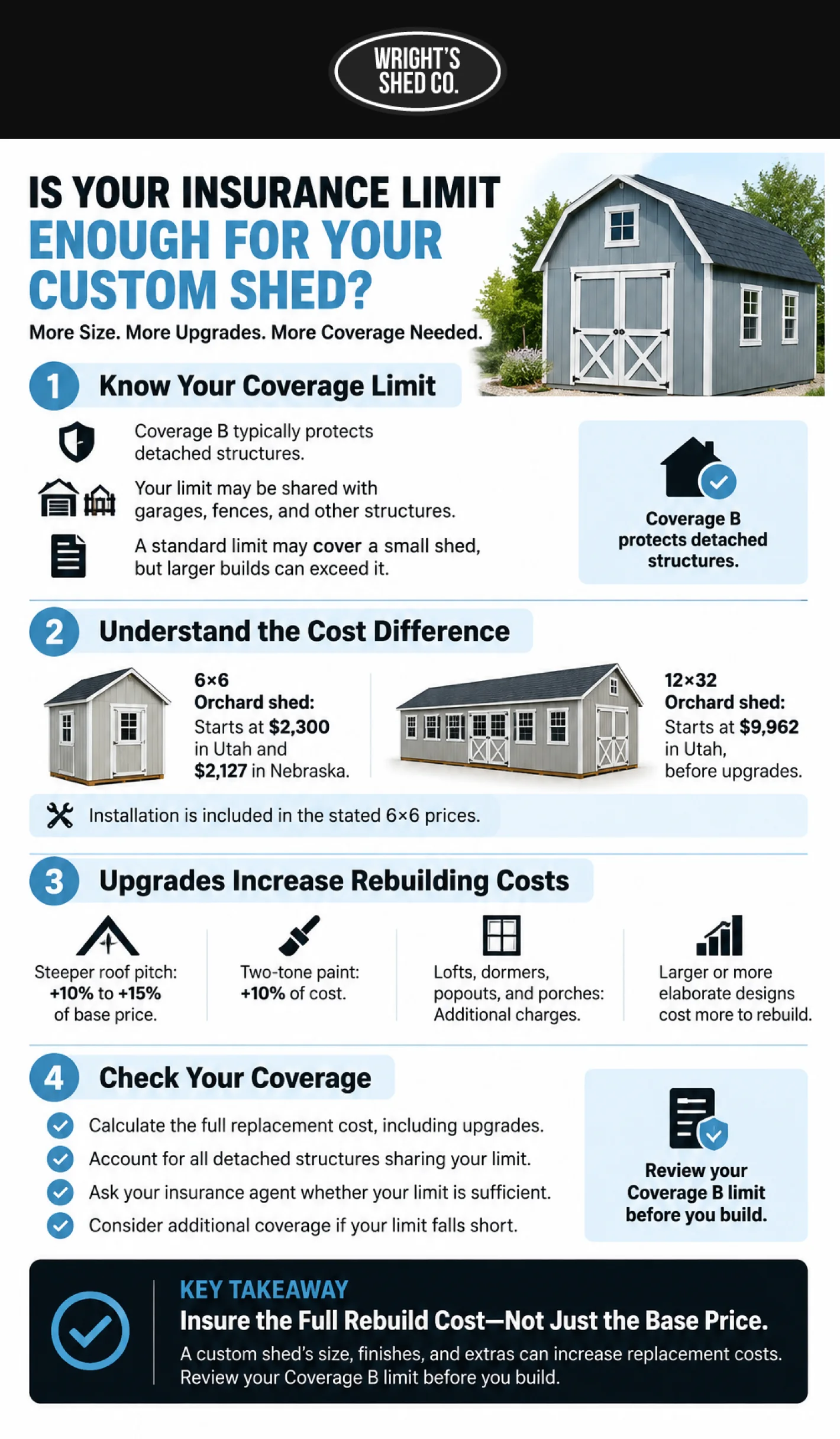
A larger custom shed with extras can outgrow the default Coverage B limit, especially when a detached garage or a fence shares it. For many buyers, the default limit is plenty. A 6×6 Orchard from us starts at $2,300 in Utah and $2,127 in Nebraska, with on-site installation included. A shed that size fits easily inside a typical 10% limit.
Bigger buildings change the math. A 12×32 Orchard from us is $9,962 in Utah, and that is the base price before any extras. Doors, windows, vents, shelving, lofts, dormers, popouts, overhangs, porches, roof pitch upgrades, ramps, and two-tone paint all come on top.
Roof pitch upgrades scale with the building. Most buyers assume add-ons are flat fees, but these are percentages, so the upgrade costs more on a bigger shed. The same logic applies to your insurance. The bigger and more finished the shed, the more it costs to rebuild.
| Upgrade | How we price it | Why it matters for coverage |
| Roof pitch upgrade to 6/12 or 8/12 | Adds 10% of the shed’s base cost | A steeper roof pitch adds framing to rebuild. |
| Roof pitch upgrade to 10/12 | Adds 15% of the shed’s base cost | The rebuild cost rises with the percentage. |
| Two-tone paint (Vineyard and Orchard) | Adds 10% of cost | A rebuild has to repeat the finish. |
| Loft, dormer, popout, or porch | Priced individually on our extras page | Each one adds structure to replace. |
Our published extras pricing lists every option, including dormers, popouts, cupolas, transom windows, and knee braces. A gambrel-roof Farm shed also holds more volume under the roof than a Vineyard of the same footprint. That means more buildings to replace. Weigh the full cost of ownership, including coverage, against renting space. Our comparison of custom storage shed vs self-storage cost shows the trade-off. Ask your agent to compare your Coverage B limit with the full cost to rebuild everything on your lot. If the limit falls short, ask about an endorsement that raises it.
Permits, Anchoring and Build Quality: Effect on Claims
Anchoring, permits, and build quality do not change what a policy covers on paper, but they can change how smoothly a claim goes. No insurer can promise how it will treat your claim in advance. Treat these as good habits, not guarantees.
Start with permits. Many cities require a building permit once an accessory structure passes a size threshold. Typical thresholds fall somewhere between 120 and 200 square feet, but they are not universal. Setback requirements and HOA rules add their own limits. An unpermitted build can complicate a claim or a later sale, so check first. Our guide on whether you need a permit to build a shed explains the framework. Our summary of the Utah building code for sheds covers one of our markets. Always confirm the rules with your local building department.
Anchoring and Foundation Choices That Affect a Wind Claim
Wind is a covered peril on most policies, but an adjuster may look at how the building was set up. Our warranty excludes damage from wind and from a poor foundation, so base preparation is your job. Site leveling and a compacted gravel pad keep the building square. They also limit movement from frost heave in cold-winter markets like Utah and Nebraska.
Choose a base that suits your soil, and ask about anchoring options for your base type when you request a quote.
Build quality shows up in the spec. Every built style we make has double top plates on all walls and 2×4 wall framing on 16-inch centers. The floor is 3/4-inch tongue-and-groove OSB, the roof sheathing is 7/16-inch OSB, and the drip edge runs around the full roof perimeter. Trusses are joined with steel plates on every style except the Lean-To, which uses 2×6 wood trusses. LP SmartSide siding, 4-inch Miratec trim, and GAF Timberline architectural shingles complete the shell. These details are checkable, and they give an adjuster concrete facts to read.
We do not publish wind or snow load ratings, so we do not claim any. Your homeowners policy is the protection against wind.
A shed warranty is not insurance. It covers defects in materials and workmanship, while homeowners insurance covers sudden damage from covered perils. Our structural warranty runs 5 years on the Vineyard and 8 years on the Orchard, Farm, and Lean-To. Doors carry 2 years. All of it is limited. Coverage requires that you paint the building within 30 days of installation and provide proof of paint purchase and completion. You must report material defects within 30 days of installation, and coverage applies only to the original purchaser. It excludes wind, natural disasters, windows, and porch, post, deck, and railing damage. Our custom shed warranty guide explains how to read the terms.
Two manufacturer warranties sometimes cause confusion. LP SmartSide siding carries a 5/50-year limited factory warranty, and GAF Timberline architectural shingles carry a limited lifetime factory warranty. Those cover single components. They do not cover the whole building, and they are not insured.
What to Document After You Build
Document your shed as soon as installation is complete. Gather dated photos, your signed quote, paint receipts, and any permit records while the details are easy to verify. Keeping these records together can help establish the shed’s condition, features, and replacement value if you need to file an insurance claim.
- Photograph all four sides, the roof, the base, the floor, and the interior.
- Save your signed quote and the style, size, and extras list.
- Keep proof of paint purchase and completion. Our warranty needs it, and an adjuster may ask for it.
- File any permit paperwork and approval letters from your city or county.
- Note your roof pitch, door and window choices, and any loft, dormer, or popout.
- Save your contents inventory and your insurer’s contact details together.
- Send your agent the size, features, and photos so they can review your limit.
Keep digital copies in two places. A fire that takes the shed can also take a paper folder in the garage.
Does a Shed Change Your Property Taxes? (Brief, Local)
Whether a shed changes your property taxes depends on your county assessor, so ask the assessor’s office before you assume either way. Some places count a shed in assessed value, and others do not. Rules differ by state and by county across Utah, Idaho, Nebraska, and Iowa. Size, permanence, and permit status can all play a role, but each office sets its own approach.
For the resale side of the question, our article on whether a custom shed adds home value covers appraisal and return on investment. Do not rely on any general tax rule you read online. Ask the office that sends your bill.
Frequently Asked Questions About Homeowners Insurance Coverage for Sheds
Does homeowners insurance cover a shed?
Yes, in most cases. A standard policy covers a detached shed under Coverage B when a covered peril such as fire, wind, hail, lightning, or vandalism causes the loss. The limit is usually about 10% of your dwelling coverage, shared with other detached structures. Read your own policy or ask your agent to confirm.
What is the other structure’s coverage (Coverage B)?
Other structures coverage is the part of a homeowners policy that pays for buildings not attached to your house, such as sheds, fences, and detached garages. It sits beside dwelling coverage, which protects the house itself. Your deductible generally applies to a Coverage B claim.
Are the contents of a shed covered if stolen or damaged by wind?
Often yes, under personal property coverage rather than Coverage B. The loss must come from a covered event, and your policy sets the limit. Ask about motorized equipment and tools used for business, because those often get different treatment.
Do I need to tell my insurer about a new shed?
We suggest telling your agent. Many policies include Coverage B automatically, so the shed may be covered already. Your agent still needs the size, features, and rebuild cost to judge whether your limit fits. Reporting rules differ by insurer, so ask.
Does a shed raise property taxes?
It depends on your county. Some assessors count a shed in the assessed value of a property, and others do not. Ask your county assessor’s office before you build.
Does our warranty cover storm damage?
No. We do not cover wind or natural disaster damage under our structural warranty. Coverage also requires that you paint the building within 30 days of installation and keep proof. You must report material defects within 30 days, and you must be the original purchaser. Storm losses belong with your homeowners insurer.
Making Sure Homeowners Insurance Covers Your Shed
Homeowners insurance covers your shed best when you confirm your Coverage B limit, check how your policy treats the contents, and document the build. Ask your agent about the replacement cost, your deductible, and any extras you added. Confirm permit rules with your local building department. This guide is general information, not insurance or tax advice, so check the details with your insurer and county assessor.
Ready to see what your shed costs with every extra count? Design your shed and pick your size, style, and options. On-site installation is included in our base price, and the quote takes only a few minutes.