
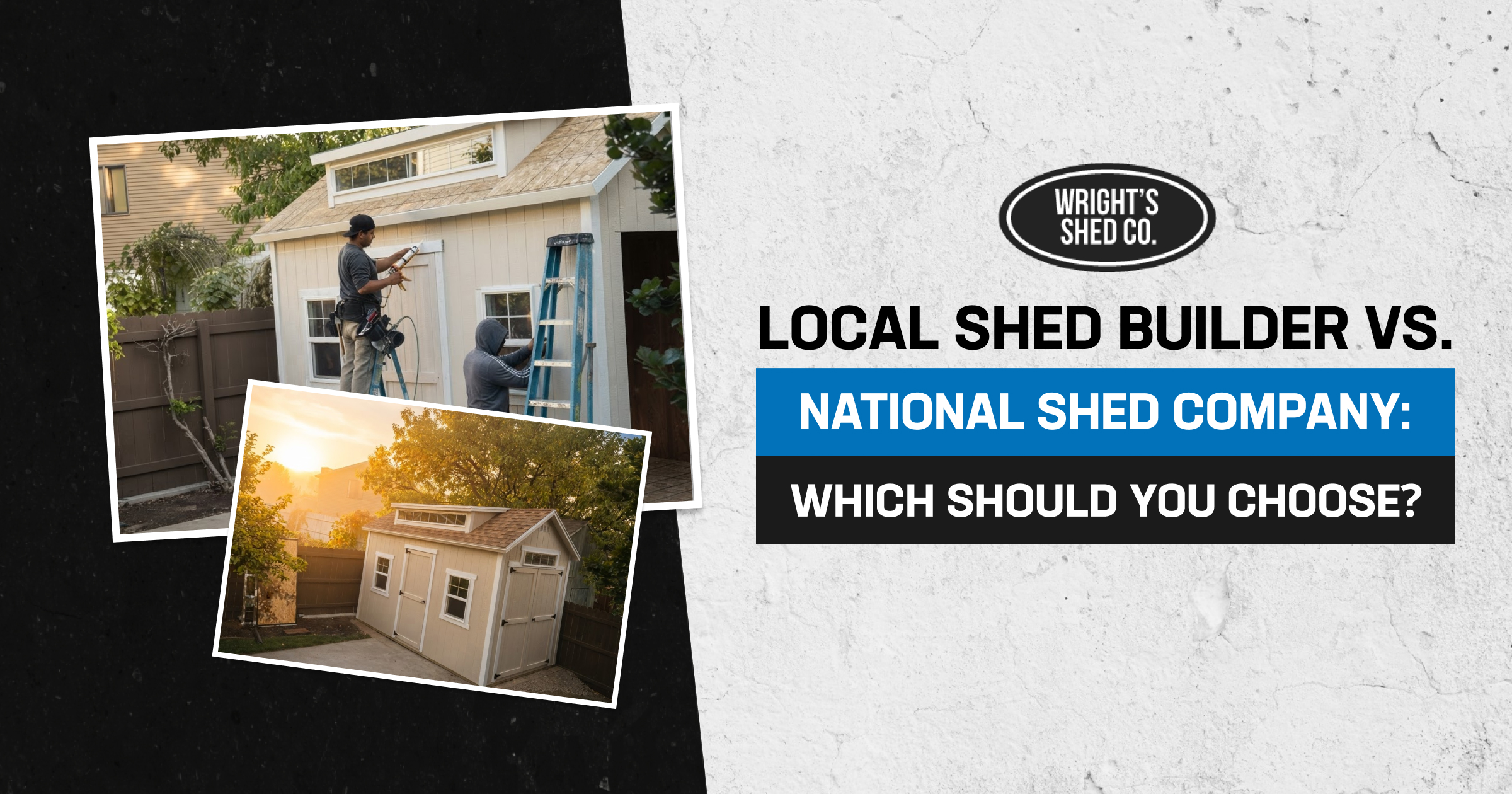
Buying a shed has never been easier. You can order one online in just a few clicks, shop through a national shed company, or visit a local shed builder to explore custom sheds designed for your property. While every option can provide additional storage, they differ in pricing, customization, delivery, warranty support, and long-term accountability. This guide compares a local shed builder vs. a national shed company so you can understand the trade-offs and choose the option that best fits your property, budget, and long-term needs.
Quick Answer: A local shed builder like Wright’s Shed Co. is generally the better choice if you want an on-site custom build, premium standard materials, direct communication with the builder, and stronger long-term accountability. National shed companies often rely on factory-built or panelized units sold through dealer networks, which may offer wider availability but typically provide less flexibility for site-specific construction and post-sale service.
The Two Ways to Buy a Shed Today
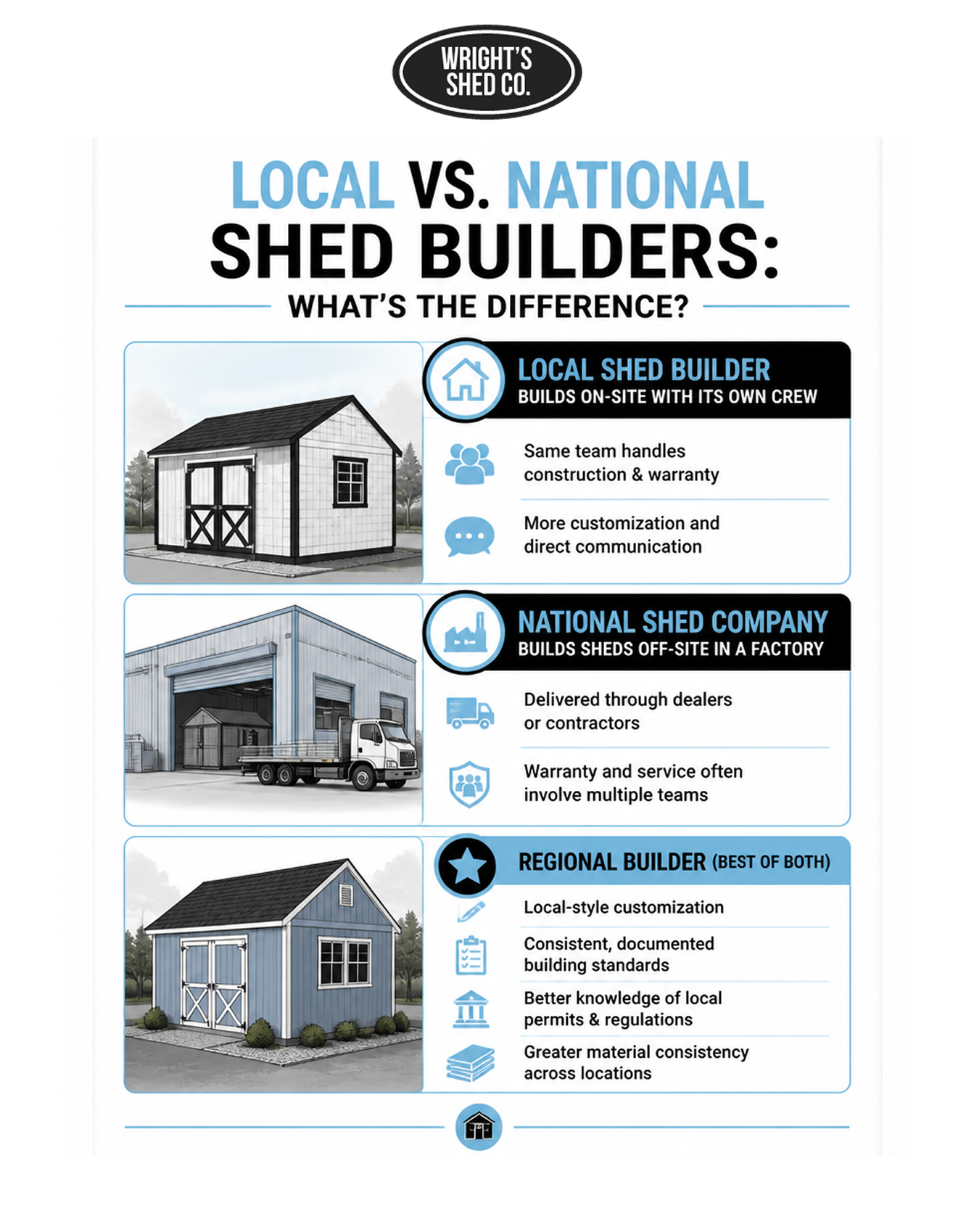
Today’s homeowners have more ways to buy a shed than ever before. You can order one online in just a few clicks, work with a national shed company, or visit a local shed builder to discuss your project in person. Each option can provide the storage space you need, but they differ in pricing, customization, delivery, warranty support, and long-term accountability. Understanding these differences before you buy can help you choose the solution that best fits your property, budget, and long-term goals.
What “Local Shed Builder” Really Means
A local shed builder typically designs, builds, and installs sheds within a specific region or service area. Instead of relying on nationwide distribution, these companies work directly with homeowners throughout the entire process, from planning and customization to delivery and after-sale support. Many local builders also have display lots or showrooms where you can inspect materials, compare designs, and discuss your project with experienced staff before making a decision.
Working directly with a local shed builder often provides greater flexibility when customizing your shed. Rather than choosing only from standardized models, you may have more options for adjusting the size, roof style, siding, windows, doors, colors, and interior layout to better match your property and storage needs. Because you’re working directly with the builder instead of a third-party dealer, communication is often more straightforward throughout the project.
If you’re comparing different local companies, it’s also important to know what separates a reputable builder from the rest. Before making your final decision, read our guide on how to choose a shed builder to learn the key questions to ask about construction quality, warranties, customization, and customer service.
What National and Online Shed Companies Offer
National shed companies and online shed builders usually focus on convenience and wider availability. Homeowners can browse models online, compare prices, and in many cases complete the entire purchasing process without visiting a physical location. For buyers looking for a standard storage solution, buying a shed online can save time and provide access to a larger selection of pre-designed models.
However, it’s important to understand exactly what is included before ordering a shed online. Some national or online companies manufacture the shed but rely on local dealers or third-party installers for delivery, assembly, and warranty service. Others may advertise a lower base price that doesn’t include shipping, installation, foundation preparation, or optional upgrades. Comparing the total delivered cost, customization options, and available after-sale support helps ensure you’re making an accurate comparison between a local builder and a national or online provider.
How On-Site Building Changes the Comparison
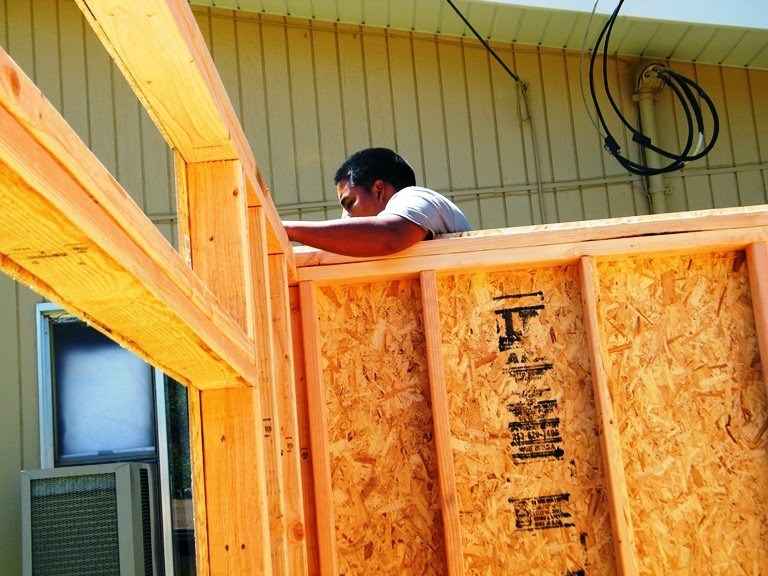
Building on your property, instead of trucking in a finished unit or shipping a flat-packed kit, changes how the shed sits and what its warranty actually covers. Our crews level and set the base to your yard’s actual grade, rather than to a generic factory pad, so the floor system and door swing match your site instead of an average lot.
A pre-built shed trucked to your property has already absorbed a highway ride before it ever touches your yard, which can rack the frame or stress the siding seams. A DIY shed kit avoids that transport stress but shifts assembly labor, and the craftsmanship warranty that comes with it, onto you. Because our crew both builds and installs, the craftsmanship warranty attaches to work we performed start to finish, which is a different guarantee than a manufacturer’s materials warranty alone.
On-site building also changes the timeline in a way buyers don’t always expect. A national company’s lead time is often tied to factory production schedules and shipping routes, so a delay at the plant or a trucking bottleneck can push your delivery date without much local visibility into why. Because we build after your order is placed and your site is confirmed, our crews can sequence work around your yard’s condition, your weather window, and any last-minute placement changes, rather than around a factory’s unrelated backlog.
Quality and Customization: What to Compare Side by Side
The materials list is where local and national shed options separate fastest, because a factory kit’s spec is fixed at the plant while a true local builder states the same standard build on every model, not as an upcharge. Ask any company for the exact siding brand, shingle brand, framing spacing, and window rating in writing, then compare that list line by line against what you’re actually being quoted.
LP SmartSide and GAF Timberline: The Standard Local Builders Compete Against
Every shed we build uses LP SmartSide engineered wood siding, SmartGuard treated, backed by LP’s 5/50-Year Limited Factory Warranty, paired with GAF Timberline architectural shingles carrying a GAF Limited Lifetime Factory Warranty. Framing runs 2×4 walls at 16 inches on center with double top plates, a spec many low-cost kits and thinner-panel national units don’t match. Below is our standard build, model by model, so you have a real baseline to compare against any other quote.
| Component | Wright’s Shed Co. Standard Spec |
| Siding | LP SmartSide engineered wood, SmartGuard treated |
| Roofing | GAF Timberline architectural shingles |
| Framing | 2×4 walls, 16″ on center, double top plates |
| Flooring | 3/4″ tongue-and-groove OSB on treated wood or steel base |
| Trim | 4″ Miratec composite trim |
| Windows | AMSCO/Alpine double-paned, 3/4″ insulating unit |
| Exterior Paint | Sherwin-Williams A-100 exterior latex, satin |
National sellers and low-cost kits don’t always publish an equivalent spec sheet. If a quote doesn’t name the siding brand, shingle brand, and framing spacing, treat that as a gap to ask about, not a detail to assume.
Warranty Differences Between Local Builders and National Sellers
Warranty coverage is the clearest dividing line, because a national seller can lean entirely on the manufacturer’s material warranty, while a true local builder backs both the materials and the structure itself with a separate craftsmanship warranty tied to its own labor.
Materials Warranty vs. Craftsmanship Warranty: Why the Difference Matters
Materials warranties come from the manufacturer regardless of who installs the product: LP’s 5/50-Year Limited Factory Warranty on SmartSide siding and GAF’s Limited Lifetime Factory Warranty on Timberline shingles apply to the material itself. A craftsmanship warranty is a separate promise from the builder covering the structure and workmanship, and it is model-specific.
Our Wright’s Limited Warranty runs 5 years on the Vineyard, 8 years on the Orchard, Farm, and Lean-To, and 8 years on detached garages; DIY kits carry no craftsmanship warranty since you assemble them yourself. OSB coop flooring and porch, deck, post, and railing add-ons are not covered under the craftsmanship warranty. See our warranty terms for the full breakdown. A builder that advertises “up to 50 years” without clarifying that the figure applies to materials, not structure, is overstating what’s actually guaranteed on the build itself.
Price: Which Is Actually Cheaper?
Sticker price alone doesn’t tell you what’s included, so compare the starting price against whether installation, siding, and shingles come standard or get added later as upgrades. On every Wright’s shed except the DIY kit, on-site installation is built into the price you see, not billed separately once the crew arrives.
What’s Included in Our Price
Starting prices below are our smallest available size per model, labeled by region. Nebraska pricing runs lower than Utah on most sizes. Two-tone paint adds 10% to the shed cost. These figures are dated to our published pricing and can change, so treat them as a starting reference and get a free quote for a current, size-specific total.
| Model | Utah Starting Price | Nebraska Starting Price |
| Vineyard | $2,117 | $1,938 |
| Orchard | $2,300 | $2,127 |
| Lean-To | $2,327 | $1,809 |
| Farm (8×8) | $3,418 | $2,723 |
| DIY Kit (no installation) | $1,809 | $1,264 |
National shed companies and kit sellers frequently quote a materials-only figure, with delivery, foundation prep, and assembly priced separately once you’re further into the sales process. When you get a national quote, ask directly whether the number in front of you includes installation, or whether it’s the starting point for add-on fees.
Customization, Lead Times, and Local Service
Customization is usually where a local builder pulls ahead, because we adjust size, door and window placement, roof pitch, and trim to your yard instead of offering a fixed catalog of factory dimensions. Every model, from the Vineyard to the Orchard, the Farm, and the Lean-To, can be resized and reconfigured before we build, because the build happens after you order rather than before.
Lead times also tend to run more predictably with a local builder, because you’re one production queue behind a crew working in your own state rather than behind a national distribution schedule shared across many regions. If your project has a hard deadline, like clearing a yard before a season change or coordinating with a landscaping project, ask any builder, local or national, for a written estimate of build start date and completion window rather than a general range.
Service Area and Local Knowledge
Permit rules for accessory structures vary by city and county, so we never quote a universal size threshold as a blanket rule. The International Residential Code, the model code many local jurisdictions build their own permit rules from, exempts some small detached accessory structures from permitting, but individual cities and counties adopt, amend, or tighten that threshold on their own. We advise on the specifics for your address during quoting rather than guessing. A national company selling into dozens of states at once is far less likely to know your local setback and permit rules the way a builder working across a handful of neighboring states does.
Reviews, Accountability, and Who Answers When Something Goes Wrong
When a shed needs warranty attention years down the road, the real difference between a local builder and a national company often comes down to who actually answers the phone. We’ve built on-site since 1997, out of two locations in Kaysville, Utah, and Greenwood, Nebraska, and we’ve built up hundreds of five-star reviews from customers who dealt directly with the crew that built their shed. Read more about our history on our About page.
National companies frequently route service requests through a call center or a third-party installer network rather than the crew that actually assembled your unit, which can add steps and delay between when you report an issue and when someone shows up to look at it. Neither approach is inherently dishonest, but it’s a fair question to ask before you buy: if this shed needs a repair in year five, who is contractually on the hook, and how do you reach them?
Reviews are useful here, but only if you read past the star rating. Look for mentions of what happened after the sale: did a warranty claim get resolved directly with the builder, or did the customer describe being redirected between a retailer, a manufacturer, and an installer before anyone took responsibility? A pattern of direct, single-point-of-contact resolution in the reviews is a stronger signal than the overall average, and it’s worth reading a dozen or more before deciding either way.
Which Buyers Should Choose Local vs. National
Choose based on what you’re optimizing for, not just the sticker price. If your top priority is the lowest possible upfront number and you’re comfortable assembling or coordinating delivery yourself, a national kit or drop-off unit can work, especially for a small, low-use storage building. If you want a shed sized to your actual yard, built to a documented standard spec, backed by a craftsmanship warranty tied to the crew that built it, and serviced by a company you can call directly, a local on-site builder is the better fit.
Most buyers land somewhere in between: they want the customization and accountability of a local builder without paying more than they have to. That’s the gap we built our standard spec, on model-specific warranties, and regional pricing to close.
A few practical checkpoints can help you decide faster. First, ask both types of company for their spec sheet in writing and compare siding brand, shingle brand, and framing spacing line by line rather than trusting a generic description like “quality materials.” Second, ask exactly what the craftsmanship warranty covers versus the materials warranty, since the two numbers are often blended together in marketing copy. Third, ask who performs the physical installation, since a subcontracted crew you’ve never met carries different accountability than the company’s own employees.
Frequently Asked Questions
Is a local shed builder more expensive than a national company?
Not necessarily. Wright’s Shed Co.’s starting prices, for example, $2,117 for a small Vineyard in Utah or $1,938 in Nebraska, are comparable to many kit and factory-built options once you account for installation being included rather than billed as an add-on.
What warranty do local shed builders typically offer?
It varies by builder, so ask for the exact terms in writing. Wright’s Shed Co.’s craftsmanship warranty runs 5 years on the Vineyard and 8 years on the Orchard, Farm, and Lean-To, separate from the LP SmartSide 5/50-Year and GAF Timberline Limited Lifetime materials warranties.
Do I need a permit for a shed built by a local company?
That depends on your city or county, not on which company builds it. Permit thresholds vary by jurisdiction, and Wright’s Shed Co. advises on specific requirements during quoting rather than quoting a universal rule.
Can a national shed company build on-site like a local builder?
Some can, but many national sellers ship a finished unit or a kit rather than building on your property. Ask directly whether the crew assembles the shed on-site or whether you’re receiving a pre-built or self-assembled unit.
Which is better for custom features: local or national?
A local builder generally offers more flexibility on size, windows, doors, and roof pitch because the shed is built after you order rather than pulled from fixed factory dimensions.
Are online sheds cheaper than local builders?
Online shed companies may advertise lower starting prices, but those prices don’t always include shipping, installation, foundation work, or optional upgrades. Comparing the total delivered cost often provides a more accurate comparison than looking at the base price alone.
Local Shed Builder vs. National Shed Company: Which Option Is Right for You?
Choosing between a local shed builder vs. national shed company involves more than comparing prices. Construction quality, customization, delivery, warranty coverage, and long-term support all play an important role in determining the overall value of your investment. Understanding these differences helps you choose a shed that fits both your property and your long-term needs.
At Wright’s Shed Co., we’ve been building custom sheds on-site since 1997 across Utah, Idaho, Nebraska, and Iowa. We combine the personalized service of a local builder with premium materials, documented construction standards, and model-specific craftsmanship warranties to deliver sheds built for lasting performance.
Ready to find the right shed for your property? Request a free quote today or explore our available shed models. Our team is happy to answer your questions, explain your options, and help you choose a shed that’s built to match your needs, budget, and location.