
A bad shed builder costs you more after you sign than before. Homeowners in Utah and Nebraska shopping for a custom shed often run into vague quotes, unnamed materials, and warranty language that sounds better than it actually reads. Learning the real shed builder red flags before you sign protects your budget and the structure you’ll look at for the next 20 years. We’ve built sheds on-site in Kaysville, Utah, and Greenwood, Nebraska since 1997, so we’ve seen the shortcuts a careless builder takes. This guide breaks down the specific red flags to watch for, what each one costs you later, and the questions that separate a builder worth hiring from one to avoid; for the positive-framed checklist, see our guide on how to choose a shed builder.
Quick Answer: The clearest shed builder red flags are unnamed materials, no on-site installation, warranty terms that blend materials and craftsmanship coverage, pressure to sign or pay cash immediately, and no fixed address or verifiable reviews. If a builder won’t name its siding, shingles, or warranty years in writing, treat that as a stop sign, not a detail to work out later.
What Counts as a Shed Builder Red Flag?
A shed builder red flag is any gap between what a builder promises out loud and what they’ll actually put in writing. Materials, warranty years, installation method, and price all belong in a written quote, not a sales pitch.
The FTC’s guidance on avoiding home improvement scams groups the clearest warning signs into a few buckets: pressure to decide fast, payment demanded before work starts, and a refusal to put terms on paper.
Not every warning sign disqualifies a builder on its own. A company that prefers text messages over phone calls, or one newer to your specific city, might still do solid work. The pattern that matters is a cluster: two or more flags showing up together, especially around materials, warranty terms, or payment, is where the risk climbs fast.
Hard flags, the kind that should end the conversation outright, include a refusal to provide a written contract, a demand for full payment before any work begins, and an inability to name the actual siding or shingle brand going on your shed. Soft flags, worth a follow-up question rather than an automatic no, include a slower callback time or a smaller portfolio of local photos.
The most reliable way to apply this checklist is to get two or three written quotes and lay them side by side before you decide anything. A single quote in isolation is hard to judge; the same quote next to a competitor’s, with materials, warranty years, and installation method spelled out line by line, makes the gaps obvious fast.
Vague or Unspecified Materials in the Quote
A vague materials list is one of the fastest ways to spot a shed builder cutting corners before the first board goes up. If a quote reads “wood siding” or “standard shingles” without naming a brand, ask why. Named materials come with named, checkable warranties; generic descriptions usually come with neither.
We specify LP SmartSide engineered wood siding treated with LP’s SmartGuard manufacturing process, and GAF Timberline architectural shingles on every standard build we sell, not as an upgrade option. Those two products carry manufacturer-backed warranty terms you can look up directly; a builder who substitutes an unnamed panel product or a generic shingle is handing you a shorter service life and a warranty you can’t verify.
Framing specs matter just as much as the visible siding and shingles. We frame walls at 2×4, 16 inches on center, with double top plates, and put that spacing in writing on every quote. A builder who won’t state a framing spec may be using wider stud spacing to save lumber, which shows up later as flex in the walls and a shorter structural life.
LP SmartSide and GAF Timberline vs. Unnamed “Standard” Materials
The easiest way to compare two quotes side by side is to ask both builders to fill in the same blanks. If one names LP SmartSide and GAF Timberline and the other writes “engineered siding” and “architectural shingles” with no brand, you’re not comparing two versions of the same shed; you’re comparing a documented product to an unverifiable one. The table below shows what a vague quote typically says next to what we put in writing on every standard build.
| What a vague quote says | What we specify in writing | Why it matters |
| “Wood siding” | LP SmartSide engineered wood siding, SmartGuard treated | Resists fungal decay and termite damage under LP’s process |
| “Standard shingles” | GAF Timberline architectural shingles | Backed by a Limited Lifetime Factory Warranty |
| “2×4 framing” | 2×4 wall framing, 16 inches on center | A named structural spec, not a wider gap that saves lumber |
| “Exterior paint” | Sherwin-Williams A-100 exterior latex | A named product line, not a generic contractor-grade can |
| “Windows” | AMSCO or Alpine double-paned, 3/4-inch insulating unit | Insulated glass instead of single-pane |
Windows, trim, and paint follow the same rule. AMSCO or Alpine double-paned windows, Miratec composite trim, and Sherwin-Williams A-100 exterior latex paint are named on our quotes, because a builder who won’t name a paint or window brand usually can’t tell you its warranty either.
The cost of an unnamed material rarely shows up on day one. It shows up three or four winters in, as faded paint, a shingle that curls at the edges, or siding that swells at the seams. By then the builder who quoted it is often long gone, and there’s no manufacturer warranty to call because the product was never named in the first place.
No On-Site Installation, Just a Drop-Off
A shed builder who can’t clearly answer whether your shed will be built on your property or trucked in pre-assembled is a red flag worth stopping on. On-site installation and drop-off delivery are two different products with different fit, leveling, and warranty implications, even when the floor plans look identical in a brochure.
A shed built off-site has to be built to fit a trailer bed and survive a highway trip, which limits size, roof pitch, and how tightly it can be leveled to your actual yard. A shed built on your property is framed, sided, and roofed in place, so it’s leveled to your specific site rather than to a flatbed.
We build every shed on the customer’s property; DIY shed kits are the only product line we sell as a delivered, self-install option, and we say so plainly on that page rather than blurring the two. If a builder markets “custom” sheds but every unit shows up on a truck already assembled, ask directly whether on-site installation is included in the price or sold as a separate line item.
Warranty Language That Blurs Materials and Craftsmanship
A shed builder who quotes one warranty number for “everything” is either confused about coverage or hoping you won’t ask a follow-up question. Materials and craftsmanship are covered separately, and the terms are rarely close in length, so a single blended number is almost always misleading in one direction or the other.
LP SmartSide siding carries a 5/50-Year Limited Factory Warranty, and GAF Timberline shingles carry a Limited Lifetime Factory Warranty. Both are manufacturer warranties on the materials themselves, backed by LP and GAF, not by the builder who installed them. Craftsmanship coverage, which protects the actual building of the structure, framing, assembly, and workmanship, is a separate warranty entirely, and it’s shorter by design.
Reading a Shed Builder’s Warranty Terms
Our own Wright’s Limited Warranty on craftsmanship runs 5 years on the Vineyard model, and 8 years on the Orchard, Farm, and Lean-To models, along with 8 years on detached garages. DIY kits are self-installed, so they carry no craftsmanship warranty since we aren’t the ones assembling them.
Certain items fall outside standard coverage on any shed, and a trustworthy builder states them up front instead of glossing over them. OSB coop flooring, along with porches, decks, posts, and railing, are typically excluded from craftsmanship coverage. Ask any builder to point to these exclusions in writing, and compare them against our warranty page, rather than accepting a verbal “it’s all covered.”
| Coverage | Term | Applies to |
| LP SmartSide siding | 5/50-Year Limited Factory Warranty | Materials, all models |
| GAF Timberline shingles | Limited Lifetime Factory Warranty | Materials, all models |
| Craftsmanship, Vineyard | 5 years | Structure and build |
| Craftsmanship, Orchard / Farm / Lean-To | 8 years | Structure and build |
| Craftsmanship, Detached Garage | 8 years | Structure and build |
| Craftsmanship, DIY Kit | None | Self-installed, no coverage |
Pressure Tactics, Cash-Only Deals, and No Written Contract
Pressure to sign today, pay in cash, or skip a written contract is a red flag no matter how good the shed looks in photos. The same FTC guidance on home improvement scams flags full payment demanded before work starts, discount pricing tied to leftover materials from another job, and unsolicited door-to-door offers as some of the most common signs of a bad-faith contractor.
A legitimate quote holds its price for a reasonable window without a same-day deadline attached. There’s rarely a real reason a shed price needs to expire in 24 hours; that urgency is usually manufactured to stop you from comparing quotes or reading the fine print.
A written contract that spells out materials, warranty terms, and a payment schedule protects both sides of the deal, not just you. A builder who resists putting any of that on paper is protecting only themselves, and that alone is reason enough to keep shopping.
No Fixed Address, Model Lineup, or Verifiable Reviews
A builder with no fixed address or a page of unverifiable five-star reviews is a red flag worth checking before any money changes hands. A real shed builder operates from a physical yard or office you can visit, sells a named lineup of models rather than one-off descriptions, and has reviews you can trace back to actual customers with dates and details.
We operate from two locations, in Kaysville, Utah, and Greenwood, Nebraska, and have built sheds on-site since 1997. That history shows up in hundreds of five-star reviews you can read directly rather than take our word for it.
Checking Reviews and a Physical Location
Search a builder’s name together with their city and read the most recent reviews first, not just the highest-rated ones at the top of the page. A sudden cluster of very recent, generic five-star reviews with no photos and similar wording is worth a second look before you trust it.
Ask to see a display model in person or photos of a recent build near your address. A builder with nothing local to show you has either not built much in your area or isn’t the one actually doing the building. Either answer is useful information before you sign.
It’s also worth checking a builder’s standing with your state or local licensing board and searching their name directly on bbb.org, since both track unresolved complaints a five-star review page won’t show. A pattern of complaints the builder never responded to matters far more than a handful of scattered one-star reviews, which every business collects over time regardless of quality.
Silence on Permits and Local Code
A shed builder who gives you a blanket “no permit needed” answer before knowing your city or lot size is a red flag, not a convenience. Permit thresholds vary by city and county, so no builder can honestly state a universal square-footage exemption that applies everywhere they work.
We advise on permit questions during quoting instead of promising a one-size answer, because the threshold in Kaysville isn’t the threshold in a Nebraska county twenty minutes down the road. A builder who skips this conversation entirely is either unfamiliar with your local rules or hoping you won’t ask again after the shed is already built.
Proper permitting also matters beyond avoiding a fine. A permitted structure is generally what allows a shed to be recognized in a home appraisal, while an unpermitted one may not count at all.
Green Flags: What a Trustworthy Shed Builder Looks Like
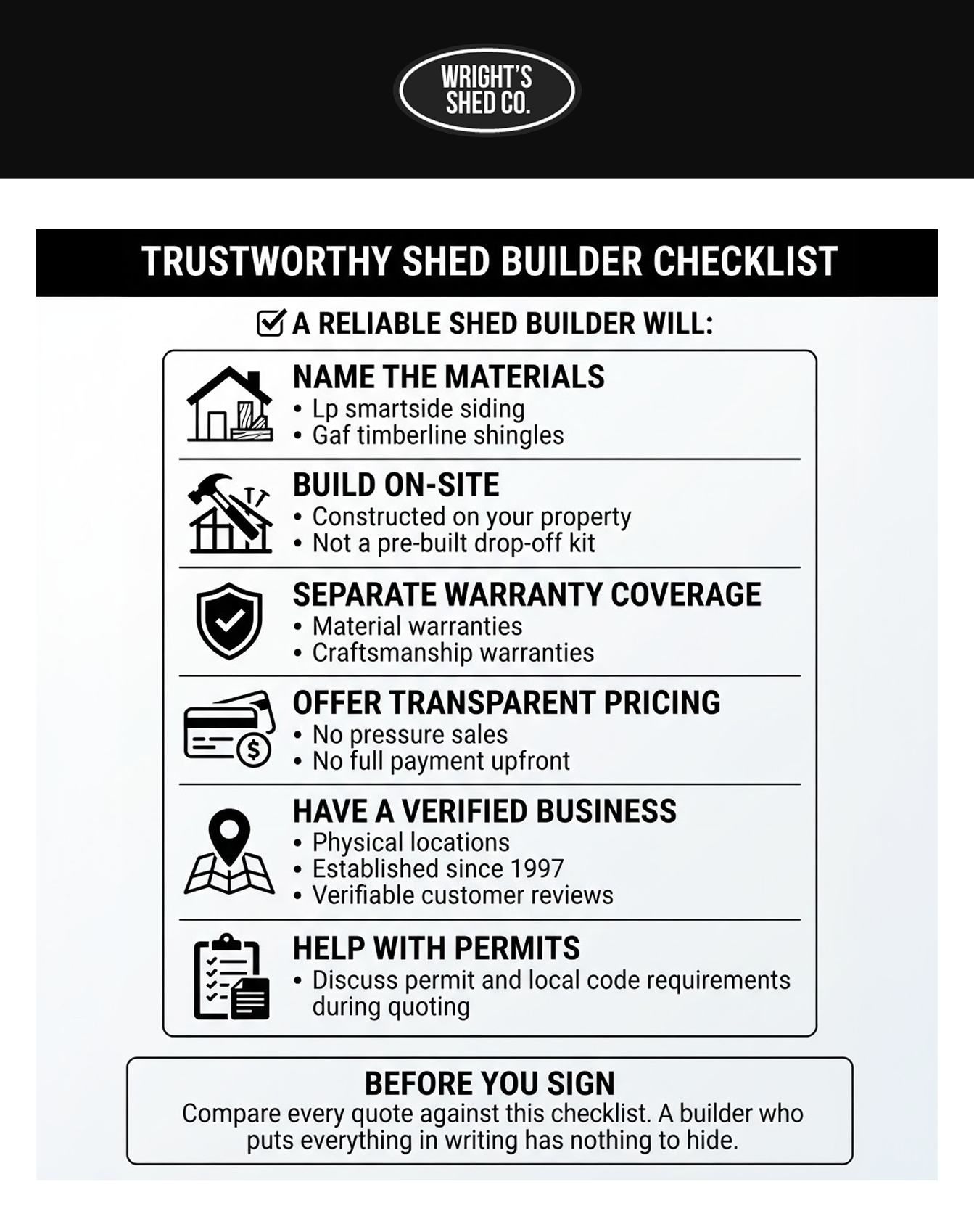
A trustworthy shed builder names its materials, separates its warranties, and builds on your property without pressuring you to decide today. Every red flag above has a mirror-image green flag, and the fastest way to vet a quote is to check it against both lists side by side.
| Red flag | Green flag (what we do) |
| Can’t name the siding or shingle brand | Names LP SmartSide and GAF Timberline by name, in writing |
| Sells installation but delivers a drop-off kit | Builds every shed on your property, on-site |
| One warranty number covers “everything” | Separate, dated terms for materials and craftsmanship |
| Demands cash or full payment upfront | Standard quote and payment process, no pressure |
| No physical address or reviews you can check | Two locations, Kaysville, UT and Greenwood, NE, since 1997 |
| Stays silent on permits | Advises on permit and code questions during quoting |
None of these signals guarantees a perfect outcome on their own, but a builder who clears all of them in writing has nothing left to hide. A builder who dodges more than one of them deserves a harder look before you sign anything or hand over a deposit.
Frequently Asked Questions
What’s the single biggest shed builder red flag?
A quote that won’t name its materials or warranty terms in writing is the single biggest red flag, since price, install method, and craftsmanship coverage all follow from what’s actually in the structure.
Is an unusually low price always a red flag?
Not always, but a price well below named-material competitors without an explanation usually means unnamed materials, a shorter warranty, or a delivered kit instead of on-site installation.
Do all shed warranties cover the same things?
No. Materials warranties, like LP SmartSide’s 5/50-Year coverage or GAF Timberline’s Limited Lifetime coverage, are separate from craftsmanship warranties, which are model-specific and typically shorter.
How can I verify a shed builder’s reviews and location?
Search the builder’s name with their city, read recent reviews first, and ask to visit a physical location or see a completed build near you.
Should a shed builder answer permit questions during quoting?
Yes. Permit thresholds vary by city and county, so a builder should discuss your specific location rather than giving a blanket answer.
Avoid Shed Builder Red Flags Before You Sign
Spotting a shed builder’s red flags before you sign protects the investment you’re about to make, not just the shed itself. Vague materials, blurred warranty terms, pressure tactics, and silence on permits are the clearest signs it’s time to walk away from a quote, no matter how attractive the price looks on the surface.
A builder who names LP SmartSide siding and GAF Timberline shingles, states separate warranty terms for materials and craftsmanship, and builds on your property instead of a trailer bed has nothing to hide. We’ve done exactly that in Utah and Nebraska since 1997, and we’re glad to answer every question on this list before you decide anything.
Ready to compare a real, written quote against the red flags above? Get a free quote, and we’ll walk you through materials, warranty terms, and on-site installation included on every shed we build.