
A shed with no windows is a dark box. You prop the door open with your foot and hunt for the hedge trimmer by the light from the yard. Shed windows fix that problem. Each one also takes wall space, adds cost, and gives a passerby a view of what you store. Getting the count and the placement right matters more than picking a pretty frame.
Most storage sheds need one or two windows, and some small sheds need none at all. A workshop or backyard office needs more, set on opposite walls for light and cross-airflow. At Wright’s Shed Co., every window is priced on our published shed extras price list, so you can see the cost before you talk to anyone. We have built sheds since 1997, and our crews frame each window opening on site, in the wall where you want it.
A few things buyers usually learn too late:
- Every window replaces wall you could shelve. On a 6-foot wall, a single 2’x2′ window takes a third of the length.
- Window cracking, fogging, and chipping are not covered under any Wright’s Shed Co. warranty. Smart placement is your real protection.
- A popout adds windows without cutting into your main walls, but it needs an 8/12 or 10/12 roof pitch, and that upgrade is a percentage of the base price.
- The 9-foot front wall on a lean-to shed is the best wall we build for high windows that bring in light without giving anyone a view inside.
- A closed window moves no air. If you want airflow all year, pair glass with a vent.
Do Sheds Need Windows?
No, a shed does not need windows to work as storage, and plenty of our customers skip them. A shed that holds a mower, a snowblower, and rakes is often better with no glass at all. You get more wall for hooks and shelves. You pay less. Nobody can look in to see what is worth taking.
Windows earn their cost when you spend time inside. Potting plants, sorting holiday bins, or working at a bench all go better in daylight. Here is a simple test. If you will stand inside for more than a few minutes at a time, plan at least one window. If you will walk in, grab a tool, and walk out, a window is optional.
Windows are not part of our standard specification, so you only pay for the ones you choose. The base build does include a steel-framed 4’x6′ door with an LP SmartSide exterior, a key latch, and a diamond-plate metal threshold.
What Windows Do for a Shed: Light, Airflow, and Lower Running Costs
Windows give a shed three things: daylight, fresh air when they open, and less need for electric light during the day. Which of the three matters most depends on how you use the building.
Daylight is the obvious one. In a shed with no power, a window and the open door are your only light sources. In a shed with power, a window still cuts the hours your lights run. The U.S. Department of Energy guide to windows, doors, and skylights points out that efficient windows lower heating, cooling, and lighting costs in a home. The same logic applies to a powered shed on a smaller scale.
Airflow only comes from a window that opens. A single-hung window opens at the bottom sash. A slider opens sideways. Either one, paired with a window or vent on the opposite wall, sets up cross-airflow. That airflow clears summer heat and the smell of fuel cans and fertilizer.
Glass is not a full ventilation plan, though. Most people close windows in winter and on rainy days. For airflow you can count on, add a wall vent at $20 in Utah, a roof vent at $50 in Utah, or a ridge vent at $12 per linear foot in Utah. Vents work with the windows shut.
Shed Window Types Compared
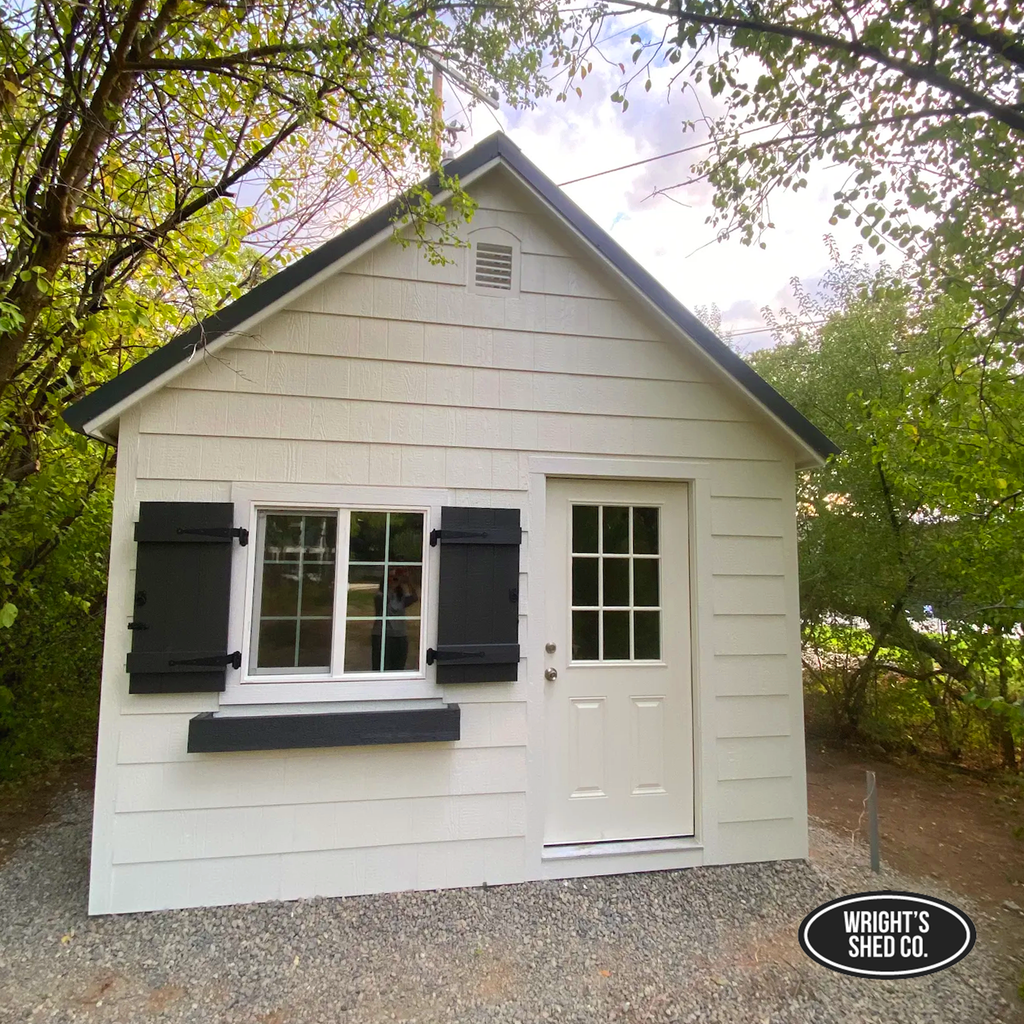
We offer four window sizes: a 2’x2′ window, a 2’x3′ single-hung window, a 3’x3′ slider, and a 4’x3′ single-hung window. Transoms and glass in the door round out the options. Our windows are AMSCO or Alpine double-paned units, not the thin single-pane sash found on many prefab sheds.
| Window option | Opening size | Best for | Utah price |
| Small window | 2’x2′ | Light in a small storage shed; low security exposure | $205 |
| Single-hung window | 2’x3′ | Taller light on a narrow wall; opens for air | $253 |
| Slider window | 3’x3′ | Easy-to-open airflow over a bench or potting table | $299 |
| Single-hung window | 4’x3′ | Workshops and offices that need the most daylight | $490 |
| Transom | Priced by width | High light above a door or along a tall wall | $125 to $302 |
| Glass in door | Standard door | A little light with no wall space used | $75 |
These figures come from our Utah extras pricing. Nebraska and Iowa buyers should confirm window pricing through a quote, because the two markets carry separate price tables.
Single-Hung vs. Slider Shed Windows
A single-hung window has a fixed top sash and a bottom sash that slides up. It suits a wall where the window sits above a bench, since you lift it from below. A slider opens side to side. It is easier to open when you have to reach over shelves or a potting table, because you push rather than lift. If airflow is the main goal, either type works. Choose based on what sits under the window.
Transom Windows and Glass in the Door
A transom is a short, wide window set high on a wall or above a door. It brings in light while staying above eye level, so it gives a passerby almost no view inside. Our transoms run from $125 to $302 in Utah, depending on width. Glass in the door costs $75 in Utah and uses no wall space at all. For a small storage shed, glass in the door plus one transom often lights the space well enough.
How Many Windows a Shed Needs by Size and Use
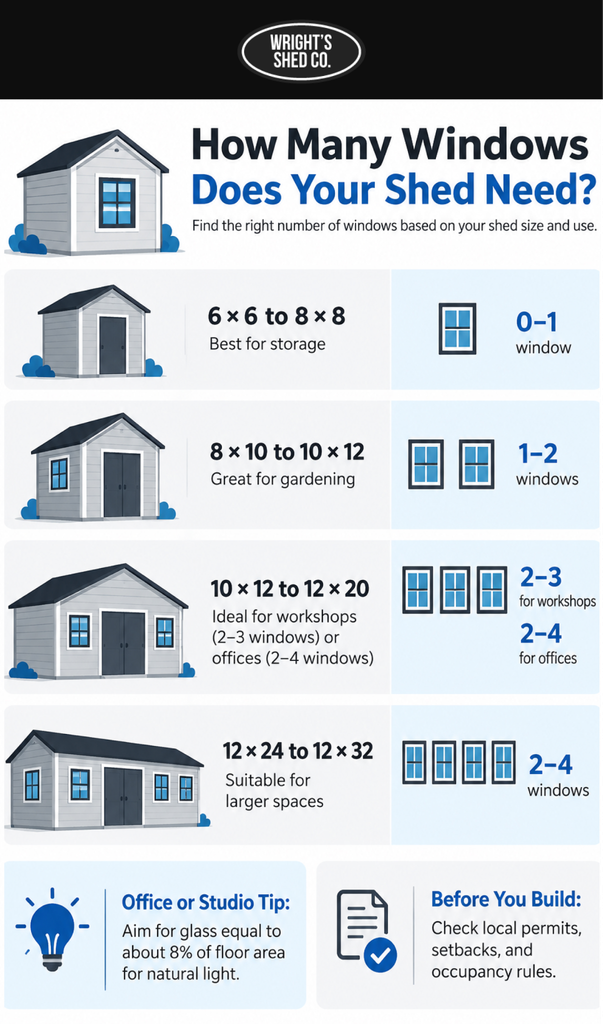
Most storage sheds need zero to two windows, while a workshop or office needs two to four, scaled to floor area and to how long you stay inside. Treat the table below as a starting point, not a rule.
| Shed size | Main use | Suggested windows | Common choice |
| 6×6 to 8×8 | Tool and mower storage | 0 to 1 | Glass in door or one 2’x2′ |
| 8×10 to 10×12 | Garden storage, potting | 1 to 2 | One 3’x3′ slider over the work area |
| 10×12 to 12×20 | Workshop or hobby space | 2 to 3 | Two windows on opposite walls |
| 10×12 to 12×20 | Office or studio | 2 to 4 | Aim for about 8% of floor area in glass |
| 12×24 to 12×32 | Large storage or shop | 2 to 4 | Windows plus a pop-out or transoms |
For a shed you will sit in, borrow a benchmark from house codes. The International Residential Code requires habitable rooms in a home for glass equal to at least 8% of floor area, as this City of Boise handout on IRC Section R303 summarizes. A shed is usually not a habitable room. Still, 8% is a useful target for an office.
Here is how the math works. A 10×12 shed has 120 square feet of floor, and 8% of that is 9.6 square feet. One 4’x3′ window is 12 square feet by its listed size. The actual glass area is smaller once you subtract the frame, so two smaller windows on opposite walls often light the room more evenly.
Using a shed as an office, studio, or sleeping space can change how your city treats it. Permit thresholds, setback requirements, and use rules for an accessory structure vary by city and county. Check with your local building department before you plan a shed you will occupy.
Where to Place Shed Windows
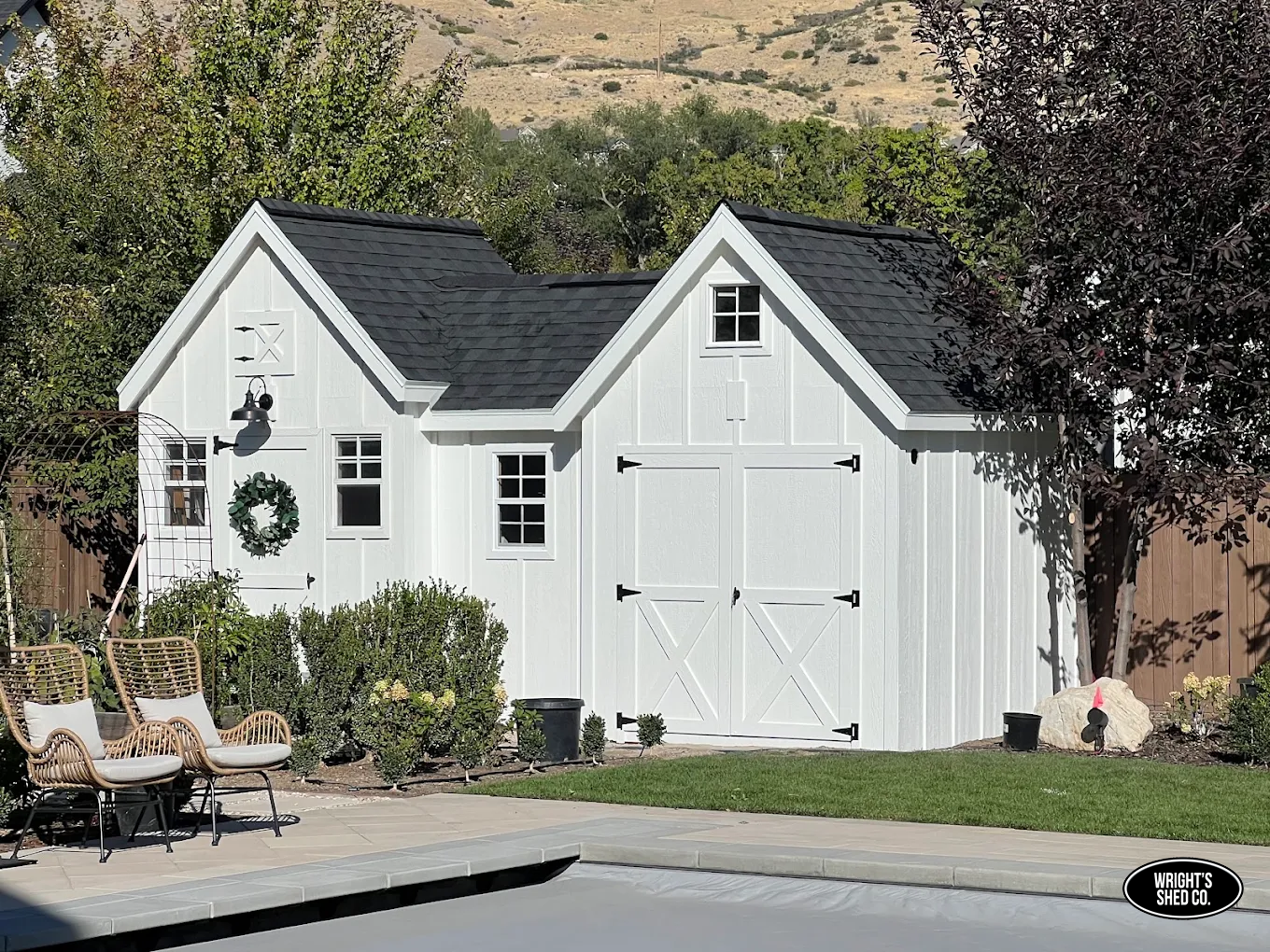
Put windows where you work, away from where you store, and on a side of the shed that gets steady daylight without harsh afternoon sun. Placement decides whether a window helps or just heats the shed.
North-facing glass gives even, soft light all day. South and west windows bring the most heat in summer. The Department of Energy recommends shading or covering south- and west-facing windows to limit heat gain, and that advice fits a shed with dark walls and stored fuel. If your only good wall faces west, consider a smaller window there and add a roof vent.
Think about what happens outside the wall, too. A window near the lawn edge takes rocks from the mower. A window in the path of a sprinkler stays wet, and our maintenance guidance already asks you to keep irrigation off the building. Keep a 6 to 12-inch barrier between the lawn and the shed, and site windows away from where the kids play catch.
Placing Windows Around Shelving and a Loft
Plan shelving first, then windows. Our wall framing is 2×4 studs on 16-inch centers. Any window wider than one stud bay means cutting studs and framing a header above the opening. That is routine work for our crews, but it fixes the window in place for the life of the shed. Sketch where shelves will run. Shelving costs $5.50 per linear foot for 16-inch depth and $6.00 per linear foot for 24-inch depth in Utah, so wall space has a real dollar value.
A loft changes the math too. A loft runs $8.00 per square foot in Utah, and it blocks any window placed above its floor line. Keep windows below the loft, or put them on a gable end the loft does not cover.
Because we build on site, you can stand in the yard with our crew and pick the exact spot. Barbara H. said in her review that she was surprised the crew built her shed right in front of her and kept her involved the whole time. Vaylene P. found it helpful to visit our locations and see sheds built in person before choosing. You can also browse our shed photo gallery to see window layouts on finished builds.
Window Placement by Shed Style
Your shed style decides how high a window can sit and how much weather hits it, because wall height and roof shape differ across our four built styles.
| Style | Walls and roof | What it means for windows |
| Vineyard | 7′ walls, 4/12 pitch, no overhead storage | Lower walls leave less room above a window. A 2’x2′ or 2’x3′ unit fits best. |
| Orchard | 8′ walls, 6/12 pitch, overhead storage | Room for a 3’x3′ or 4’x3′ window below the overhead storage line. |
| Farm | 8′ walls, gambrel roof, no overhangs | No eave shelter, so window trim sees more rain. Keep caulk fresh. |
| Lean-To | 9′ front wall sloping to 7′ rear | The tall front wall takes high windows and transoms for private light. |
The Vineyard shed is our simplest style and works well with one small window. The Orchard shed is our most popular, and its 8-foot walls give the most freedom on window size. On the Farm shed, the gambrel roof maximizes overhead space, so plan windows below that storage zone. The Lean-To shed is the one we suggest most for natural light, since a row of high windows on the 9-foot front wall lights the room and keeps your gear out of sight.
Eave overhangs shelter windows from rain. A 6-inch overhang costs $220 on a 6-foot wall, $250 on an 8-foot wall, $275 on a 10-foot wall, and $300 on a 12-foot wall in Utah. A Lean-To overhang is $275 in Utah.
Every Window Costs You Wall Space
More windows are not always better, because every opening is wall you can no longer shelve, hang tools on, or lean a ladder against. This is the trade most buyers miss when they add windows for looks.
Run the numbers on an 8×10 shed. The four walls total 36 linear feet. Subtract the 4-foot door, and you have 32 feet of usable wall. Two 3’x3′ sliders take 6 of those feet, which is nearly a fifth of your shelving space. On a storage shed, that is a real loss. On a workshop, it may be worth it.
Popouts: Adding Windows Without Losing Wall Space
A popout is a small bump-out section of wall that holds its own windows. A 4-foot popout with one window costs $600 in Utah. A 6-foot popout is $700 and an 8-foot popout is $800 in Utah. An 8-foot-wide popout with three windows runs $1,300 in Utah.
Popouts require an 8/12 or 10/12 roof pitch. That matters because roof pitch upgrades are a percentage, not a flat fee. Moving to 8/12 adds 10% of the shed’s base cost, and 10/12 adds 15%. On a large shed, that percentage becomes a bigger dollar figure than the popout itself. Weigh it before you commit.
Are Shed Windows a Security Risk?
Yes, a window is usually the weakest point on a shed, but size and placement control most of that risk. A thief looks for two things: something worth taking and an easy way in. Windows can offer both.
- Choose smaller units. A 2’x2′ window is hard to climb through and shows little of the inside.
- Set glass high. Transoms and high windows on a lean-to shed bring in light above eye level.
- Face windows away from streets and alleys. Point them toward your house so you can see the shed instead.
- Keep valuables out of the sightline. Store the generator and power tools on the wall with no glass.
- Add privacy film or a simple curtain if the window faces a fence line or neighbor.
Our standard door helps here. It is steel-framed and key-latched with a diamond-plate threshold. We do not keep spare keys, so store your extras somewhere safe. For a shed with no windows, motion lighting on the door side does most of the deterrent work.
Double-Pane Windows, Condensation, and Insulated Sheds
Double-pane glass reduces condensation and heat loss compared with single-pane glass, which matters most in a shed you heat or insulate. That is why we install AMSCO or Alpine double-paned windows instead of single-pane sash.
Condensation forms when warm, moist air touches cold glass. In a Utah or Nebraska winter, a single-pane window in a heated shed can drip all day. Water then runs onto the sill, the OSB sheathing, and anything stored below. Double-pane glass keeps the inner surface warmer, so less moisture forms.
Glass is only part of the answer. Moisture still needs a way out, so pair windows with a wall vent or ridge vent. If you plan to heat the shed or keep electronics inside, compare ratings before you upgrade further. ENERGY STAR window performance criteria are based on National Fenestration Rating Council ratings and change by climate zone, which makes them a useful yardstick.
Windows for Workshops, Home Offices, and She Sheds
A shed you work or relax in needs more glass than a storage shed, so plan windows on at least two walls with enough area to light the room without a lamp at midday.
Workshops. Put an operable window over the bench. A 4’x3′ single-hung unit gives the most light on your work and opens to clear sawdust and finish fumes. Add a second window or vent on the far wall for cross-airflow.
Home offices. Avoid a window directly behind or in front of your screen, because both cause glare. Side light works best. North light is the easiest to work in. Use the 8% glass benchmark from earlier as a target.
She sheds and studios. Looks matter more here, and trim details add character. Shutters cost $80 per window, and a window box costs $50 per window in Utah. Plan color early with our custom color design tool. Two-tone paint adds 10% of the shed’s cost, so choose a trim color you will want for years.
Any shed you plan to occupy may face different permit rules than a storage shed. Those rules vary by municipality, so confirm with your local building department first.
Shed Window Prices and Upgrade Options
Our shed windows range from $205 for a 2’x2′ window to $490 for a 4’x3′ single-hung window in our Utah pricing, and no window is included in a base price.
| Window upgrade | Utah price |
| 2’x2′ window | $205 |
| 2’x3′ single-hung window | $253 |
| 3’x3′ slider window | $299 |
| 4’x3′ single-hung window | $490 |
| Transom (priced by width) | $125 to $302 |
| Glass in door | $75 |
| Shutters | $80 per window |
| Window box | $50 per window |
| 4′ popout with one window | $600 |
| 8′-wide popout with three windows | $1,300 |
Base prices for each style and size are on our full shed pricing tables, published for both Utah and Nebraska. Those base prices include on-site installation on every built style. They exclude all extras, including windows, vents, shelving, roof pitch upgrades, and two-tone paint. We do not publish an all-in total because every window combination is different.
If you live in Nebraska or Iowa, our Greenwood, Nebraska shed team can confirm window pricing for your market. We run a debt-free, low-overhead operation, which our owners credit for keeping these prices where they are.
What the Warranty Says About Shed Windows
Window glass is not covered by any Wright’s Shed Co. warranty, because cracking, fogging, and chipping are excluded, even though the walls around each window carry our structural warranty. We say this up front so it never surprises you after a stray rock.
| Product | Structure | Doors | Window glass |
| Vineyard | 5 years limited | 2 years limited | Not covered |
| Orchard | 8 years limited | 2 years limited | Not covered |
| Farm | 8 years limited | 2 years limited | Not covered |
| Lean-To | 8 years limited | 2 years limited | Not covered |
Every structural warranty comes with conditions:
- The building must be painted within 30 days of installation, with proof of paint purchase and completion. All paintable exterior surfaces must be painted, including window trim and shutters, or the warranty is not valid.
- Material defects must be reported within 30 days of installation.
- Coverage is limited to the original purchaser and does not transfer.
- Claims must be submitted within 30 days of the issue appearing.
Windows also need care. Caulk around them regularly, repaint every 3 to 5 years, and keep sprinklers from hitting the glass and trim. Read the full terms on our shed warranty page.
Frequently Asked Questions about Shed Windows
Do sheds need windows?
No. A storage shed works without windows, and skipping them gives you more wall space, a lower price, and better security. We recommend at least one window if you will spend more than a few minutes at a time inside the shed.
Where should windows go on a shed?
Place windows over your work area, on a north or east wall when possible, and away from mowers and sprinklers. We frame windows on site, so you can choose the exact spot with the crew during the build.
Are windows a security risk in a shed?
Yes, windows are usually the easiest way to see in or break in. Smaller units, high placement, transoms, and privacy film cut most of that risk. Keep valuables on a wall with no glass.
Do shed windows help with ventilation and light?
They help with light every day, but only operable windows help with airflow, and only when open. We suggest pairing windows with a wall vent, roof vent, or ridge vent for airflow that works with the glass closed.
What size windows are best for a shed workshop?
A 4’x3′ single-hung window over the bench gives the most light and opens for fumes and dust. Add a second window or a vent on the opposite wall for cross-airflow.
How much do shed windows cost?
At Wright’s Shed Co., a 2’x2′ window costs $205 in Utah, a 2’x3′ single-hung window costs $253 in Utah, a 3’x3′ slider costs $299 in Utah, and a 4’x3′ single-hung window costs $490 in Utah. Nebraska buyers should confirm pricing through a quote.
Planning the Right Shed Windows for How You Use It
The right shed windows come down to three questions: how long you stay inside, what you store against the walls, and what a passerby can see. A storage shed may need none. A workshop or office needs light from two sides. Since 1997, brothers Dan and Chad Wright have run our family-owned shed company on published prices and published specs. Wright’s Shed Co. has 29 years of industry experience, more than 6,000 sheds built, and 664+ five-star customer reviews.
Pick your style, choose your windows, and see every line item before you commit. Design Your Shed to get started. On-site installation is included in the base price of every built shed, and the quote takes only a few minutes.