
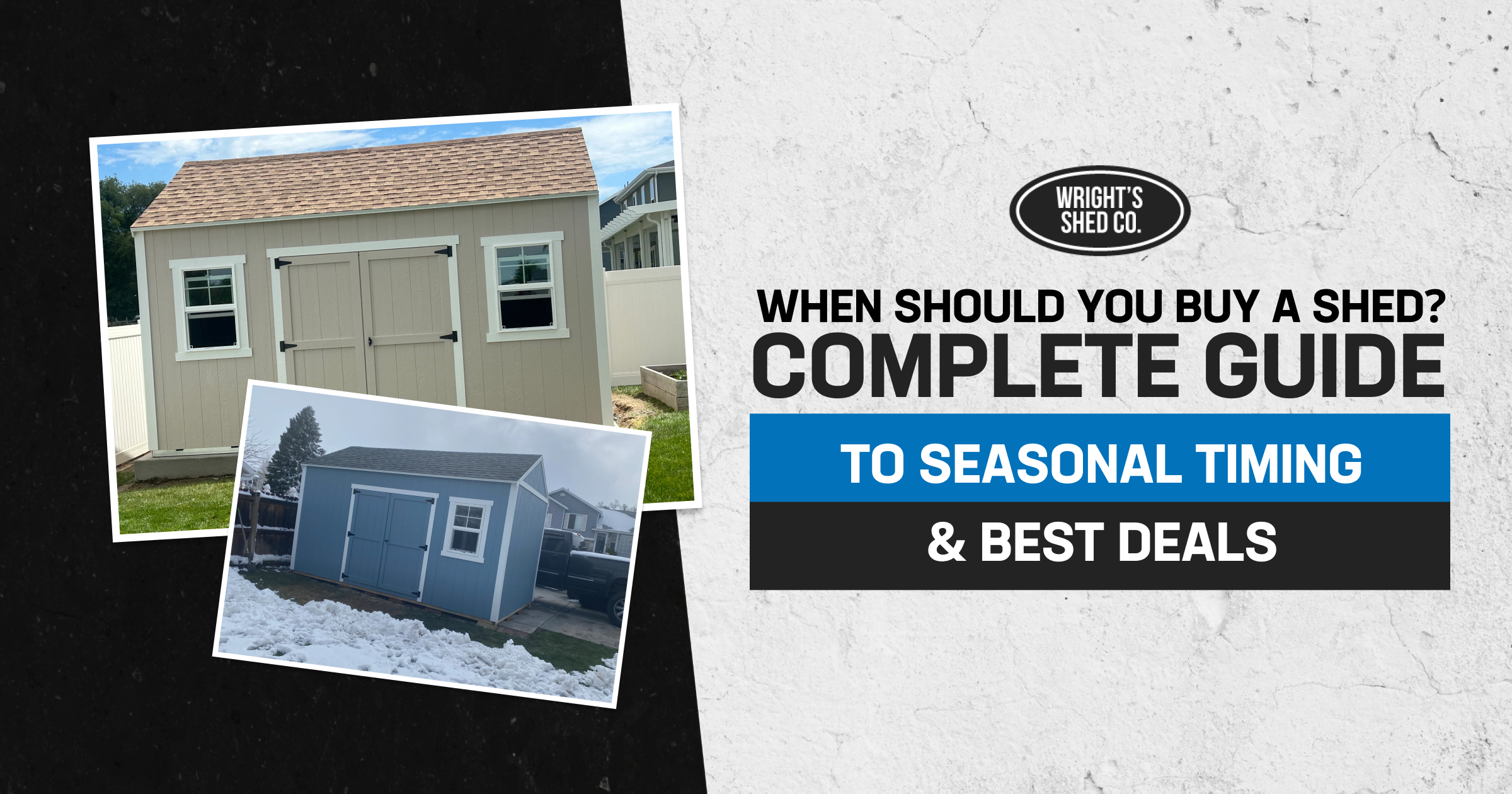
The best time to buy shed is usually decided under pressure: the week the garage is already full and the bikes have nowhere to go. By then, you’re shopping against a deadline instead of planning around one.
Late summer through fall is the best time to buy a shed for most buyers. The ground is firmer, roofing goes on faster in cooler air, and you’re not competing with the spring rush. Winter and spring purchases still work; they just carry different weather trade-offs during installation.
A few things matter here more than the month on the calendar.
- Ground conditions matter more than the season name. A gravel pad or pressure-treated skid needs level, dry ground, and that is possible in almost any month depending on your yard and your region.
- Utah and Nebraska are two different price tables. We publish size-by-size pricing separately for each state, so the number you see depends on where the shed goes up. Check our current pricing before you compare anything else.
- The painting clock starts at delivery, not at your convenience. Every built style has to be painted within 30 days of installation for the warranty to hold, so your own schedule matters as much as the season.
- A do-it-yourself kit sidesteps weather-dependent labor entirely. If timing is tight, you control the schedule instead of a crew.
- Financing can decouple the timing question from the saving-up question. We offer financing through HFS Financial, so waiting for the “right” season doesn’t have to mean waiting until you’ve saved the full price.
- Roof style changes what a season means for storage. A gambrel-roof Farm shed holds more overhead volume than a Vineyard, which matters if you rotate seasonal gear twice a year.
How Weather Shapes the Best Time to Buy Shed
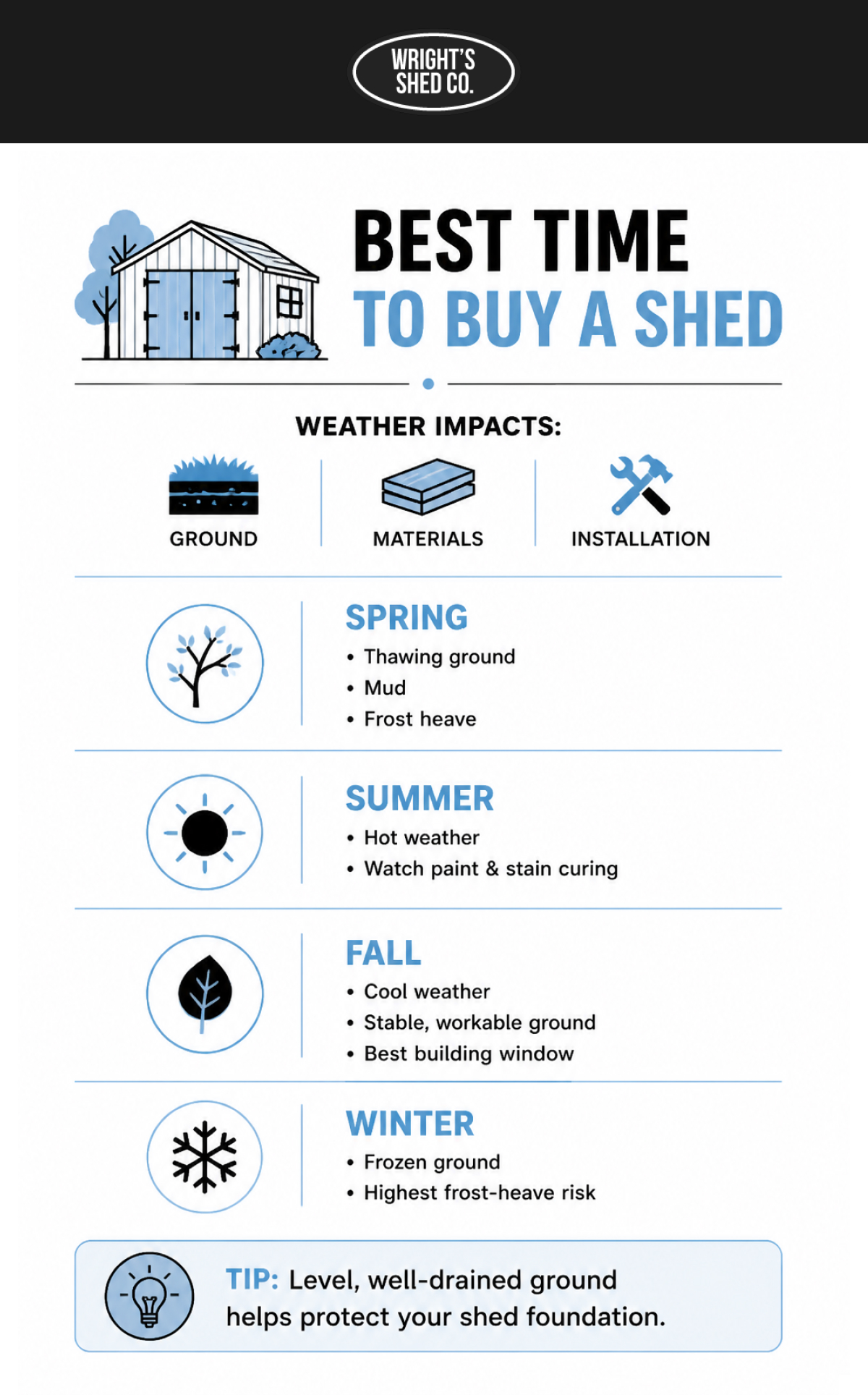
Weather affects three things on a shed project: the ground under it, the materials going onto it, and the schedule for building it.
Frozen ground shifts as it thaws, a process called frost heave, and that can move a foundation that was set before the freeze. A pressure-treated skid or galvanized steel base needs level, well-drained ground, so site leveling matters before a single wall goes up. In wetter yards, a gravel pad drains better under a foundation than bare soil does.
Frost Heave and Site Leveling
Heat and cold affect the materials too. Architectural shingles have adhesive strips that bond as they warm in the sun, so shingles installed in cold weather can take longer to seal fully against the roof deck. Tar paper and OSB sheathing are more forgiving, but keeping them dry during a build matters in any season.
We build every shed on site rather than dropping off a pre-built box. Barbara H., one of our reviewers, was surprised to watch the crew assemble her shed in her own yard instead of hauling in a finished structure. Building on site lets the crew work with the ground and weather in front of them, not fight a factory-built shape down a gate.
For a closer look at how lumber responds to seasonal moisture and temperature, the USDA Forest Products Laboratory publishes research that applies to any outdoor wood structure, including a shed.
Drip edge around the full roof perimeter is standard on every built style, and it carries water away from the siding instead of letting it run down the wall. An overhang does the same job and is priced as an add-on if your style doesn’t already include one (the Farm style, for example, is built without overhangs). Either way, this matters more in a wet spring or snowy winter than in a dry August.
| Season | Ground and Weather | What to Watch For |
| Spring (March to May) | Thawing ground, occasional mud, mild temperatures | Frost heave still settling from winter, wetter site prep |
| Summer (June to August) | Hot and mostly dry across the service area | Heat affects paint and stain cure time |
| Fall (September to November) | Cool, stable, ground still workable | First freeze can arrive earlier at higher elevation |
| Winter (December to February) | Cold, ground frozen across Utah, Idaho, Nebraska, and Iowa | Frost heave risk is highest; foundation work often waits for thaw |
Buying a Shed in Spring (March to May)
Spring gives you workable ground and mild temperatures, but it is also when the most buyers are shopping.
Melting snow and spring rain leave some yards soft, so a site that looked flat in February can need regrading by April. Once the ground firms up, spring is a comfortable season for a crew to work in, without the heat of summer or the frozen ground of winter.
Because spring is a popular season for yard projects generally, we recommend starting the conversation early. Current availability and any active promotions change throughout the year, so check our specials page and talk to your local warehouse for what applies right now, rather than assuming last year’s timing still holds.
Spring is also a good time to double-check setback requirements with your city or county before you finalize placement. A shed that sits closer to a property line than local rules allow can hold up an otherwise smooth spring project, and it is a far easier fix on paper in March than after concrete has been poured.
Buying a Shed in Summer (June to August)
Summer offers long, dry stretches for building, though heat changes how a couple of materials behave during installation.
Warm weather actually helps architectural shingles seal, since the adhesive strips bond faster in the heat. Paint and stain, on the other hand, can flash dry too quickly in direct sun, which is one reason we recommend painting within the required 30-day window rather than waiting for a cooler week that may not come.
Summer is also when yards get the most use, so timing a build around vacations, kids’ schedules, and outdoor entertaining is worth thinking through before you set a delivery date.
Buying a Shed in Fall (September to November)
Fall is often the easiest season for both site prep and roofing work, since the ground has dried out from summer and has not frozen yet.
Cooler air is comfortable for a crew, humidity tends to drop, and a shed built in fall has a full season to settle before spring planting or entertaining season arrives. For customers in agricultural areas of Nebraska and Iowa, fall often lines up naturally with the end of the harvest calendar, which makes it a natural time to think about equipment storage.
Buying a Shed in Winter (December to February)
Winter is the most weather-dependent season across all four states we serve, since frozen ground complicates foundation work.
Utah, Idaho, Nebraska, and Iowa all get real winters, and frost heave risk is highest, since repeated freeze-thaw cycles do more damage to a foundation than one hard freeze. Depending on your elevation and how hard the ground has frozen, installation may need to wait for a thaw rather than going in on schedule.
If timing matters more than the calendar to you, contact your Utah location or your Nebraska location directly. Ground conditions vary block by block in winter, and the team at your local warehouse has better information on current ground conditions than a general seasonal guideline.
Regional Timing: Utah, Idaho, Nebraska, and Iowa
The right season shifts by region because Utah, Idaho, Nebraska, and Iowa do not share the same weather patterns or the same product lineup.
Best Time to Buy a Shed in Utah and Idaho
We serve Utah and Idaho from our Kaysville, Utah warehouse. Valley locations around Salt Lake City tend to have a longer workable season than higher-elevation parts of Idaho, where snow arrives earlier and stays longer. Detached garages are not available in Utah or Idaho; that product line is built only through our Nebraska and Iowa operation. Pergolas are a Nebraska-only product. If you’re in Idaho, your local contact page is the fastest way to get site-specific timing.
Timing Considerations for Nebraska and Iowa
We serve Nebraska and Iowa from our Greenwood, Nebraska warehouse. In these markets, fall often follows the harvest calendar, and detached garages are available as a product line here in a way they are not in Utah or Idaho, though pricing for garages is not published and requires a quote. If you’re closer to Greenwood’s Iowa service area, your local contact page has current details for your area.
How to Plan Your Shed Purchase Timeline
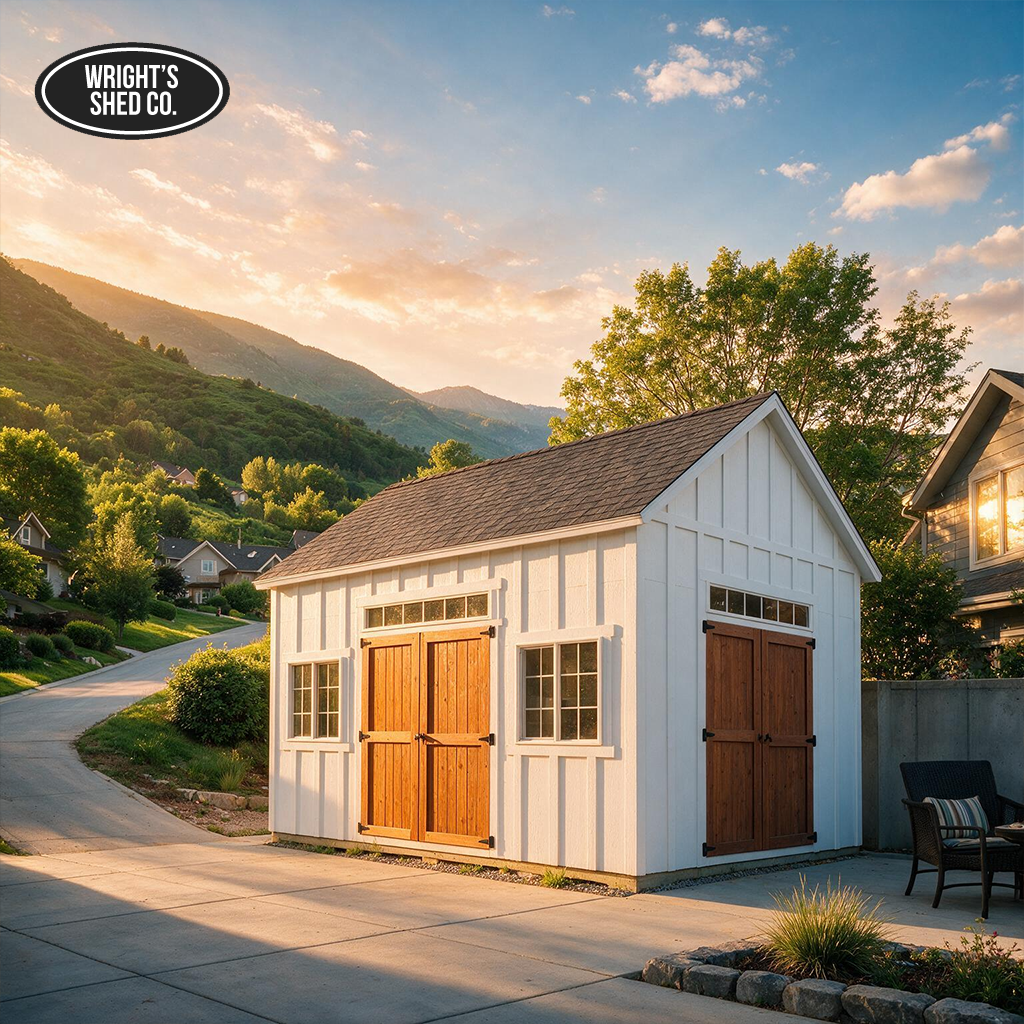
The simplest way to plan a shed purchase is to start from your need-by date and work backward, then confirm timing with your local warehouse.
Decide first what the shed is actually for. A shed needed for summer entertaining has a different deadline than one meant to store fall harvest equipment or hold holiday decorations through the winter. Once you know the deadline, build in extra room, since weather, current order volume, and your own customization choices can all shift a build schedule.
You control which style you pick, which extras you add, and how fast you finalize a design. You don’t control the ground, so building a week or two of slack into your target date costs you nothing and saves you a headache if a thaw runs long.
We do not publish fixed lead times, because they change with the season and with how many orders are already on the schedule. The most accurate answer is always the one you get by starting a quote or a conversation with your local warehouse, rather than a rule of thumb from a blog post.
Before you commit to a season, our 3D Shed Designer lets you try out sizes, colors, and layouts for your state, so you walk into that first conversation already knowing roughly what you want.
Shed Styles, Starting Prices, and Warranty at a Glance
Price depends on style, size, and state, and every built style includes on-site installation and a stated warranty term.
The prices below are the smallest published size for each style, in both Utah and Nebraska. Larger sizes cost more, and custom sizes outside the published tables are available by quote. None of these figures include extras such as doors, windows, vents, shelving, lofts, dormers, popouts, overhangs, porches, or roof pitch upgrades. A roof pitch upgrade to 6/12 or 8/12 adds 10 percent of the shed’s base cost, and a 10/12 pitch adds 15 percent, so the upgrade gets more expensive as the shed gets bigger. Two-tone paint adds 10 percent of cost on the Vineyard and Orchard styles.
| Style | Utah Starting Price | Nebraska Starting Price | Structure Warranty | Door Warranty |
| Vineyard | $2,117 (6×6) | $1,938 (6×6) | 5 years limited | 2 years limited |
| Orchard | $2,300 (6×6) | $2,127 (6×6) | 8 years limited | 2 years limited |
| Farm | $3,418 (8×8) | $2,723 (8×8) | 8 years limited | 2 years limited |
| Lean-To | $2,327 (6×6) | $1,809 (6×6) | 8 years limited | 2 years limited |
| DIY Shed Kit | $1,809 (6×6) | $1,264 (6×6) | None | None |
| Chicken Coop | $2,200 (4×5) | $1,200 (4×7) | 1 year limited | 1 year limited |
The DIY Shed Kit is priced lowest for a reason. It does not include shingles, a drip edge, installation, or a warranty. It is a genuinely good option if you want to build it yourself and are comfortable finishing the roof and setup on your own schedule, but it is not an apples-to-apples comparison with a built style.
Every warranty above depends on the building being painted within 30 days of installation, with proof of paint purchase and completion on file, and coverage applies only to the original purchaser. Material defects need to be reported within 30 days of installation as well. LP SmartSide siding carries its own 5/50-year limited factory warranty, and GAF architectural shingles carry a limited lifetime factory warranty from the manufacturer. Those are component warranties, not a whole-building guarantee. Full terms and exclusions are on our warranty page, and a full list of add-on pricing is on our extras page.
For style-specific details, see the Vineyard, Orchard, Farm, and Lean-To pages, or the Chicken Coop page if you are storing birds instead of tools.
Frequently Asked Questions About Shed Buying Timing
Is it cheaper to buy a shed in the off-season?
We do not publish a fixed off-season discount schedule. Current promotions are posted on our specials page and change over time, so that page is the only reliable source for what is currently offered.
How long does shed installation take?
As covered above, we don’t publish a standard timeline since site conditions and current schedule both affect it. Contact your local Utah or Nebraska warehouse for a current estimate before you plan around a specific date.
Can a shed foundation go in on frozen ground?
Frozen ground is more likely to shift as it thaws, which can move a foundation set before the ground fully freezes or after it starts to thaw unevenly. In cold months, waiting for stable ground or planning for a spring installation is often the safer choice.
Do I need a permit to build a shed?
Permit thresholds for an accessory structure vary by city and county, and a size that needs no permit in one municipality may need one next door. The International Code Council publishes the model code that many local jurisdictions adopt, but your local building department has the final word for your address, so check with them before you build.
What is the best season for shed installation in Utah versus Nebraska?
Both states get a comfortable building window in fall, though Nebraska’s agricultural calendar often pushes buyers there toward a post-harvest fall purchase, while Utah and Idaho buyers tend to watch elevation and snow timing more closely. Neither state has a season that is off the table, just different weather to plan around.
Does the DIY Shed Kit avoid weather-related delays?
Yes, since there is no installation crew schedule to work around with the DIY Shed Kit. You control the timeline entirely. Just remember it ships without shingles, without a drip edge, and without a warranty, so you are responsible for finishing the roof yourself.
Timing Your Shed Purchase the Right Way
There is no single best time to buy a shed that applies to every buyer, but fall gives most people the easiest combination of stable ground and comfortable building weather, and spring is a close second once the thaw settles.
What matters more than the season is starting the conversation early enough that current pricing, current availability, and your own painting deadline all line up with your plans. We publish complete pricing by size and by state for exactly this reason, so you can plan with real numbers instead of a guess.
When you are ready, design your shed. On-site installation is included in the base price on every built style, and building your quote only takes a few minutes.