

When planning shed storage for tools and equipment, it is important to know which fuels and chemicals can be stored safely and which need to stay elsewhere. A gas can for the mower, leftover paint, garden pesticides, and a spare grill cylinder may seem like ordinary shed contents, but each comes with different storage requirements.
You may be able to store a small quantity of gasoline in a detached shed, provided local fire codes permit it, and the fuel is kept in an approved, tightly closed container under suitable storage conditions. Propane cylinders should remain outdoors, upright, and away from ignition sources. Paint, pesticides, and fertilizers also require attention to product labels, temperature limits, and chemical compatibility. Wright’s Shed Co. has built more than 6,000 sheds across Utah, Idaho, Nebraska, and Iowa since 1997. This guide explains the storage precautions, ventilation considerations, and building requirements to review before deciding whether your shed is suitable for fuel and chemical storage.
Here are a few points most fuel storage guides skip:
- Gasoline vapor is heavier than air. A single roof vent does little for it, so a fuel shed needs a low vent near the floor as well as a high one.
- The ignition source people forget is usually a chest freezer, a battery charger, or a low wall outlet, not an open flame.
- Freezing ruins latex paint and can damage many liquid pesticides, so a Utah or Nebraska winter makes the shed the wrong home for them.
- Many granular fertilizers and pool chlorine products are oxidizers. They make a fire burn hotter and belong on a different wall from fuel.
- The first part of a shed to suffer from fuel storage is the floor, not the walls or roof.
What Belongs in a Shed and What Does Not
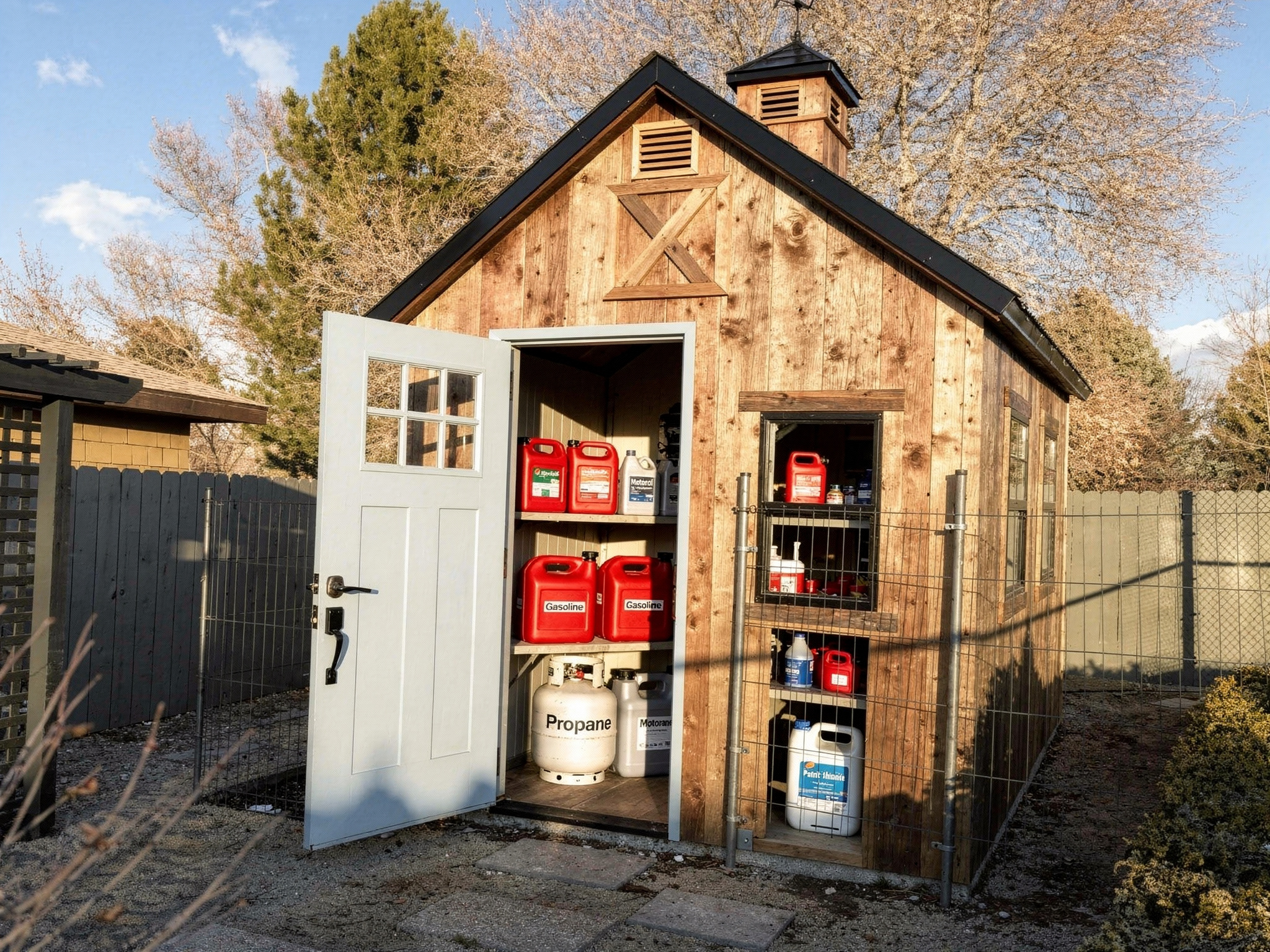
Gasoline in approved cans, motor oil, sealed garden chemicals, and oil-based paint can go in a ventilated shed. Propane cylinders, unlabeled containers, and anything that must stay above freezing should live somewhere else.
| Item | In a shed? | Conditions |
| Gasoline in approved cans | Yes, with limits | Small quantity, closed cans, low and high vents, no ignition sources nearby |
| Propane cylinders (20 lb and 1 lb) | No | Store outdoors, upright, shaded, away from doors and windows |
| Diesel and kerosene | Yes, with limits | Use the correct color-coded approved can and keep each fuel separate |
| Motor oil and 2-cycle oil | Yes | Sealed original containers on a shelf or in a tray |
| Latex paint | Seasonal | Move indoors before the first hard freeze |
| Oil-based paint, stain, solvents | Yes, with limits | Tight lids, cool spot, away from heat and sparks |
| Liquid pesticides and herbicides | Check the label | Many labels list a minimum storage temperature |
| Granular fertilizer | Yes | Dry, sealed, off the floor, away from fuel |
| Pool chlorine | Yes, kept apart | Away from fuel, oil, and acids |
| Lithium tool batteries | Store only | Charge them somewhere other than the fuel shed |
Read the table as a starting point. The product label is the first authority on storage temperature and airflow. Your local fire code is the final word on quantity. Where either one disagrees with general advice, follow the label and the code.
One pattern stands out in that table. The risky items are not always the obvious ones. Gasoline gets the attention, but a forgotten propane cylinder or a frozen gallon of latex paint causes more trouble for most homeowners. Nobody thinks to check on them.
Propane Tanks: Why Outdoors Is the Standard Advice
Store propane cylinders outdoors, upright, and outside any enclosed space, including a shed. Leaking propane is heavier than air, so it collects near the floor of a closed building.
This is not a fringe position. The North Carolina Department of Agriculture propane safety brochure puts a shed on its list of places a cylinder should never be stored. Basements and garages are on the same list. Propane suppliers and fire departments give the same advice.
The reasoning is simple once you picture the space. A storage shed is small and usually closed tight. A slow leak at a valve has nowhere to go, so the gas settles low and builds. Then someone flips a light switch, a freezer compressor kicks on, or a warm mower rolls in. Now an ignition source shares the same air.
Heat adds a second problem. A closed shed in a Utah or Nebraska summer gets much hotter than the air outside. As a cylinder warms, its internal pressure rises. The relief valve is designed to vent gas when pressure climbs too high. Inside a shed, that vented gas stays trapped.
Here is where a propane cylinder should go instead:
- Outdoors on a firm, level surface, standing upright with the valve on top.
- In a shaded spot, out of direct afternoon sun.
- Away from doors, windows, dryer vents, and air intakes, so a leak cannot drift indoors.
- With the valve fully closed and the protective cap on when not in use.
- Apart from the grill when it is a spare, not tucked beside it.
Small 1-pound camping cylinders follow the same rule. So do cylinders you think are empty. A cylinder that no longer runs the grill still holds propane vapor under pressure.
We do not build propane enclosures. We would rather say that plainly than sell you a shed for a job it should not do. For weather protection, ask your propane supplier about a ventilated outdoor cage or rack that meets local code.
Gasoline and Fuel Cans: Containers, Quantity, and Placement
You can store gasoline in a shed when it sits in approved, tightly closed fuel cans. Keep the smallest amount you actually use, and keep it well away from anything that sparks or heats up.
A set of gasoline handling tips published through Texas A&M recommends storing gasoline outside the home, in a garage or lawn shed. The container should be closed tight and approved by a testing laboratory or fire authority. The same tips rule out glass jars and throwaway plastic jugs. They also say to keep only as much fuel as your equipment needs.
Container color matters too. Approved cans follow a common color code: red for gasoline, blue for kerosene, and yellow for diesel. Keep each fuel in its own color. That way nobody pours kerosene into a mower or gasoline into a heater.
Use these placement rules for fuel cans inside a shed:
- Set cans on the floor in a spill tray, not on a high shelf where a dropped can can split open.
- Put fuel near the door and the low vent, so vapor has the shortest path out.
- Keep cans away from freezers, refrigerators, battery chargers, outlets, and space heaters.
- Close the cap and the can vent tightly whenever you are not pouring.
- Let mowers and trimmers cool, then refuel them outside the shed.
Fill portable cans the right way at the pump. Set the can on the ground before filling, never in a truck bed or trunk. A can sitting on a bedliner can build a static charge. A spark from that charge can ignite vapor at the nozzle.
How Much Gasoline Can You Store in a Shed?
There is no single national limit. The fire code your city or county adopted sets the amount a homeowner may store, and some codes also limit the size of each container.
Call your local fire marshal’s office before you stock up. Staff there can tell you the limit for a detached accessory structure on a residential lot. They can also tell you whether container size is restricted where you live.
Practical need usually sets a lower number than the code anyway. Untreated gasoline starts to break down within a few months. A summer of mowing rarely needs more than a can or two. Buy fuel for the season, add a fuel stabilizer if it will sit, and follow the engine maker’s off-season storage steps before winter.
Paint, Pesticides, and Fertilizer: Temperature Swings Change the Rules
Paint, pesticides, and fertilizer can stay in a shed for part of the year. An unheated shed in Utah, Idaho, Nebraska, or Iowa freezes in winter and overheats in summer. Many of these products are damaged by one or the other.
| Product | Winter risk | Summer risk | What to do |
| Latex paint | Freezing can ruin it | Partly used cans dry out | Bring it indoors before the first hard freeze |
| Oil-based paint and stain | Thickens in the cold | More vapor in the heat | Tight lids, low shelf, away from heat |
| Liquid pesticides and herbicides | Some separate or lose strength | Some break down in heat | Follow the storage temperature on the label |
| Granular fertilizer | Pulls in moisture and clumps | Bags can split | Seal in a lidded bin, keep off the floor |
| Pool chlorine | Low risk | Heat speeds breakdown and fumes | Store apart from fuel, oil, and acids |
| Gasoline | Low risk | Pressure builds in the can | Leave headspace and keep cans shaded |
The EPA guidance on household hazardous waste gives two rules that apply directly to shed storage. Keep products in their original containers with the labels on. Never move them into food or drink containers. A labeled jug tells the next person what it holds and how to store it. A relabeled soda bottle tells them nothing.
Separation matters as much as temperature. Many granular fertilizers and pool chlorine products are oxidizers. An oxidizer feeds a fire with extra oxygen. That is why it should never share a shelf with gasoline, oil, or solvents. Give fuels one zone and oxidizers another, ideally on opposite walls.
Can You Store Paint in an Unheated Shed?
Oil-based paint and stain can stay in an unheated shed through mild weather. Latex paint should come indoors before the first hard freeze, because freezing can ruin it.
This matters for your shed itself, not just house projects. We finish our sheds with Sherwin-Williams A-100 exterior latex paint, and keeping a touch-up can is smart. Repainting every 3 to 5 years is part of the required maintenance, so that leftover can has a real job ahead. Store it in the basement or a heated garage, not in the shed it was mixed for.
When paint or chemicals are past use, do not pour them on the ground or down a drain. Most counties run household hazardous waste drop-off days or permanent collection sites. Your local solid waste office can tell you where to take them.
Ventilation and Ignition Sources in a Shed
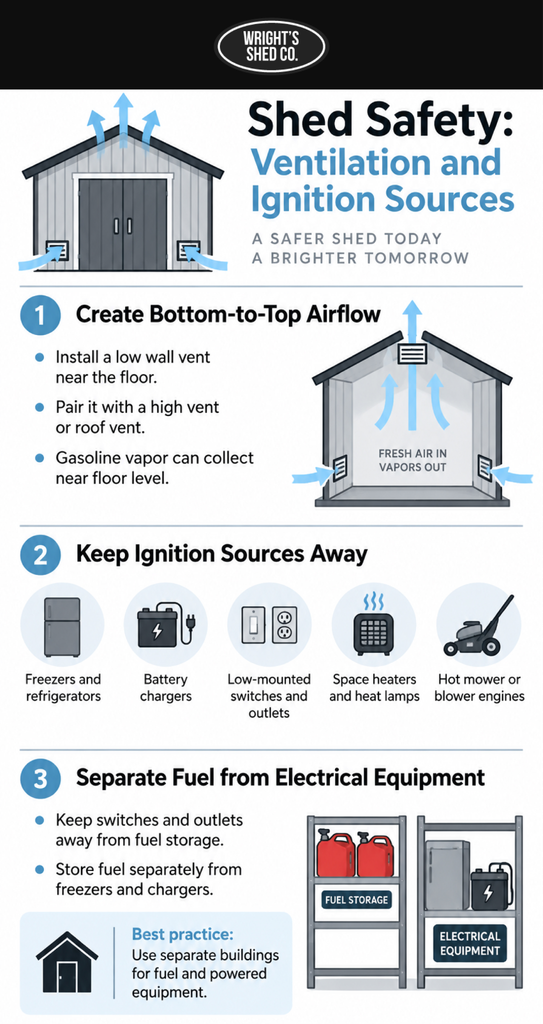
A shed that holds fuel needs a low vent near the floor, a high vent near the roof, and a spark-free zone around the fuel. Heavy vapor escapes low, and fresh air moves through high.
Gasoline vapor sinks and spreads across the floor. A single roof vent pulls warm air out of the top of the shed. It does little for vapor sitting at ankle height. A low wall vent near the fuel corner, paired with a roof vent or ridge vent, sets up a path from bottom to top.
Ignition sources in a shed are rarely open flames. They are ordinary items that cycle on and off:
- Chest freezers and old refrigerators, whose compressors start without warning.
- Battery chargers for drills, mowers, and e-bikes.
- Light switches and outlets mounted low on the wall.
- Space heaters and heat lamps.
- A mower or blower put away while the engine is still hot.
If your shed has power, keep switches and outlets high on the wall and on the far side from the fuel. A better plan is two buildings: fuel in one, and the freezer and chargers in the other.
Which Shed Vents Help Clear Fuel Vapors
The most useful setup for fuel storage pairs a low wall vent with a roof vent, turbine, or ridge vent. Every vent below is an add-on to the base shed price.
| Vent option | Utah price | Best use in a fuel shed |
| Wall vent | $20 | Low opening near the fuel corner |
| Decorative wall vent | $50 | Same airflow role with a finished look |
| Translucent vent | $70 | Airflow plus daylight, so the light switch stays off |
| Roof vent | $50 | High exhaust for warm air and vapor |
| Turbine | $90 | Wind-driven exhaust that pulls harder on breezy days |
| Ridge vent | $12 per linear foot | Continuous exhaust along the full peak |
These are the Utah prices listed on our shed extras and add-ons page. Nebraska and Iowa extras are priced separately, so confirm them in your quote. Vents add airflow, but they do not make a shed fire-rated. Their job is to shorten how long vapor lingers.
Distance From the House and Property Line
Keep fuel in a shed that stands apart from the house, and treat the exact distance as a local rule. Fire codes, zoning setback requirements, and HOA covenants set different numbers in different places.
A detached shed counts as an accessory structure. Most cities set a minimum distance from property lines and from the house. Many also set a building permit threshold based on floor area or height. Those figures vary by city and county across all four states we serve. We never tell a customer a size needs no permit in their town. Your local building department makes that call, usually in one short phone call.
Beyond the legal minimum, think about where a fire would travel. Keep a fuel shed away from windows, decks, wood fences, and the woodpile. Point the door toward the open yard, not toward the house. Leave a clear path so you can carry a can out without squeezing past a hot grill.
Site prep matters here too. A level gravel pad drains water away from the base and keeps the floor dry. Careful site leveling keeps the door square, so it latches tight. In freeze-thaw country, frost heave can shift a poorly prepared base over a few winters and pull the door out of line.
Because we build every shed on site, the crew can set the building exactly where your plan calls for it. Barbara H. left one of our five-star customer reviews. She was surprised the crew built her shed right in front of her. She noted they kept her involved, cleaned up after themselves, and were polite. That on-site approach lets placement fit the real yard instead of wherever a truck can drop a box.
Have questions about your own lot? Our Utah team in Kaysville serves Utah and Idaho. Our Nebraska team in Greenwood serves Nebraska and Iowa.
The Floor Is the Weak Point, Not the Walls
In a shed that holds fuel and chemicals, the floor takes damage first. Every drip and spill lands there, and a wood floor absorbs what it touches.
Our standard floor is 3/4-inch tongue-and-groove OSB over a pressure-treated wood or galvanized steel base. It is a solid storage floor, but it is still wood. Gasoline acts as a solvent. Oil soaks in and stays. Water-based spills can swell OSB edges. A soaked floor from a tipped can is not a material defect, so plan for spills instead of hoping they never happen.
Simple floor protection works well:
- A low-sided spill tray or containment mat under every fuel can and under the mower.
- A bag of absorbent, such as clay cat litter, kept on a shelf for quick cleanup.
- A sealed metal can for rags soaked in oil-based stain or linseed oil. Those rags can heat up and ignite on their own as they dry.
- Shelving for chemicals, so jugs stay off the floor and out of mower traffic.
Shelving is inexpensive to add. On our Utah extras pricing, a 16-inch shelf runs $5.50 per linear foot and a 24-inch shelf runs $6.00 per linear foot. Use the lower shelf for heavy liquids and the upper shelf for dry goods. Keep anything toxic above a child’s reach. The steel-framed, key-latched door that comes standard on every built style keeps the collection locked. We do not keep spare keys, so store yours somewhere you will find it.
For rolling equipment in and out, an aluminum ramp helps. In Utah, a 4’x3′ ramp is $250 and a 6’x3′ ramp is $275. A smooth ramp over the diamond-plate threshold means fewer bumped cans by the door.
Building a Dedicated Flammables Shed
A small, dedicated shed for fuel and chemicals makes sense when you keep more than a can or two. It separates vapor from the freezer, chargers, and workbench in your main shed.
Be honest about the size of the need first. If you own one gas can and a quart of stain, you do not need a second building. A ventilated corner of your existing shed, or a lockable outdoor storage cabinet, is the cheaper and right call. A dedicated shed earns its cost when you run a generator, keep several fuel cans, store pool chemicals, or have a workshop where sparks are normal.
Which Shed Style Works Best for Fuel and Chemical Storage
A 6×6 Vineyard, Orchard, or Lean-To is enough for most fuel sheds. The right pick depends on how you want to vent it and how much overhead room you want.
| Style | Utah starting price | Nebraska starting price | Fit for fuel storage |
| Vineyard | $2,117 (6×6) | $1,938 (6×6) | 7′ walls, simplest layout, room for cans and a mower |
| Orchard | $2,300 (6×6) | $2,127 (6×6) | 8′ walls and 6/12 pitch, more height for a high vent |
| Lean-To | $2,327 (6×6) | $1,809 (6×6) | 9′ front wall sloping to 7′ at the rear, tall wall for a high vent |
| Farm | $3,418 (8×8) | $2,723 (8×8) | Gambrel roof with more volume than most fuel sheds need |
| DIY Shed Kit | $1,809 (6×6) | $1,264 (6×6) | No shingles, no drip edge, no installation, no warranty |
Each figure is the starting price for the smallest published size of that style in that state. Base prices exclude extras such as vents, shelving, ramps, and upgraded doors. Roof pitch upgrades are a percentage, not a flat fee: 6/12 and 8/12 add 10% of the shed’s base cost, and 10/12 adds 15%. Two-tone paint adds 10% to the Vineyard and Orchard. On-site installation is included in the base price on every built style.
You can compare available sizes on the Vineyard shed pricing page and the Lean-To shed pricing page.
The kit deserves an honest word. Our DIY Shed Kit has the lowest starting price, but it comes with no shingles, no drip edge, no installation, and no warranty. For a fuel shed you want to keep dry for years, the missing shingles and drip edge are real gaps you would need to fill yourself.
On built styles, the specs that matter for a fuel shed are checkable. Walls use 2×4 framing on 16-inch centers with double top plates. Trusses are joined with steel plates, except on the Lean-To, which uses 2×6 wood trusses. Siding is LP SmartSide panel with 4-inch Miratec trim. The roof is 7/16-inch OSB sheathing under GAF Timberline architectural shingles, with drip edge around the full perimeter. A tight, dry shell keeps rain off the cans and off the floor.
| Style | Structural warranty | Door warranty |
| Vineyard | 5 years limited | 2 years limited |
| Orchard | 8 years limited | 2 years limited |
| Farm | 8 years limited | 2 years limited |
| Lean-To | 8 years limited | 2 years limited |
| DIY Shed Kit | None | None |
Our structural warranty runs 5 years on the Vineyard and 8 years on the Orchard, Farm, and Lean-To, with 2 years on doors. Coverage requires painting every paintable exterior surface within 30 days of installation, with proof of paint purchase and completion. Material defects must be reported within 30 days of installation. Claims must be filed within 30 days of an issue appearing, and coverage applies only to the original purchaser. Wind, natural disasters, over-watering, poor foundations, windows, and porches or decks are excluded. Required maintenance includes regular caulking, repainting every 3 to 5 years, and keeping irrigation off the walls. Full terms are on our shed warranty page.
What to Move Out of Your Shed This Winter
Before the first hard freeze, move latex paint, any liquid product with a minimum storage temperature on its label, and any propane cylinder that ended up inside.
- Latex paint, caulk, and wood glue go to a heated space.
- Liquid pesticides and herbicides go wherever the label says, often somewhere above freezing.
- Propane cylinders go outdoors, upright, in a shaded spot.
- Gasoline gets a stabilizer or gets used up in the last mowing of the season.
- Tool and mower batteries come inside, since cold shortens their life and charging belongs away from fuel.
- Expired or unknown products go to a household hazardous waste collection site.
Then check the shed itself. Look for a dry floor, clear vents, a door that latches, and caulk lines without gaps. That fall walk-through matches the maintenance the warranty asks for. It also keeps winter moisture off everything you leave inside.

Frequently Asked Questions About Storing Gas and Chemicals in a Shed
Can you store gasoline cans in a shed?
Yes. Gasoline can be stored in a detached shed in approved, tightly closed fuel cans, in small quantities, away from freezers, chargers, outlets, and heaters. We recommend a low wall vent and a high roof vent in any shed that holds fuel. Your local fire code sets the quantity limit.
Can you store a propane tank in a shed?
No. Safety agencies advise storing propane cylinders outdoors, upright, and outside enclosed spaces such as sheds, garages, and basements. Leaking propane is heavier than air and collects near the floor. The rule covers small camping cylinders and cylinders that seem empty.
How far should gas be stored from the house?
There is no universal distance. Fire codes, zoning setback requirements, and HOA rules set different figures by city and county. Store fuel in a detached shed, face its door toward an open yard, and ask your local fire marshal or building department for the distance that applies to your lot.
Can you store paint, fertilizer, and pesticides in an unheated shed?
Partly. Oil-based paint and granular fertilizer can stay in an unheated shed if they are sealed and dry. Latex paint should come indoors before the first hard freeze. Liquid pesticides should follow the storage temperature on the label. Keep fertilizer and pool chlorine away from fuel.
Do I need a fire-rated shed for fuel storage?
For typical homeowner quantities, a detached, ventilated shed is the usual approach. We do not publish a fire rating for our sheds, and adding vents does not create one. If you plan to store larger amounts, ask your fire marshal whether a rated cabinet or other measures are required where you live.
Can I keep a gas-powered mower in my shed?
Yes, once the engine has cooled. Park it over a drip tray, close the fuel valve if it has one, and keep it away from chargers and outlets. Before winter, follow the maker’s off-season storage steps for the fuel in the tank.
Can You Store Gas in a Shed Safely?
You can store gasoline in a detached shed only when local fire codes allow it and the container, quantity, and storage conditions meet applicable requirements. Keep propane cylinders outdoors, follow the storage instructions on paint and chemical labels, separate incompatible products, and keep fuels away from ignition sources. Ventilation alone does not make a shed fire-rated or guarantee that fuel storage is safe. Before storing gasoline or other flammable materials, check with your local fire marshal and review the relevant product instructions.
Planning a shed for tools, lawn equipment, or approved fuel storage? Wright’s Shed Co. can help you compare shed styles, sizes, and available features for your property. Review the applicable requirements before choosing a layout, and use the shed quote page to discuss your project and request pricing. A suitable design starts with your storage needs, local code requirements, and a clear plan for keeping incompatible materials separate.