
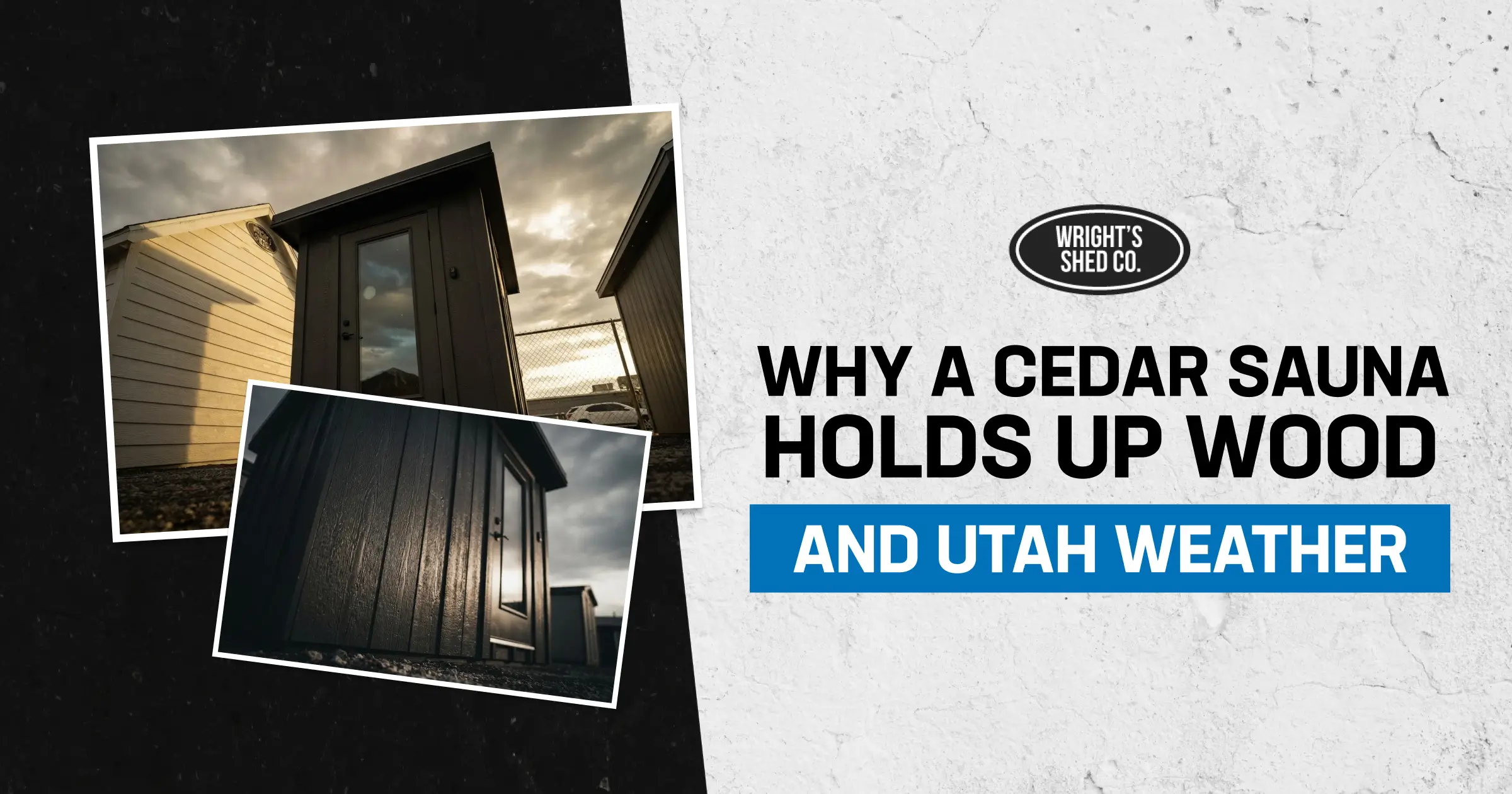
The wood inside your custom backyard sauna matters because western red cedar has low thermal conductivity, very small shrinkage, and heartwood that is naturally resistant to decay. Those properties make cedar well suited to the heat, moisture, and repeated temperature changes of a sauna. The actual surface temperature of a bench still depends on the sauna temperature, moisture, and how long the wood has been heated.
We build every Wright’s Shed Co. sauna with cedar inside and standing-seam metal outside, and we picked that pairing for reasons that show up the first time you sit down and the twentieth year you still own it.
A few things about cedar are worth knowing before you compare it to anything else on the market:
- Cedar’s low thermal conductivity lets bare skin rest on a bench at 180 degrees without discomfort.
- Heartwood decay resistance comes from natural oils in the wood, not a chemical treatment applied afterward.
- Cedar shrinks and swells less than pine or spruce through repeated heat and cold cycles, so tongue-and-groove joints stay tight.
- We face the sauna in cedar and shield it with standing-seam metal on the sides and roof, a detail most sauna builders skip.
- The cedar scent is strongest the first few weeks and settles into a light background note within months.
What Makes a Cedar Sauna the Right Choice
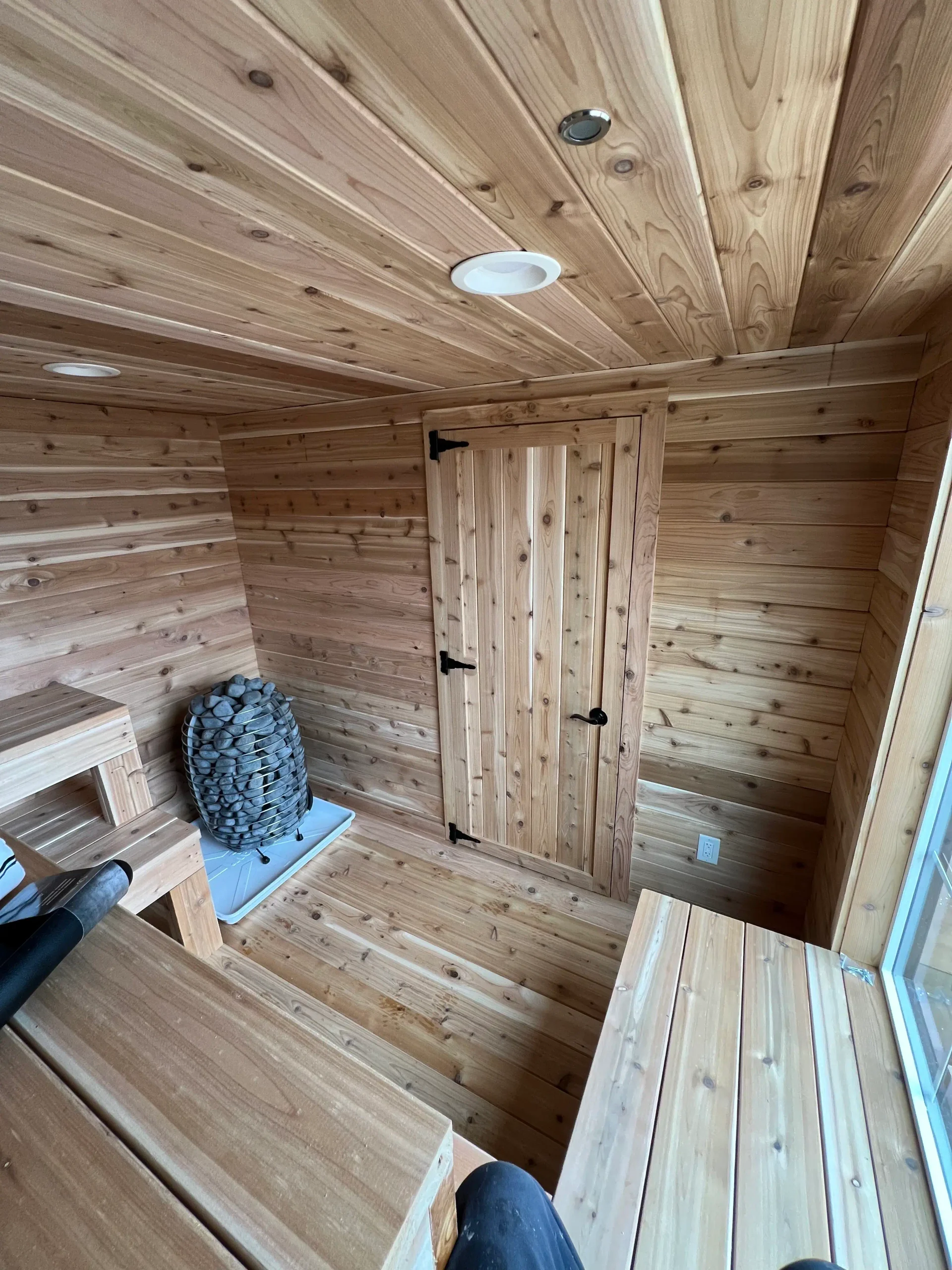
A cedar sauna is a strong choice because western red cedar has low thermal conductivity, natural decay resistance in the heartwood, and very small shrinkage. These properties make cedar comfortable for sauna benches, resistant to decay, and relatively stable as it responds to changes in moisture and temperature. Thermally modified spruce and aspen are also legitimate sauna woods, but cedar remains a proven choice for sauna interiors.
The USDA Forest Service Wood Handbook, Chapter 4, covers the physical properties that matter in a sauna environment, including thermal conductivity, shrinkage, dimensional stability, and how wood responds to changes in moisture. Those properties help explain why cedar is well suited to a room that repeatedly moves between hot, humid sessions and cooler, drier periods.
- Heat behavior: low thermal conductivity keeps the surface touchable.
- Decay resistance: natural extractives in the heartwood resist rot without added chemicals.
- Dimensional stability: minimal shrinkage keeps tongue-and-groove joints tight through heat cycling.
- Weight and workability: light enough to mill into tight-fitting boards without sagging over a span.
These are not marketing adjectives. Each one is a measurable property of the wood, and each one shows up in a specific way once the sauna is installed and in regular use. Heat behavior determines whether the room is comfortable within the first minute. Decay resistance determines whether the walls still look and perform the same in ten years. Dimensional stability determines whether the joints stay tight through hundreds of heat cycles a year.
If you want to understand how those material choices fit into the larger structure, you can read more about how a custom sauna is built from the frame up.
Cedar Does Not Get Too Hot to Sit On
Cedar is well suited to sauna benches because wood has relatively low thermal conductivity, which means it does not transfer heat as quickly as materials with higher thermal conductivity. USDA Forest Products Laboratory data show that cedar has low thermal conductivity compared with many common materials. In a hot sauna, that property helps cedar feel more comfortable to the touch, although the actual surface temperature still depends on the bench, room temperature, moisture, and how long the wood has been heated.
Low thermal conductivity means the wood surface stays closer to room temperature than wood that transfers heat quickly, even when the surrounding sauna air has reached much higher temperatures. You feel warmth radiating off the wood rather than heat conducting straight into your skin. That is the difference between a bench you can sit on and one you need a towel to touch.
This is also why the upper bench in a two-tier layout runs noticeably hotter than the lower one. Heat stratifies in a sauna, so the air near the ceiling is always warmer than the air near the floor, regardless of the wood used. Cedar does not change that physics. What it changes is how the wood itself feels once you are sitting in that hotter air, which is the part a builder actually controls.
Cedar Resists Rot Without Chemicals
Cedar resists rot without chemicals because the heartwood contains natural extractives that make it inhospitable to the fungi that cause decay. This matters more inside a sauna than almost anywhere else in a home, since the wood cycles between hot, humid air and cool, dry air multiple times a week.
The resistance applies to the heartwood, the older wood at the center of the tree. Sapwood, the lighter band nearer the bark, is not decay-resistant and is narrower on a cedar log than on many other species. That distinction is documented in the USDA Forest Service western redcedar factsheet, which is why we specify heartwood-grade cedar rather than mixed-grade lumber for a sauna interior. Cedar is naturally decay-resistant at the heartwood. It is not rot-proof, and no wood is.
Cedar Moves Less Than Other Softwoods
Western red cedar has very small shrinkage, which helps limit dimensional changes as the wood dries and takes on moisture. That stability is useful in a sauna where the interior experiences repeated changes in heat and humidity, and it can help tongue-and-groove joints maintain a consistent fit over time. USDA Forest Products Laboratory data specifically rate western redcedar’s shrinkage as small.
Very small shrinkage means the tongue-and-groove joints on the wall and ceiling stay tight through that swing instead of opening gaps or cupping at the edges. On the Wasatch Front, where outdoor temperature swings add another layer of cycling on top of the sauna’s own heat, that stability is not a cosmetic detail. It is the reason the walls still look and fit the same after years of use.
Cedar vs. Hemlock, Spruce, and Pine
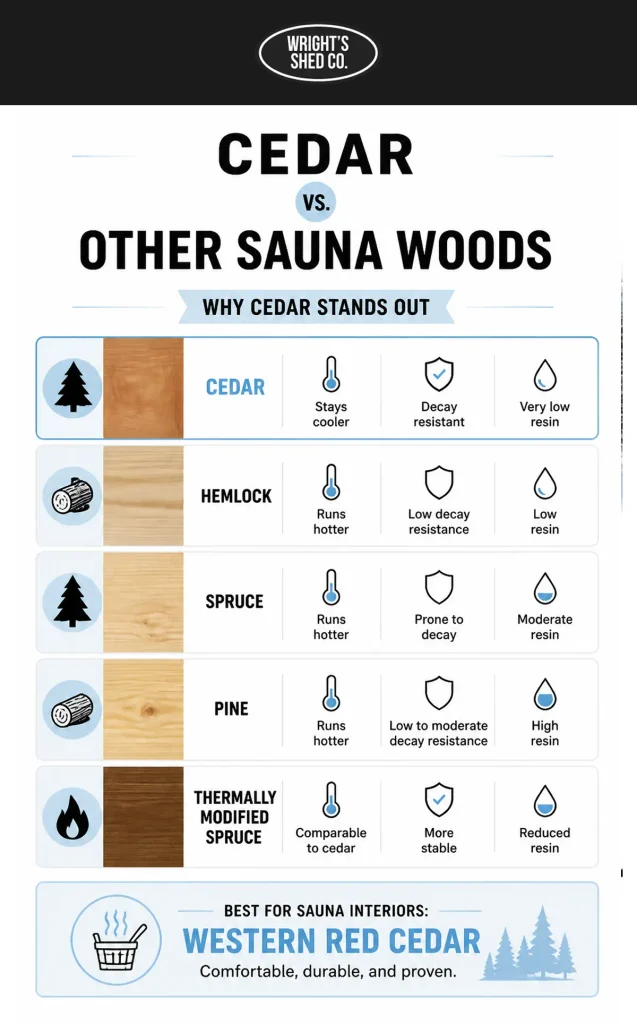
Cedar is the wood Wright’s chose for its sauna interiors, and the comparison below explains the practical properties behind that choice. The table is not a list of species Wright’s offers. Hemlock, spruce, pine, and thermally modified spruce are included only to show how commonly discussed sauna woods differ in heat behavior, decay resistance, and resin characteristics.
| Wood | Heat Behavior | Decay Resistance | Resin Risk | Typical Use |
| Western red cedar | Stays cool to the touch | Resistant in the heartwood | Very low | Sauna interior standard |
| Hemlock | Runs hotter to the touch | Low, needs added treatment | Low | Budget sauna kits |
| Spruce (untreated) | Runs hotter to the touch | Low, prone to decay | Moderate | General framing, not sauna interiors |
| Pine | Runs hotter to the touch | Low to moderate | High, sap can bead under heat | Furniture, not sauna benches |
| Thermally modified spruce | Comparable to cedar | Improved by the modification process | Reduced by processing | Modern sauna alternative |
Thermally modified spruce is a legitimate alternative some builders use, since the heat treatment reduces resin and improves stability. We build in cedar because it delivers the same result without an added manufacturing step, and it has a multi-decade track record in sauna construction that thermally modified wood does not yet have.
The comparison matters most for the wood you actually touch. A sauna bench in pine or untreated spruce can sting bare skin at operating temperature, which is why kit manufacturers who use those species often recommend a towel on every bench. Cedar’s slower heat transfer is the reason we skip that recommendation entirely.
Resin is the other quiet problem with pine specifically. Heat draws sap out of pine boards, and that sap can bead on the surface, stain clothing, and leave a sticky residue on skin. Cedar’s resin content is low enough that this is not a concern, and it is one more reason pine shows up in furniture rather than sauna interiors.
Why the Outside Is Not All Cedar
The outside is not all cedar because we use it where you see and touch it and shield it everywhere else. Every Wright’s Shed Co. sauna gets a cedar facing on the front, where it sets the look of the build, with standing-seam metal covering the sides and the roof.
That pairing is the same design logic behind the siding choices on our storage sheds: put the material that looks and feels right where a person interacts with it, and put the material that shields best where weather actually hits hardest. The metal takes the brunt of sun, snow, and rain on the sides and roof, so the cedar facing is not carrying the full weather load on its own. You can see that material combination in the builds we have delivered, where the cedar facing and metal exterior work together as part of the overall structure.
This combination is a design choice rather than just a visual detail. Cedar provides the appearance and material experience Wright’s wants on the front, while standing-seam metal covers the sides and roof. That gives the exterior a mix of cedar and metal rather than relying on one material for every exposed surface.
What Cedar Smells Like, and How That Changes
Cedar smells strongest in the first few weeks after your sauna is built, when the wood is releasing the most volatile oils. That scent settles into a lighter, warmer background note over the following months as the surface oils work their way out. Heat and steam will bring the scent back up during a session, though never as strong as it was on day one.
In a small number of people, prolonged exposure to cedar dust or the wood itself can trigger bronchial irritation or contact dermatitis. That note comes directly from the USDA Forest Products Laboratory, and it is worth knowing rather than glossing over. If you have a known sensitivity to cedar, talk to your doctor before ordering a cedar sauna.
Metal cladding also changes the maintenance conversation. A cedar sauna finished entirely in wood needs the whole exterior watched for weathering. Ours limits that job to the cedar facing on the front, since the metal on the sides and roof sheds water and holds its finish with far less attention. If you have looked at our shed color and siding options, the same logic applies to a sauna: put the low-maintenance material where the weather actually lands.
How Cedar Ages Inside a Sauna
Cedar ages inside a sauna by shifting from a light, fresh tone to a deeper amber patina over years of heat and steam exposure. We leave the interior unsealed on purpose, since a sealant would trap moisture against the wood instead of letting it breathe with the heat cycle.
- Color shifts from pale gold to a warm amber patina over repeated sessions.
- The surface develops a soft, worn texture rather than staying glassy smooth.
- Unsealed cedar releases moisture between sessions instead of trapping it under a finish.
- You should not varnish or paint a sauna interior. A film finish defeats the reason cedar was chosen in the first place.
That aging process is different from what cedar does on the outside of a structure, where sun and moisture drive a faster shift toward silver-gray. Inside a sauna, heat and steam are doing the work instead of weather, which is why the same species can look noticeably different on a shed exterior. If you want to see how cedar behaves as an outdoor material on its own, our page on designing a shed built for Utah weather covers that separately.

Frequently Asked Questions About Cedar Saunas
Is cedar the best wood for a sauna?
Western red cedar is the wood most custom sauna builders reach for first, and for good reason. It resists decay without chemical treatment, moves very little as it heats and cools, and stays comfortable to sit on at sauna temperatures. Thermally modified spruce and aspen are legitimate alternatives some builders use, but cedar remains the benchmark for heat behavior and stability. If you are comparing the entire sauna format rather than just the wood, our barrel sauna vs. custom-built sauna comparison lays out the trade-offs between the two approaches.
Does a cedar sauna need to be sealed or treated?
Inside the sauna, the cedar is intended to remain unsealed so the interior can retain its natural wood surface. For the exterior cedar facing, the appropriate finish and maintenance should be confirmed with Wright’s during the quote because the current published information does not establish whether the sauna cedar is sealed, finished, or left natural. Do not apply the shed’s exterior finishing requirements to the sauna unless Wright’s confirms that the same practice is used.
Will the cedar smell fade?
Yes. Cedar smells strongest in the first few weeks after your sauna is built, then settles into a lighter background scent over the following months. Heat and steam bring the scent back up during a session, though never as strong as it was on day one.
Can cedar cause a reaction?
In a small number of people, cedar dust or prolonged exposure can trigger bronchial irritation or contact dermatitis, according to the USDA Forest Products Laboratory. This is uncommon and typically tied to woodworking exposure rather than sitting in a finished sauna, but if you have a known sensitivity to cedar, talk to your doctor before ordering.
How long does cedar last outdoors in Utah?
The cedar facing on a Wright’s Shed Co. sauna is protected by standing-seam metal on the sides and roof, so it is not carrying the full weather load on its own. Paired with heartwood’s natural decay resistance, that combination is built to hold up through repeated freeze-thaw cycles along the Wasatch Front. Exact lifespan still depends on sun exposure, upkeep, and site conditions, and structural coverage is spelled out on our warranty page.
Choosing a Cedar Sauna That Lasts
Choosing a cedar sauna that lasts comes down to the wood doing its job for as long as you own the building. Cedar resists rot at the heartwood, stays cool enough to sit on, and holds its shape through the exact heat cycling that ruins lesser softwoods. Paired with a standing-seam metal exterior, it is the combination we have built every Wright’s Shed Co. sauna on since we started offering the product.
None of that shows up as a line item on a spec sheet the first time you look at a sauna. It shows up two years in, when the joints still fit, and the bench still feels the same, or it shows up as a problem on a build where the builder chose a cheaper species and did not tell you why. Ask any sauna builder what wood they use and why, and use the answer to judge how seriously they take the rest of the build.
We have been framing structures for Wasatch Front weather since 1997, and that experience shapes every material decision on a sauna the same way it shapes a shed.
If cedar is the right fit for your sauna, the next step is to choose the size and layout that work for your backyard. Request a quote for a cedar sauna built around your space and intended use. You can also browse the gallery to see completed builds before deciding on your design.