
If you’re comparing custom backyard saunas with a barrel sauna, the biggest differences are heat-up time, usable space, maintenance, winter performance, and long-term durability. The format you choose affects how the sauna fits your yard, how it is maintained, and how much usable space you get. The comparison below breaks down where each option makes the most sense.
A barrel sauna heats faster and costs less upfront. A custom-built sauna gives you more headroom, a longer structural life, and a room sized to your family instead of pulled from a factory mold. A flat-pack kit sits in the middle on both price and durability. The right pick depends on your budget, how permanent you want the build to be, and how many people need to fit inside.
A few differences decide most of that choice before you ever compare price tags:
- A barrel’s curved wall cuts dead air, so it can reach sauna temperature in 20 to 30 minutes. A framed room usually takes closer to 45 minutes to an hour.
- Steel tension bands on a barrel sauna need periodic tightening as the staves shrink and swell with the seasons. A framed structure does not carry this maintenance step.
- A flat ceiling on a custom build makes room for a two-tier bench. A barrel’s curved roofline usually limits seating to one tier.
- Freeze-thaw cycling on the Wasatch Front is harder on a single-wall barrel than on a framed wall built for the site.
- None of the three formats include the heater or the electrical hookup. That work goes to a licensed electrician regardless of which structure you pick.
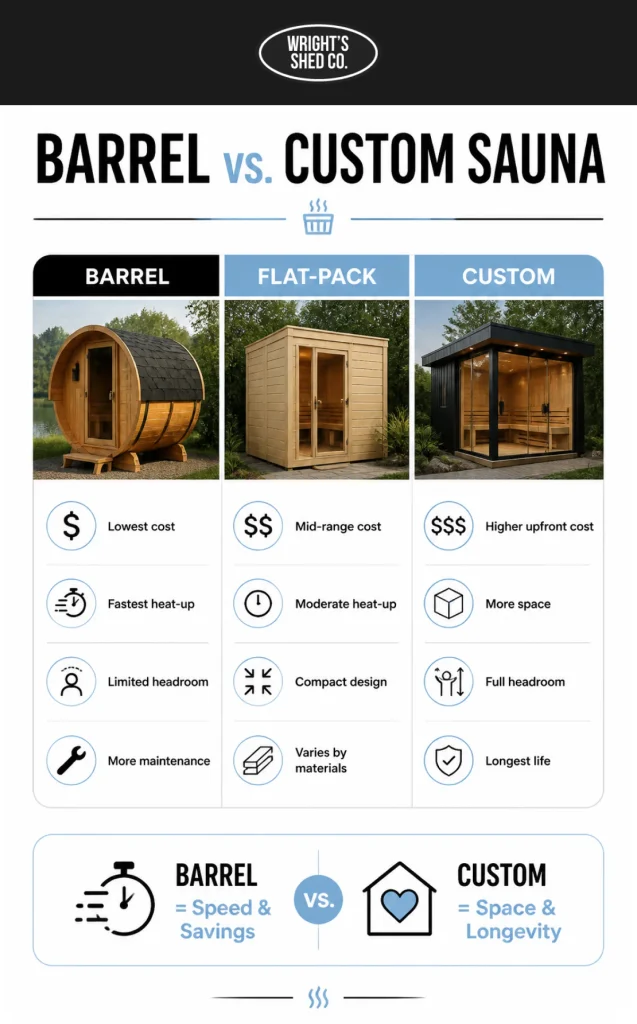
A custom-built sauna outlasts a barrel sauna and gives you more usable space. A barrel sauna wins on upfront cost and heat-up speed. A flat-pack kit lands in between on both counts. Here is how the three formats stack up.
| Factor | Barrel Sauna | Flat-Pack Kit | Custom-Built |
| Upfront cost | Lowest of the three formats | Mid-range, varies by kit and finish | Highest upfront, reflects custom sizing and construction |
| Heat-up time | Fastest, curved wall cuts dead air | Moderate, depends on insulation level | Slower, larger volume takes longer to warm |
| Insulation | Typically single-wall | Varies by kit, single or double wall | Framed wall assembly built for the site |
| Headroom | Limited by the curved ceiling | Flat ceiling, standard headroom | Flat ceiling, full standing height |
| Footprint | Narrow but deep | Compact rectangle | Sized to the yard and the build |
| Maintenance | Tension bands need periodic tightening | Panel seams need occasional attention | Standard exterior upkeep |
| Expected life | Shorter, tied to stave and band condition | Mid-range, depends on materials | Longest, framed to the same standard as a shed |
The table covers format-level differences. Your actual price, timeline, and size depend on your yard, so treat these as starting points, not a quote.
What a Barrel Sauna Actually Is
A barrel sauna is a cylindrical room built from wood staves held together by steel tension bands, curved to cut down the volume of air the heater has to warm.
The curve is the whole idea. A square room has dead air pooling in the corners. A barrel does not have corners. Most barrel saunas ship pre-built or in large sections, arrive on a trailer, and get set on a simple base. The steel bands run around the circumference and get tightened as the wood settles into place.
Barrel saunas typically use single-wall construction. That keeps the design light enough to ship and simple enough to assemble in a day, but it also means the wall between you and the outside air is one board thick.
What a Flat-Pack Sauna Kit Is
A flat-pack sauna kit is a panelized room shipped in pieces, usually from overseas, that you or a crew assemble on site over a weekend.
Kits sit between a barrel and a custom build on almost every measure. The walls are pre-cut panels that bolt or screw together, the roof arrives as a unit, and the insulation level depends entirely on which kit you buy. Some kits are single-wall like a barrel. Others carry a proper insulated cavity. Read the spec sheet before comparing price, because two kits at the same price point can be built very differently.
What “Custom-Built” Means Here
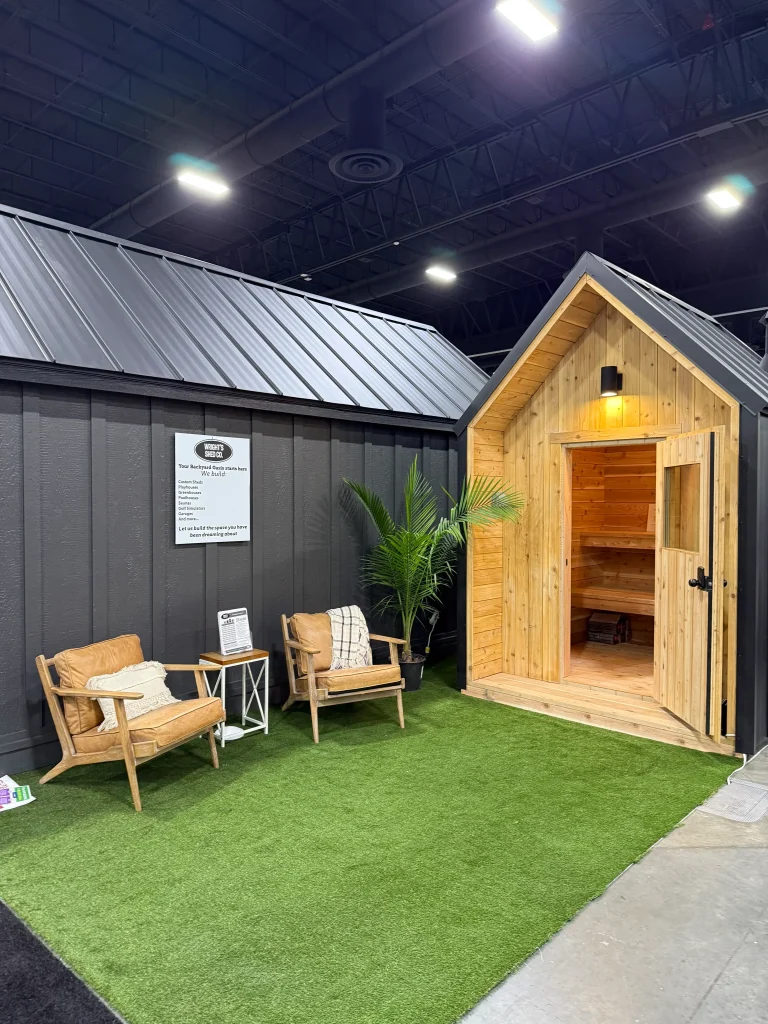
A custom-built sauna is framed, sided, and roofed to the dimensions of your yard rather than pulled from a fixed catalog size. We build our saunas by hand in Kaysville using the same construction standard we have applied to our sheds since 1997, with cedar inside and standing-seam metal outside. The same custom-versus-pre-built logic applies here: the sauna is sized to the space and use instead of forcing your yard into a fixed format.
Head-to-Head On Cost, Heat-Up, Comfort, and Lifespan
Format decides the tradeoffs. Here is how barrel, kit, and custom-built saunas compare on the four questions that actually change a buying decision.
Upfront cost
Barrel saunas cost the least to buy. Flat-pack kits land in the middle. Custom-built saunas cost the most upfront because the frame, siding, and roof are all built on site rather than shipped as a pre-made unit.
| Format | Typical Market Position (2026) |
| Barrel sauna | Lower end of the market |
| Flat-pack kit | Mid-range |
| Custom-built sauna | Higher end, reflects on-site framing and finish |
These are general market positions as of 2026, not our price list. Sauna pricing depends on size, site conditions, and finish level. For a real number, see our backyard sauna cost breakdown.
How fast each one heats
A barrel sauna heats fastest, often reaching temperature in 20 to 30 minutes, because the curved wall removes dead air the heater would otherwise have to warm.
A flat-pack kit heats at a rate that depends on its insulation, somewhere between a barrel and a framed room. A custom-built sauna takes longer to heat, typically 45 minutes to an hour, because the room holds more air and a flat ceiling does not concentrate heat the way a curve does. Once it is warm, an insulated framed room tends to hold that heat longer between sessions.
Headroom and bench layout
A custom-built sauna gives a taller person full standing headroom and room for a two-tier bench. A barrel’s curved ceiling does not.
Heat stratifies in any sauna, so the upper bench always runs hotter than the lower one. A flat ceiling gives the height to stack benches and let people choose their heat level. A barrel’s curve works against a second tier, so most barrel saunas seat everyone at roughly the same height, which flattens the temperature choice along with the room.
How long each lasts
A custom-built sauna, framed and sided the way a shed is, is built for the longest structural life of the three formats, generally cited at 25-plus years when the building is built right and properly used. That same durability question is what our page on why a cedar sauna holds up walks through in more depth. A barrel sauna’s lifespan depends heavily on how well the tension bands are maintained.
The heater is a separate question from the structure in every format. A well-chosen heater, run and maintained correctly, typically lasts somewhere in the 10- to 15-year range regardless of which building it sits inside. The staves in a barrel sauna move with temperature and humidity, and the steel bands need to be checked and re-tightened periodically, or the joints between staves start to gap. A framed wall with tongue-and-groove cedar inside does not carry that same recurring task.
How Each One Handles a Utah Winter
A framed, custom-built sauna handles a Wasatch Front winter better than a single-wall barrel, mainly because of how each one deals with freeze-thaw cycling and roof load.
- Freeze-thaw cycling. Utah winters swing above and below freezing repeatedly, and a single-wall barrel expands and contracts with every swing. A framed wall assembly moves less.
- Snow load. Utah design ground snow loads vary by location, so the applicable load should be considered when designing a structure for a specific site. West Jordan’s design criteria direct projects to use the ASCE Hazard Tool for ground snow loads and Chapter 7 of ASCE 7-22 for roof snow loads.
- Wood durability. The USDA Forest Service rates western red cedar heartwood as very resistant to decay. That supports cedar as a durable material for an outdoor sauna, but it does not by itself establish that one sauna format handles winter movement better than another.
- Door seal. A door that is out of square from seasonal movement lets heat and cold air trade places. A framed opening holds its shape better over time than a curved stave wall does.
None of this means a barrel sauna cannot survive a Utah winter. It means the maintenance list is longer and the margin for a loose band or a shifted stave is smaller. Our guide to using an outdoor sauna in winter covers heat-up times and snow load in more depth.
Footprint And What Actually Fits in a Normal Backyard
A barrel sauna is narrow but deep, a flat-pack kit is a compact rectangle, and a custom-built sauna is sized to whatever shape your yard actually offers.
| Format | Typical Footprint | Fits Well In |
| Barrel sauna (2 to 3 people) | Narrow and deep, often 6 to 8 feet long | Narrow side yards |
| Flat-pack kit | Compact rectangle, similar to a small shed | Corner lots |
| Custom-built (Wright’s sizes) | 6×6, 7×8, or 8×12 | Yards where you choose the exact spot |
A narrow side yard often fits a barrel better than a square footprint would suggest, because a barrel’s width is fixed by its diameter and most of its length is where people are lying down, not standing. A custom build has no fixed shape to work around. Our sizing guide walks through the three sizes we build most: 6×6, 7×8, and 8×12.
Cost Per Year of Use Tells a Different Story Than Sticker Price
A cheaper sauna is not automatically the cheaper choice once you divide the price by how many years it lasts.
A barrel sauna typically costs less upfront than a custom-built sauna, but a lower purchase price does not automatically mean a lower cost over time. If a barrel needs its bands re-tightened every season and eventually needs new staves, while a framed build is still standing decades later, the framed build can end up costing less per year of actual use. The same math applies to a flat-pack kit, where lifespan depends heavily on the specific product and how well it was assembled.
This is not an argument that the cheaper option is always wrong. Some buyers genuinely need the lower number today more than they need the lower number spread over two decades, and that is a legitimate reason to buy a barrel. It is only worth doing the division before deciding, rather than comparing sticker prices as if they described the same thing.
When a Barrel Sauna Is the Right Call
A barrel sauna is the right call when budget, speed, or flexibility matters more than long-term structural life.
That is a real answer, not a hedge. Buyers who are renting, who expect to move within a few years, who want the fastest possible heat-up time, or who want a sauna in the yard this month rather than after a build schedule all have good reasons to buy a barrel. A barrel sauna is also simply cheaper to get into, and for some buyers that is the whole decision.
Choose a barrel sauna if:
- You are renting or expect to move in the next few years
- Budget matters more than a structure meant to hold up 25-plus years
- You want the fastest heat-up time available
- You want it installed in weeks, not a build season
Choose a custom-built sauna if:
- You own the property and plan to stay
- You want two-tier seating or room for more than two or three people
- You want a structure framed for your specific site and snow load
- You are comparing total cost per year of use, not just the sticker price
What the Comparison Table Does Not Show You
The spec sheet does not capture how a sauna actually gets used, and that changes which format is worth the money.
A room you can stand up and stretch out in gets used differently than one you have to duck into. Cedar scent fades and returns with heat the same way in any format, but a framed room with more air volume tends to hold a longer, quieter session. None of that shows up in a comparison table, and none of it is a reason to buy the cheaper option if what you actually want is a room the whole family uses on a Tuesday, not just the one person who ordered it.
Frequently Asked Questions About Sauna Types
Are barrel saunas any good?
Yes, for what they are built to do. A barrel sauna heats fast, costs less upfront, and works well for a buyer who wants speed and a lower price over structural longevity. The trade-offs are a curved ceiling that limits seating and a maintenance routine built around the tension bands.
Do barrel saunas leak?
They can, and the real failure mode is seasonal wood movement rather than a manufacturing defect. As the staves shrink and swell and the steel bands loosen over time, gaps can open between boards and let water in. Regular band tightening is the fix, and it is a recurring task rather than a one-time setup step.
Is a barrel or cabin sauna better for a small yard?
It depends on the shape of the yard, not just the square footage. A barrel is narrow but runs long, which can fit a tight side yard well. A rectangular cabin or custom-built room is easier to tuck into a corner or against a fence line. Measure the actual space before assuming one format automatically fits better.
Can you insulate a barrel sauna?
Most barrel saunas ship as single-wall construction, which is part of what keeps them light and fast to heat. Some manufacturers offer a double-wall or insulated option, so check the spec sheet rather than assuming. A single-wall barrel loses heat faster in cold weather than an insulated, framed room, which is one reason heat-up time and cost to run are connected.
Which holds its value better?
There is not enough reliable appraisal data to say that one sauna format will consistently hold more resale value than another. A custom-built sauna may make more sense for a homeowner planning to stay in the property, while a barrel sauna can make more sense for someone who expects to move. Buy based on how you will use the sauna rather than assuming either format will deliver a particular return when you sell.
Barrel Sauna vs. Custom-Built Sauna: Making the Call
There is no single right answer between a barrel sauna and a custom-built sauna. There is a right answer for your yard, your budget, and how long you plan to own the place.
If you want it fast and inexpensive and you are not staying put, a barrel sauna does the job. If you want a room built for your family, framed for your address, and meant to hold up 25-plus years, a custom-built sauna is the better bet. We build the custom-built option, framed the same way we have framed sheds since 1997: cedar inside and metal outside, sized to your yard instead of a catalog.
Get a free quote and tell us about your yard. It takes just a few minutes, and we will walk you through sizing, siting, and what the build actually involves before you decide anything.