
Most homeowners never calculate the true long-term cost of owning a shed over 10 years, including the initial price, maintenance, and ongoing value. They compare a sticker price at the store, or a quote from one builder against another, and stop there. That single number is a poor stand-in for the real long-term shed investment cost of owning a shed for a decade.
Comparing upfront prices alone is misleading, because a shed is not a one-time purchase. It is a ten-year relationship with maintenance, weather, and whatever you decide to store in it. Below, we run the full ten-year math on three scenarios: a custom-built shed from us, a big-box or delivered prefab shed, and a rented self-storage unit, using our real published Utah and Nebraska pricing wherever a real figure exists and clearly labeled market ranges everywhere else.
A few things stand out once you run a full decade of numbers side by side:
- On-site installation is included in the base price on every built style we sell. Many delivered-shed and big-box quotes bill that step separately once you ask.
- A shed you never repaint is a shed whose warranty you may have voided. The 30-day painting requirement, with proof of paint purchase and completion, is the most overlooked line item in shed ownership.
- A storage unit has no salvage value in year ten. A shed, maintained on schedule, is still standing on your property and still holding your gear.
- Roof pitch upgrades price as a percentage of the base cost, not a flat fee, so the same 8/12 pitch costs more on a bigger shed. Small early decisions compound over ten years.
- The DIY shed kit’s lower price does not include shingles, drip edge, or installation. You have to add those back in before comparing it honestly to a built shed.
Year 1 Financial Breakdown
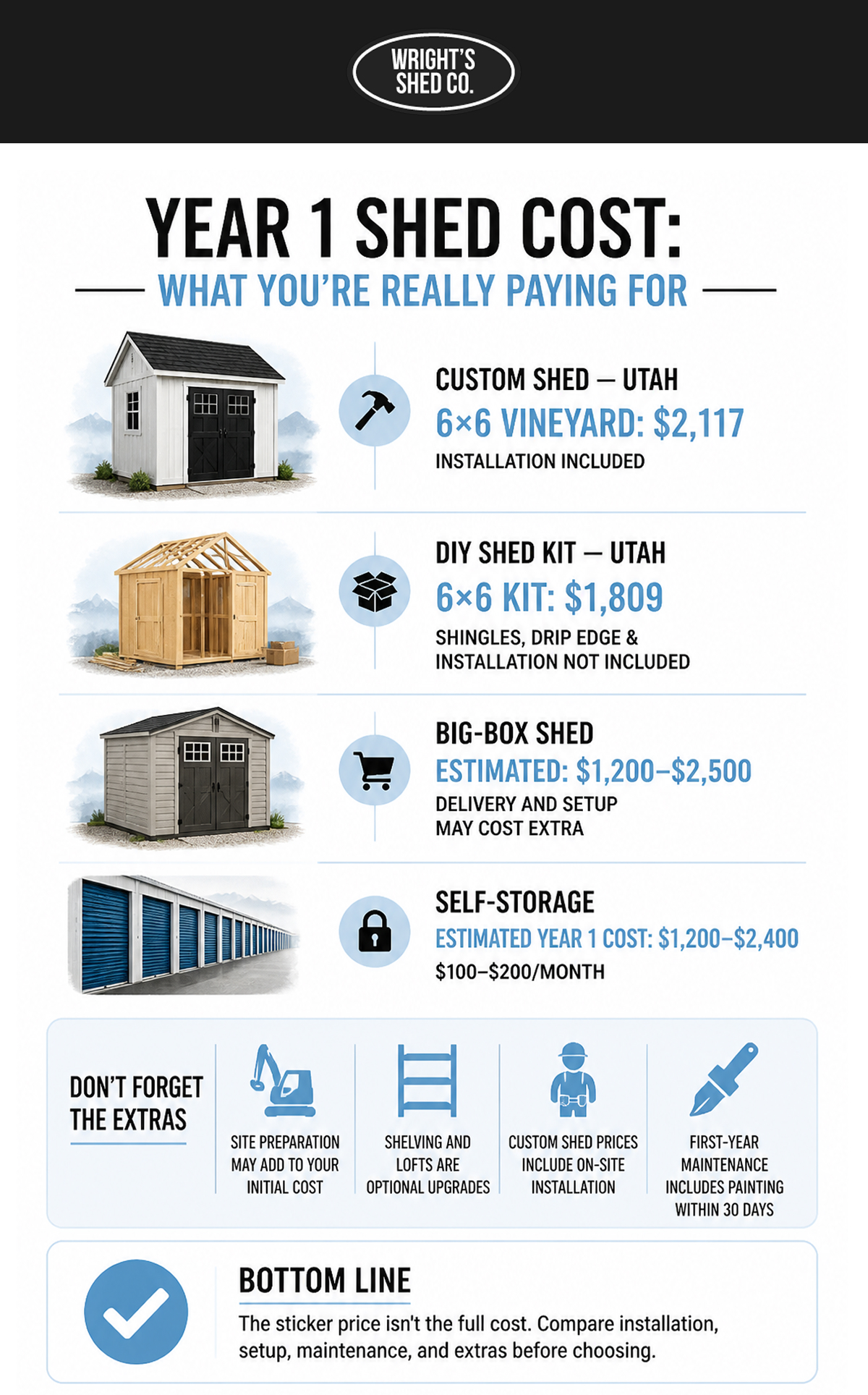
In year one, your total cost is the published base price plus whatever extras you choose, because on-site installation is already built into that number for every style we build. For more detail on the installation process and expected timeline, see our How Long Does It Take to Build a Custom Shed guide.
Initial Purchase and Setup. We publish a starting price for every style, broken out by size and by state. A 6×6 Vineyard starts at $2,117 in Utah and $1,938 in Nebraska. A 6×6 Orchard, our most popular style, starts at $2,300 in Utah and $2,127 in Nebraska. An 8×8 Farm starts at $3,418 in Utah and $2,723 in Nebraska. Every one of those figures already includes on-site installation.
Site preparation is a real year-one cost for any shed, ours or a competitor’s. A leveled base or gravel pad, and in some cities a building permit, are common requirements once a structure crosses a certain size threshold. Those thresholds vary by city and county, so check with your local building department before you order. The International Code Council publishes general guidance on how most municipal codes treat accessory structures, though your local office has the final word for your address.
If you want shelving or a loft from day one, those are priced separately on our extras and add-on pricing page: a 16-inch shelf runs $5.50 per linear foot, a 24-inch shelf runs $6.00 per linear foot, and a loft runs $8.00 per square foot. Those are real add-on prices, not estimates, so you can price your own accessory plan exactly.
First Year Maintenance. The first real maintenance item on a custom shed is paint. Every shed we build must be painted within 30 days of installation, with proof of paint purchase and completion, or the structural warranty is not valid. All paintable exterior surfaces must be painted, not just the visible sides. Beyond that, weather protection is already built in: drip edge runs the full roof perimeter and tar paper is standard on every shed we build, so there is nothing extra to buy there in year one. Minor hinge or latch adjustments after the first season are typical of any outbuilding and are not a sign of a problem.
Comparison Point: Year 1 Alternatives. A big-box shed’s year one number usually looks smaller on the shelf tag, but delivery and setup are frequently a separate line item once a crew shows up to assemble it, often several hundred dollars depending on the retailer. A self-storage unit has no purchase price at all, only a monthly rate, which commonly runs $100 to $200 for a small unit depending on the market, climate control, and access hours. A do-it-yourself build has its own year one math: our own DIY Shed Kit starts at $1,809 for a 6×6 in Utah and $1,264 in Nebraska, but it does not include shingles, drip edge, or installation, and it carries no warranty, so a fair comparison has to add those three items back in before the price means anything.
Long-Term Shed Investment Cost: The Year 1 Numbers
Here is what year one looks like across four options, using our published Utah pricing for the built and DIY sheds and typical national ranges for the alternatives. Monthly cost is the simple division of the year one total by 12, so you can compare options that are structured very differently.
| Option | Year 1 Total | Approx. Cost/Month |
| Custom Vineyard shed, Utah (6×6) | $2,117* | $176 |
| DIY Shed Kit, Utah (6×6) | $1,809* (excludes shingles, drip edge, install) | $151 |
| Big-box prefab shed, comparable size | 1,200-2,500** | 100-208 |
| Self-storage unit, comparable size (12 months) | 1,200-2,400** | 100-200 |
*Published price, verified for the size and state shown. **General market ranges for comparison purposes only; actual rates vary by region and provider.
Year 5 Analysis
By year five, a maintained custom shed has needed only routine upkeep, while a cheap shed is often being replaced and a storage unit has cost thousands with nothing left to show for it.
Accumulated Maintenance, Years 2 Through 5. The maintenance our warranty page asks for is straightforward: caulk the building regularly, repaint every 3 to 5 years, hammer in any loose nails, and keep irrigation and lawn equipment away from the exterior. A 6- to 12-inch barrier between lawn and building is also part of the required upkeep. Paint supplies for a repaint typically run in the range of a couple hundred dollars depending on shed size and paint choice, and many owners set aside a small annual reserve for unexpected repairs the same way they would for any outbuilding. None of this is expensive on its own, but skipping it is what turns a small issue into a warranty dispute.
The Storage Unit Tally. Renting a comparable storage unit for five years, at a typical monthly rate with the annual increases of roughly 3 to 5 percent that many facilities apply, commonly totals several thousand dollars. Add climate control, which many facilities price at a premium over standard units, and access fees at some locations, and the five-year total climbs further. All of it is spent. None of it is recoverable, and there is no unit left standing in your name at the end.
The Big-Box Shed Reality. Many lower-cost prefab and big-box sheds are built to a shorter service life, often cited in the 3 to 5 year range for lower-grade materials, before siding, roofing, or framing problems force a replacement. Maintenance needs tend to escalate as the materials age faster than they would on a shed built with steel-plate truss connections and tongue-and-groove flooring. A second purchase in year four or five erases whatever the lower sticker price saved back in year one.
Custom Shed vs Storage Unit Cost Over 5 Years
| Option | 5-Year Cumulative Cost | Condition at Year 5 |
| Custom Vineyard shed, Utah (6×6) | $2,117 base* + routine paint and upkeep | Standing, under warranty if maintained and painted on schedule |
| Storage unit, comparable size | roughly 6,300-12,600** | Nothing retained; rent continues |
| Big-box shed, comparable size | original cost plus a likely replacement** | Often replaced once by year 4-5 |
*Published price. **Illustrative market estimates based on typical monthly rates and commonly cited service life; not our data.
Year 10 Comparison
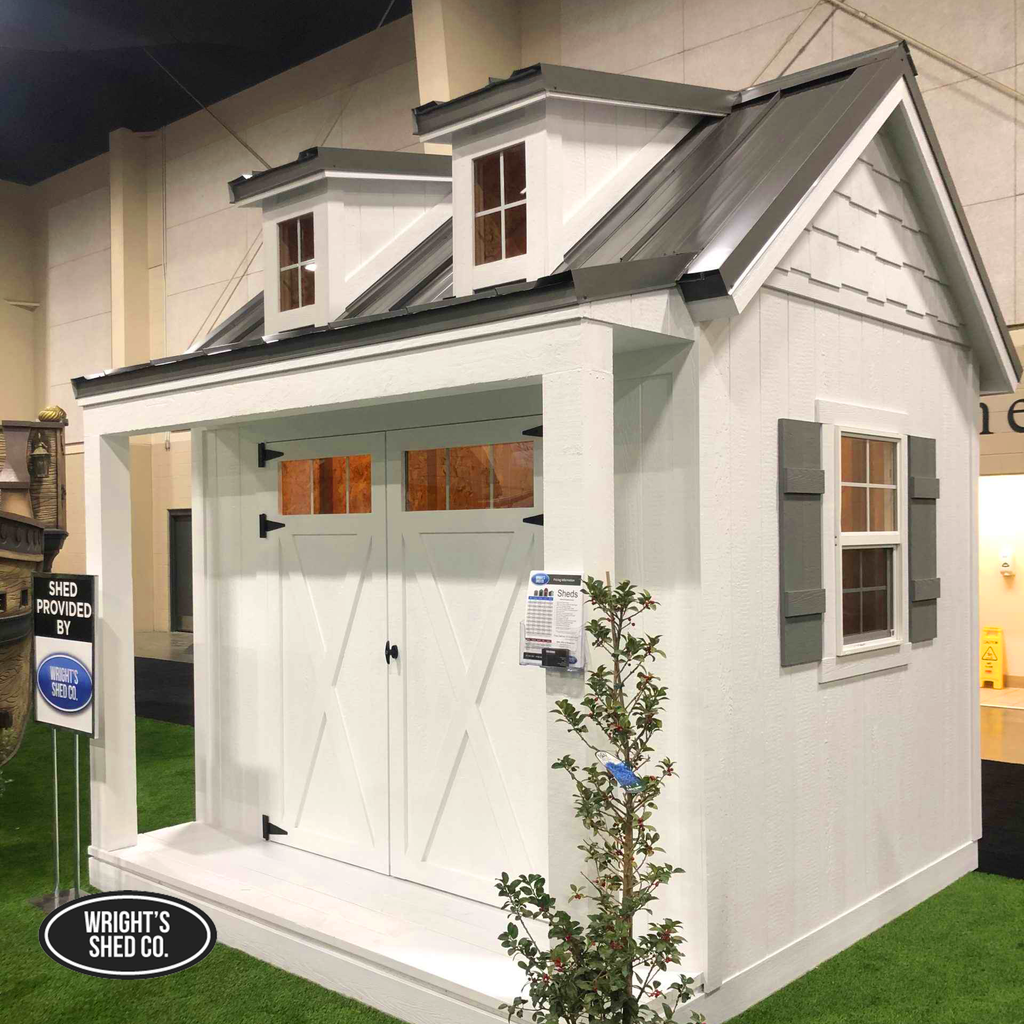
At year ten, a well-maintained custom shed typically has required only routine repainting and small repairs, while the alternatives have usually required at least one full replacement or a decade of rent with nothing retained.
Long-term maintenance between years six and ten mirrors years two through five: repainting on a 3- to 5-year cycle, a periodic roof check, and keeping the exterior clear of irrigation and lawn equipment contact. The materials underneath are built for that timeline. GAF Timberline architectural shingles carry a GAF limited lifetime factory warranty on the shingles themselves, and LP SmartSide panel siding carries an LP 5-year full, 50-year prorated limited factory warranty on the substrate through LP Building Solutions. Those are manufacturer warranties on specific components, not a whole-building lifetime warranty from us. Our own structural coverage runs 5 years on the Vineyard and 8 years on the Orchard, Farm, and Lean-To, in both cases limited to the original purchaser and conditional on the 30-day painting requirement. For a complete explanation of what’s covered and what can affect coverage, see our Custom Shed Warranty Guide.
The Resale Value Component. A shed in good condition, still meeting warranty conditions and properly painted, is generally viewed as a maintained asset rather than a liability when a home goes on the market. There is no published, universal figure for how much value a shed adds to a sale, since local markets and buyer preferences differ. Ask a local real estate professional for numbers specific to your area rather than relying on a national average. Our
For a sense of how finished, well-kept sheds actually look after a few seasons, our project gallery shows real installations rather than renderings.
The Full 10-Year Picture. Your total ten-year investment in a custom shed is the published base price, plus any extras you chose in year one, plus the light, predictable maintenance described above. Your effective return is the difference between that total and whatever the shed is still worth to you or to a buyer at the end, whether that value is measured in avoided rent, continued use, or resale interest. A storage unit’s ten-year total is pure rent with no asset at the end. A big-box shed’s ten-year total depends heavily on how many times it needed replacing.
| Option | 10-Year Investment | Asset at Year 10 |
| Custom Vineyard shed, Utah (6×6) | $2,117 base* + ongoing paint and upkeep | Standing structure, still usable, potential resale interest |
| Storage unit, comparable size | roughly 12,000-24,000** | None; rent stops when payments stop |
| Big-box shed, comparable size | original cost plus one or two replacements** | Aging structure, often past its original service life |
*Published base price; excludes extras, permits, and site prep, which vary by project. **Illustrative market estimates, not our data; request a quote for your exact configuration.
Real Numbers: What Ownership Looks Like by Situation
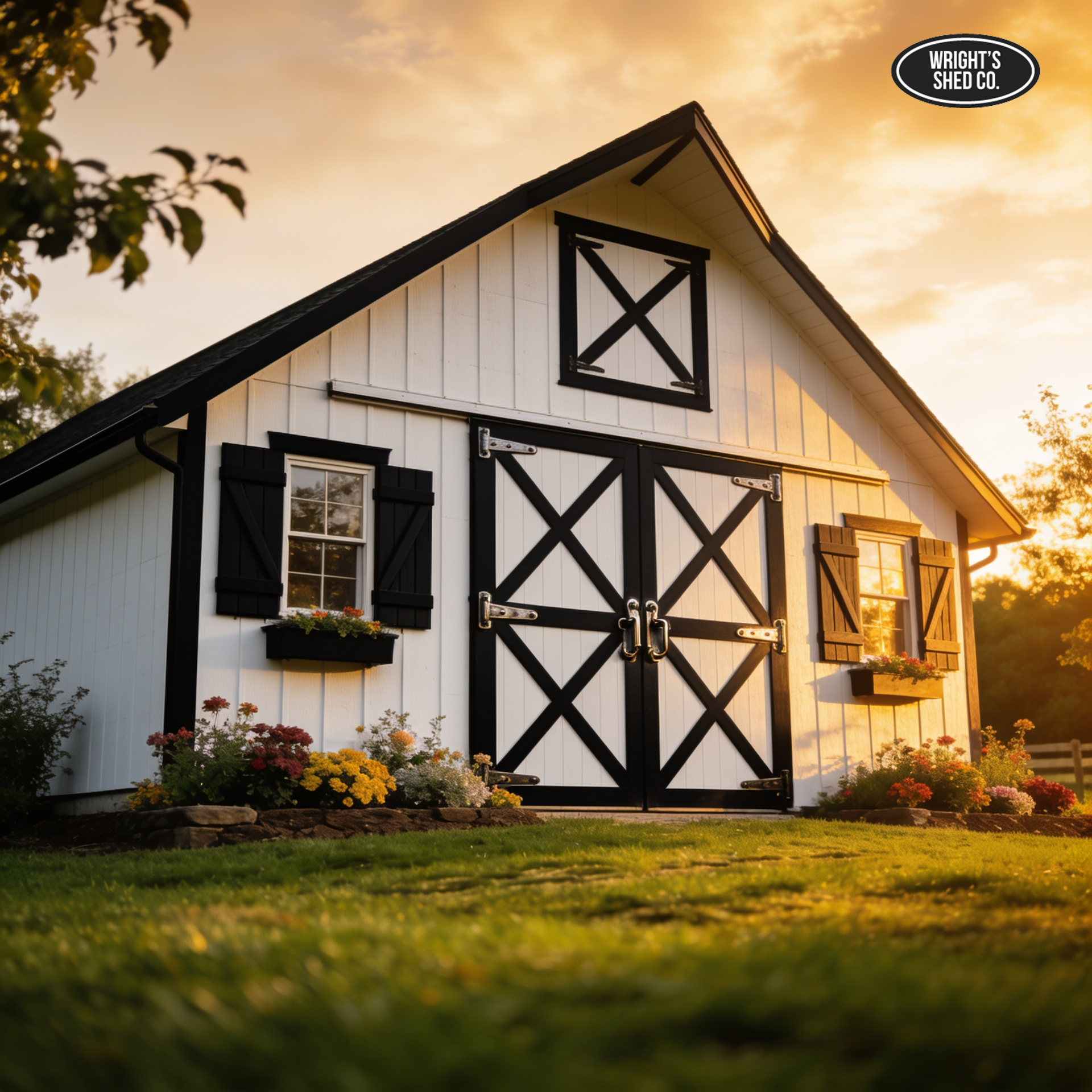
The three profiles below are illustrative, built entirely from our real published pricing and published maintenance and warranty terms. They are not individual customer accounts, since we only publish figures and outcomes we can stand behind.
Profile 1: The Practical Homeowner (Utah)
A homeowner near Salt Lake City, served from our Kaysville, Utah warehouse, orders a 6×6 Vineyard shed for general yard storage at the published price of $2,117, installation included. The structure carries a 5-year limited structural warranty and a 2-year limited door warranty, both conditional on painting within 30 days with proof kept on file, and both limited to the original purchaser. Ongoing costs over the following years are limited to periodic repainting, caulking, and keeping sprinklers from hitting the siding, the same maintenance list that applies to every style we build. Space is typically used for yard tools, seasonal items, and overflow from a garage.
Profile 2: The Farm and Ag User (Nebraska)
An agricultural buyer near our Greenwood, Nebraska warehouse orders an 8×8 Farm shed for equipment storage at the published price of $2,723, installation included, with an 8-year limited structural warranty and a 2-year limited door warranty under the same painting and original-purchaser conditions. The Farm’s gambrel roof is built for maximum overhead volume, which matters most when the storage needs are bulky feed, tools, or seasonal equipment rather than boxes. Daily-use agricultural storage puts more wear on a structure than occasional weekend use, which is one reason the upgraded specification- steel-plate truss connections, double top plates, and 3/4-inch tongue-and-groove flooring- matters more here than it does on a shed that mostly holds a lawnmower.
Profile 3: The Property Investor
An owner of a small rental property in Nebraska adds a 6×6 Orchard shed at the published price of $2,127, installation included, with an 8-year limited structural warranty under the same conditions as any other buyer. For an investor, the calculation is less about personal storage and more about tenant appeal and property upkeep: a clean, on-brand outbuilding is generally viewed as a maintained feature rather than a liability, though the exact effect on rent or resale is market-specific and not something we publish a figure for. Investors considering a garage instead of a shed should note that detached garages are currently a Nebraska and Iowa product only; Utah and Idaho buyers would need to compare shed styles instead.
Across all three situations, real customer feedback tells a consistent story. Reviewer Barbara H. says she was surprised to watch the crew build her shed on site, and that they kept her involved and cleaned up afterward. Reviewer Dan S. describes fair, competitive pricing, exceptional quality, and delivery that arrived exactly on time. You can read these and other verified customer reviews in full before you decide.
Hidden Costs Most People Miss
The costs buyers miss most often are not on any price tag at all: property tax exposure, insurance coverage, and the cost of not having enough storage in the first place.
Often-Forgotten Expenses. Whether an outbuilding raises your property tax assessment depends on your local jurisdiction’s rules, so check with your county assessor before you assume either way. Ask your insurance agent whether a detached accessory structure is already covered under your homeowner’s policy or needs its own rider. If you have an HOA, check your covenants, since some restrict size, placement, or color. And if you plan to heat or cool the space, factor in seasonal utility usage, which is not part of any published shed price.
The Opportunity Cost Angle. There is a real cost to not owning enough storage. A garage full of shed-destined items is a garage your car does not fit in, which means more weather exposure and wear on the vehicle. Every month spent renting a storage unit instead of owning a shed is a month of the same money that could have gone toward an asset you keep, and every hour spent hunting for space in a cluttered garage is a cost too, even if it never shows up on a receipt.
Cheap storage costs more over time for a simple reason: it is specified to a lower standard. Our building includes double top plates on all walls, trusses joined with steel plates, 2×4 wall framing on 16-inch centers, and 3/4-inch tongue-and-groove OSB flooring as standard, not as an upgrade. You can learn more about how these components affect durability and long-term performance in our Custom Shed Materials Guide. Lower-grade materials are more exposed to humidity and temperature swings, which can damage sensitive stored items and shorten the shed’s own service life. There is also a stress and hassle cost to a structure that needs constant patching, one that is real even though it is hard to put a number on. If a lower price on the DIY shed kit is tempting you, remember it does not include shingles, drip edge, or installation, and it carries no warranty. That can still be the right call for a handy buyer on a tight budget, but it is a different product, not a cheaper version of the same one.
The Break-Even Point Analysis
There is no single break-even year that applies to every buyer, but you can find yours with three numbers: your shed’s published price, your local storage rate, and how long you plan to use the space.
For example, a 6×6 Vineyard in Utah at $2,117 breaks even against a storage unit renting for $150 a month in about 14 months, since $150 multiplied by 14 months is roughly $2,100. At a local rate of $100 a month, that same shed breaks even in about 21 months. Both are simple examples meant to show the method, not a universal timeline. Run your own local rate against your own shed’s size and state price for your real number.
Big-box sheds are harder to run this math against directly, since their all-in cost depends on how many times they get replaced. A shed that needs replacing twice in ten years never truly breaks even against one purchase, no matter how low the original sticker price was.
A few additional factors change your personal break-even math:
- Frequency of access: if you need items constantly, a shed on your own property has a convenience value a storage unit across town does not.
- Item sensitivity: climate-controlled storage costs more to rent and more to build, which shifts the break-even point in both directions.
- Future plans: a ten-year horizon favors ownership more heavily than a two-year horizon does, since the fixed cost of the shed is spread over more years of use.
Interactive Cost Calculator: A Worksheet for Your Own Numbers
We do not publish a single national number because your real long-term shed investment cost depends on your size, your state, and your options. Use the worksheet below to build your own estimate, then confirm the exact figure through our quote page, which takes just a few minutes and returns a published price for your exact configuration.
How to Use the Worksheet. Fill in five fields: your shed size, your state (Utah and Nebraska have separate published price tables), how you plan to use the space, and your expected ownership timeline. Those four inputs are all the published pricing and maintenance data above need to produce a personal estimate.
| Field | Your Answer |
| Shed style and size | |
| State (Utah or Nebraska) | |
| Primary use (general storage, workshop, seasonal/overhead, agricultural, chicken keeping) | |
| Planned ownership timeline (years) | |
| Local monthly storage-unit rate for comparison |
What the Worksheet Reveals. Once those fields are filled in, you can build your own version of every table in this article: a year one total, a five-year cumulative comparison, and a ten-year projection, using your published base price plus the same maintenance pattern described above. You can also run the break-even formula from the previous section with your own numbers to see when ownership overtakes renting.
Interpreting Your Numbers. A good outcome is not necessarily the lowest year one number. It is the option whose ten-year total, including maintenance and any retained value, is lowest for how you actually plan to use the space. If your timeline is short, a storage unit or the DIY kit may genuinely be the better call. If your timeline is a decade or more, a custom shed usually wins on the same math. Either answer is a legitimate outcome of running your own worksheet.
Frequently Asked Questions About Long-Term Shed Investment Cost
Is a custom shed cheaper than a storage unit over time?
In most cases, yes, once you look past year one. A storage unit is pure rent with no asset at the end, while a custom shed is a one-time purchase with modest ongoing maintenance. The exact break-even point depends on your local storage rate and your shed’s published price, so run the math on your own numbers using the worksheet above.
Does a big-box shed really cost more in the long run?
It often does, mainly because lower-grade materials commonly need replacing sooner. A shed that gets replaced once or twice over ten years usually ends up costing more in total than one built with steel-plate truss connections, tongue-and-groove flooring, and installation included from the start.
What voids our warranty?
The most common cause is skipping the painting requirement. Every building must be painted within 30 days of installation, with proof of paint purchase and completion, or the structural warranty is not valid. Coverage is also limited to the original purchaser and does not transfer, and it excludes windows, decks, porches, posts, railing, broken handles and keys, and damage from wind, natural disaster, over-watering, or a poor foundation.
Do sheds add resale value to a home?
A well-maintained shed is generally viewed as a kept asset rather than a liability when a home sells, but there is no published, universal figure for how much value a shed adds to a sale, since local markets and buyer preferences differ. For a closer look at the factors that can influence a shed’s contribution to a property’s appeal and value, see Does a Custom Shed Add Home Value?.
How much should I budget for shed maintenance each year?
Routine upkeep is light: caulking as needed, keeping irrigation and lawn equipment away from the exterior, hammering in loose nails, and repainting every 3 to 5 years. The one hard deadline is the first paint job, due within 30 days of installation with proof kept on file.
Is the DIY shed kit a good long-term investment?
It can be, for the right buyer. The DIY Shed Kit starts lower than any built style, but it does not include shingles, drip edge, or installation, and it carries no warranty. That makes it a genuinely different product built for a handy owner on a tight budget, not a discounted version of a built shed.
The Long-Term Shed Investment Cost Comes Down to Ownership, Not Just Price
When you look at the total cost over time, a well-built shed generally works out to be a more cost-effective long-term storage solution than years of storage-unit rent or repeated purchases of lower-cost sheds. With on-site installation included, predictable maintenance, and a structure you continue to own, the initial purchase is better viewed as a long-term investment. If the upfront cost is a concern, financing options are available through HFS Financial. If you move, a well-maintained shed can remain a useful feature of the property and may contribute to its appeal. And if you’re considering upgrades such as a loft, shelving, or additional windows, compare the added cost with the extra storage and functionality they provide over the years.
Ultimately, the best choice depends on your budget, storage needs, and how long you plan to use the space. If you’re ready to see what a custom shed would cost for your situation, Design Your Shed to get a published price based on your size, state, and options, with on-site installation included.