
A shed looks heavy until strong winds test how securely it’s anchored to the ground. If you are figuring out how to anchor a shed to the ground, you are asking the right question early. A shed is a tall, light box with large flat walls, and wind treats it like a sail. Gravity alone is a weak anchor, especially when the shed is half empty.
To anchor a shed, tie its base to the ground with a method that matches the base underneath. Use auger anchors with straps on a gravel pad or soil, anchor bolts on a concrete slab, and piers with embedded tie-downs where the shed rests on blocks.
Four details change how you anchor, and most guides skip them:
- Wall height changes the load. An 8-foot wall on our Orchard shed, which starts at $2,300 for a 6×6 in Utah and $2,127 for a 6×6 in Nebraska, gives wind more area to push than the 7-foot wall on our Vineyard.
- Winter can undo summer’s work. Frost heave can lift shallow anchors, so depth matters as much as the anchor type.
- A permit exemption is not a code exemption. Where small sheds skip the permit, the building code can still apply.
- Our warranty excludes wind damage and poor foundation. The anchors you choose protect your own investment.
Do You Need to Anchor a Shed?
Yes, you should anchor every shed, even a small one, because wind can slide, lift, or tip an unanchored building, and some local codes require tie-down. Weight does not solve the problem. A shed on pressure-treated skids stays put through friction and its own mass, and both are modest when the shed holds little. A half-empty shed in a hard wind is the situation that gets people in trouble.
Anchors also cost little next to the shed and the tools inside it. Most hardware stores sell kits. A shed that stays square and level also protects your investment. If you are weighing a shed against a rented unit, our shed versus self-storage cost comparison walks through the numbers.
One honest caveat: anchoring helps, but it does not make a shed wind-proof. No anchor can promise that, and we do not publish a wind rating for our buildings. The goal is to keep the shed on its base through ordinary storms.
What Wind and Uplift Do to An Unanchored Shed
Wind pushes a shed sideways, lifts its roof edges, and can roll the whole building off its base. Each force acts differently, so each needs its own answer.
Sliding comes first. Wind hits a wall and shoves the building across its base. A shed on skids and gravel resists only through friction, and friction drops once the shed starts to move.
Uplift is the second force. Wind flowing over a roof pulls up on it, much like air over an airplane wing. Wind pushing under an eave overhang lifts from below. The base must be held down, and the frame must be joined together above it.
Overturning is the third. A tall shed with a narrow footprint can tip, because wind pressure acts high on the wall while the weight acts low.
Shed shape changes all three. A 7-foot wall on our Vineyard presents less area than the 8-foot walls on our Orchard and Farm sheds. Roof shape counts too. A gambrel roof puts volume high, and an eave overhang gives wind a lip to catch. On the styles that take one, the 6-inch overhang is an option on our extras pricing page. It looks good, and it adds a surface for uplift. Taller and larger sheds deserve more care in anchoring, not less.
Site matters as well. Open yards, fence corners that funnel wind, and spots near canyon mouths see harder gusts than sheltered lots. Buyers in Utah and Idaho along the Wasatch Front, and in Nebraska and Iowa on open ground, should plan for that.
Anchor Options: Augers, Straps, Anchor Bolts, Piers
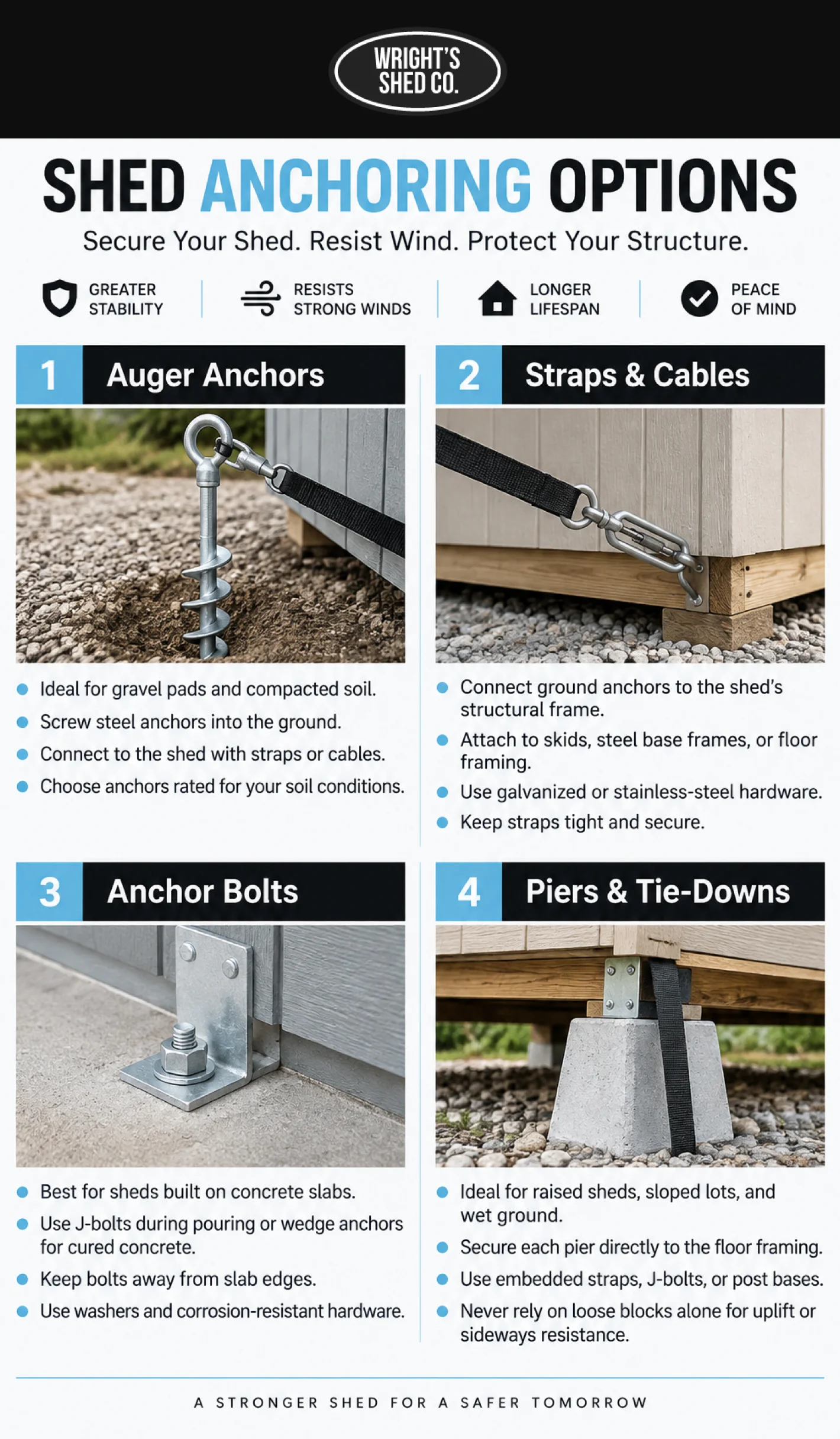
Four methods cover nearly every shed: auger anchors, straps and cables, anchor bolts, and piers with tie-downs. They work as a team more than as rivals. The anchor holds in the ground, and a strap or bolt connects it to your shed.
Auger Anchors for a Shed on Gravel or Soil
Auger anchors are steel shafts with a helical plate that screws into the soil, and they suit sheds on gravel pads or compacted ground. You turn each anchor in with a bar or drill, then connect a strap or cable. The plate grips the soil as the anchor is pulled up. Holding power depends on the soil. Loose, sandy, or saturated ground holds less than firm clay. Choose a kit rated for your soil and follow the manufacturer’s length and spacing. Start with one anchor at each corner, then add more along long walls if the directions call for it.
Straps and Cables That Tie the Shed Down
Straps and cables are the link between the anchor and the building, and they matter as much as the anchor itself. Attach them to a structural member, such as a skid, a steel base frame, or a framed floor. Do not attach them to siding or trim. LP SmartSide siding and 4-inch Miratec trim finish the building, but neither is a tie-down point. Use galvanized or stainless hardware so it does not rust through. A strap loose enough to rattle is not doing a job.
Anchor Bolts Into a Concrete Slab
Anchor bolts hold a shed to a concrete slab by passing through the bottom plate into cured concrete. You can set J-bolts into wet concrete when the slab is poured. On an existing slab, drill and install wedge or sleeve anchors instead. Keep each anchor away from the slab edge, because concrete near an edge can crack out under load. Use washers and galvanized hardware. Pressure-treated lumber corrodes bare steel, so plain bolts are a poor match.
Piers and Tie-Downs for Raised Sheds
Piers lift a shed off the ground, and each pier needs a real connection to the frame. A block that simply sits under a corner carries weight but resists nothing sideways or upward. Embed a strap, J-bolt, or post base in the concrete pier, then fasten it to the floor framing. Piers suit sloped lots and wet ground. They ask for more careful work than a slab or a gravel pad.
Which Method Fits Gravel, Slab, Skids or Piers
Match the method to the base: auger anchors suit gravel pads and soil, anchor bolts suit concrete slabs, and tied piers suit raised sheds. The table lines up each base with the method that usually fits.
| Base | Best anchor method | How it connects | Watch for |
| Gravel pad with pressure-treated skids | Auger anchors with straps or cables | Strap over or through the skid | Soil under the gravel must hold the auger |
| Galvanized steel base on gravel or soil | Auger anchors with cable or strap | Hook to the steel base frame | Ask your builder before drilling the base |
| Poured concrete slab | Wedge, sleeve, or cast-in J-bolt anchors | Bolt through the bottom plate | Edge distance, cure time, galvanized hardware |
| Concrete piers or blocks | Piers with embedded tie-downs | Strap or bolt from pier to floor framing | Loose blocks do not anchor anything |
Base choice comes first. Our guides on which foundation is best for a shed, shed foundation types, how to build a shed base, and garden shed base options cover leveling, gravel depth, and drainage. This article covers only the tie-down.
Whatever method you use, it works only if the shed above it is built as one unit. Our buildings use 2×4 wall framing on 16-inch centers, double top plates on all walls, and trusses joined with steel plates. The Lean-To is the exception, with 2×6 wood trusses. The floor is 3/4-inch tongue-and-groove OSB. Ask any builder for the same details, because they are the questions that separate one shed from another.
Frost Heave and Anchor Depth
Set anchors as deep as your soil and local frost line allow, because frost heave can lift a shallow anchor and loosen its grip each winter. Frost heave happens when water in the soil freezes and expands. The soil swells and pushes up on anything in it. When the ground thaws, it settles, but often not back to the same spot. An anchor in the frost zone can rise a little each winter, and its holding power fades. That matters in Utah, Idaho, Nebraska, and Iowa, where the ground freezes every year.
Three habits reduce the problem. First, drive the anchor past the frost zone where the kit length allows. Frost depth varies by city and county, so ask your local building department for the figure. Second, build the base to drain. A compacted gravel pad gives water somewhere to go, which leaves less water to freeze. Third, check the straps each spring and fall, and snug them after the ground thaws. A strap that was tight in October can be slack by April.
A concrete slab can heave too if it sits above the frost line. Bolting to the slab keeps the shed attached, but it cannot stop the slab from moving. That is one more reason the base comes first.
Step by Step: Installing Auger Anchors
Install auger anchors by calling 811, marking each spot, driving the anchors, connecting straps to the base frame, and tightening them evenly. Read your kit instructions first, since lengths and torque vary by maker.
- Call 811. Contact 811 a few business days before you dig. The free service sends locators to mark buried lines, and the 811 homeowner guide explains the process.
- Check the base. Confirm the shed sits level and the base is sound. Fix any dip before you anchor. See our guide on how to prepare your yard for shed installation if the site needs work.
- Mark the spots. Mark a spot beside each corner and more along the long walls, Drive close to the base frame. Keep every spot clear of marked utility lines.
- The anchors. Screw each anchor in with the bar from the kit until the eye sits near the surface. If you hit a rock, move over a few inches and try again. Do not bend or cut the anchor.
- Connect the straps. Run each strap or cable through the eye and around or through a structural member, such as a skid or steel frame. Avoid siding and trim.
- Tighten evenly. Tension each strap until snug, and alternate corners so you do not rack the shed out of square. Open and close the door afterward to check the fit.
- Recheck. Look at every strap after the first heavy wind and after each thaw.
Permits, HOA and code
Your local building department decides whether anchoring is required, and the rules differ by city and county. Call or check the department’s website before you buy anchors.
The International Code Council publishes the model International Residential Code that many jurisdictions adopt. In the 2021 edition, the model language exempts one-story detached accessory structures up to 200 square feet from a permit. Cities and counties can change that number, and some set it lower, so treat 200 as typical rather than universal. The same model language says a permit exemption does not authorize work that breaks the code.
Our published sizes run up to 12×32, which is 384 square feet. A shed that large may cross a local permit threshold, and a review can include foundation and tie-down details. Our guides on whether you need a permit to build a shed and the Utah building code for sheds cover the process in more depth.
Other rules apply too. A setback requirement sets the minimum distance from your property lines, and an HOA can limit size, color, and placement of any accessory structure. Check your covenants before the shed arrives. We do not state permit rules for any specific city, so confirm every requirement with your local building department.
Mistakes to Avoid
The biggest anchoring mistakes are tying to siding or trim, anchoring an unlevel base, using too few anchors, and skipping the frost check. A few more are worth a look:
- Tying to trim or siding. Straps belong on structural members, not on finish materials.
- Anchoring an unlevel base. A twisted base fights every anchor and strains the door frame.
- Using too few anchors. One anchor in one spot leaves the other corners free to lift.
- Using short stakes or rebar pounded in. Plain stakes slide out under uplift, so use rated anchors.
- Ignoring corrosion. Use galvanized or stainless hardware, especially where it touches pressure-treated lumber.
- Over-tightening. A strap cranked past snug can pull the shed out of the square.
- Skipping 811. A single auger can hit a buried line.
Frequently Asked Questions About Anchoring a Shed to the Ground
Do you need to anchor a shed?
Yes. Anchor every shed you care about, and check local code, because some jurisdictions require tie-downs. Anchors keep wind from sliding, lifting, or tipping the building.
How do you anchor a shed on gravel, concrete, or a wood base?
On gravel, use auger anchors with straps to the skids or frame. On concrete, use anchor bolts through the bottom plate. On a wood or pier base, use embedded tie-downs fastened to the floor framing. The comparison table above lines up each base with its method.
What kind of anchors work for a shed?
Auger anchors with straps, wedge or sleeve anchors and J-bolts for concrete, and piers with embedded tie-downs all work. Choose rated hardware in galvanized or stainless steel, matched to your soil and base.
How much wind can a shed take?
It depends on the building, the site, and the anchoring. We do not publish a wind rating for our buildings, and our warranty excludes wind damage. Ask your local building department for the design wind speed in your area.
Does anchoring a shed require a permit?
Your shed may need a permit depending on its size and location, and the review may include tie-down details. Requirements vary by city and county, so ask your local building department. Our guide on whether you need a permit to build a shed explains the general framework.
Anchor a Shed to the Ground Once, Then Check It Every Season
The best way to anchor a shed to the ground is to start with a level base, pick the method that matches it, and recheck the connections each season. That means auger anchors and straps on gravel, anchor bolts on a slab, and tied piers on raised bases, always connected to structure and set past the frost line where possible. Call 811 before you dig, confirm permit and code rules with your local building department, and check your insurance.
When you are ready for a shed worth anchoring, Design your shed to explore your options and find a setup that fits your needs. The quote takes only a few minutes, and on-site installation is included in the base price.