
Backyard sauna cost is the first question most Wasatch Front homeowners ask, and it is also the hardest one to get a straight answer to. Search results mostly return national averages that ignore Utah trenching, Utah electrical rates, and Utah winters.
A custom backyard sauna is really four separate purchases: the structure, the base, the heater, and the electrical work. Each one is priced by a different party, and each one moves the total a different amount.
A few things shape the number before you ever get a quote:
- Structure, base, heater, and electrical are four separate line items, not one bill from one company.
- We include on-site installation in the structure price with no separate delivery charge for the building itself.
- Electrical is usually the most variable bucket. Trenching distance from the panel swings it more than anything else.
- A barrel sauna costs less upfront but is not automatically cheaper once you count years of service.
- Only a quote sized to your yard gives you a binding number. Everything below is a planning range.
Backyard Sauna Cost And What to Budget
For 2026 planning, a fully custom outdoor sauna can range from about $12,000 to $34,000 installed based on current national cost data, while Utah projects can vary depending on the structure, base, heater, electrical work, finish, and site access. This is a market planning range, not a Wright’s Shed Co. price list or quote. Your actual backyard sauna cost depends on the size and configuration you choose, the site conditions, and the work required to connect the sauna.
The table below breaks the total into its four buckets so you can see where the money actually goes.
| Cost bucket | Typical 2026 planning range | What moves it | Who supplies it |
| Structure | Custom outdoor sauna projects can run roughly $12,000 to $34,000 installed overall | Size, bench configuration, finish detail | Wright’s Shed Co. |
| Base | Varies by site and base type | Concrete, gravel, treated wood platform, grading | You arrange, we advise at quote |
| Heater | Roughly $700 to $3,800 for a typical electric heater | Heater type and output | You select and purchase |
| Electrical | Roughly $250 to $900 for a dedicated 220V circuit before unusual site work | Panel distance, trenching, panel capacity | Your licensed electrician |
Every figure here is a planning range, not a Wright’s Shed Co. quote. Pricing depends on size, site, and finish, and only a quote is binding.
National cost aggregators publish a single blended average for the whole country, which tells you almost nothing about a Wasatch Front yard. Utah trenching distances, Utah electrical rates, and Utah snow-load framing all move the number in ways a national figure cannot capture. That gap is exactly why the four-bucket breakdown above matters more than a single headline price.
Why Backyard Sauna Prices Vary So Much in Utah
A backyard sauna does not have one universal Utah price because two saunas with the same interior dimensions can require very different site work. The structure may be nearly identical, while the base and electrical installation change substantially from one property to another.
For example, a sauna located close to an existing electrical panel on a level, accessible section of the yard may need very little site preparation. Move that same sauna to the opposite side of the property and the electrician may need a longer trench, additional conduit, or changes to the existing electrical service. A sloped yard can also change the base requirements before construction begins.
The same applies to the sauna itself. A basic 6×6 layout with straightforward benches and few openings has different material and labor requirements than a larger 8×12 sauna with additional windows, a more elaborate bench arrangement, and upgraded finish details.
That is why a useful sauna budget should be thought of as a range of project costs rather than a single sauna price. The structure gives you the starting point, while your yard determines how much additional work is needed around it.
The four questions that narrow the range fastest are:
- How large does the sauna need to be?
- Where will it sit in relation to the house and electrical panel?
- What type of base does the site require?
- What heater and finish configuration do you want?
Once those are known, the difference between a generic online estimate and a site-specific quote becomes much smaller.
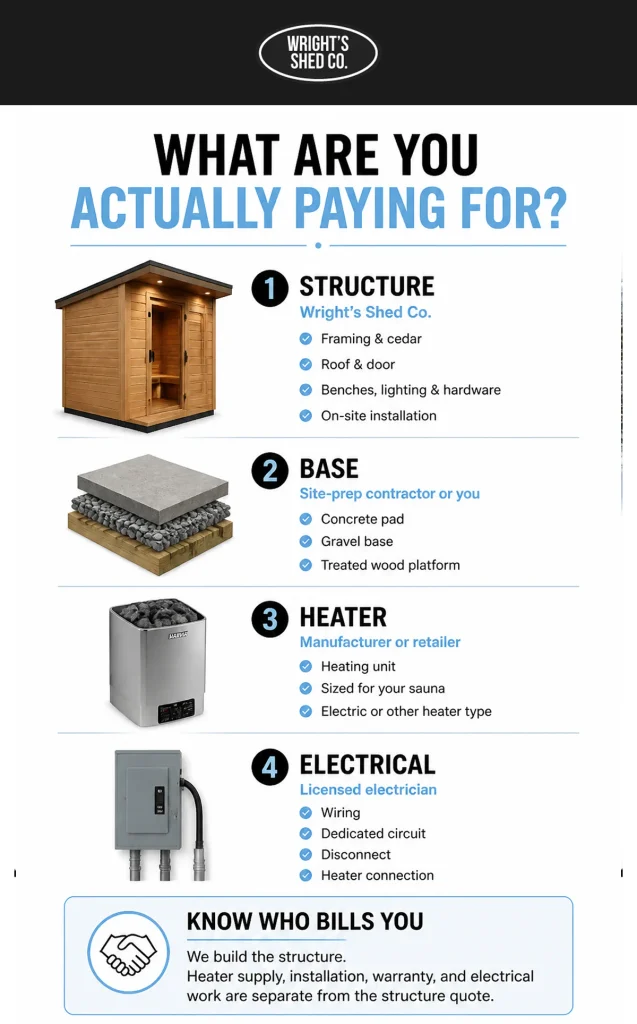
The Four Things You Are Actually Paying For
A backyard sauna cost breaks into four purchases from four different sources, and knowing which is which stops surprise invoices later.
| What you’re buying | Who bills you | What it includes |
| The structure | Wright’s Shed Co. | Framing, cedar inside and out, roof, door, benches, lighting, hardware, and on-site installation |
| The base | Your site-prep contractor or you | Concrete pad, gravel base, or treated wood platform |
| The heater | The heater manufacturer or retailer | The heating unit itself, chosen by size and type |
| The electrical | Your licensed electrician | Wiring, circuit, disconnect, and connection to the heater |
We build the structure. We do not select, supply, install, warranty, or wire a heater, and we do not perform electrical work. That line stays fixed no matter how the quote comes together.
What Drives the Price of a Custom Sauna Build
Size is the biggest lever on a custom sauna build, and finish level and site access come right behind it. We build three standard sizes, 6×6, 7×8, and 8×12, and our sauna sizing guide breaks down how many people fit in each one before you size your budget around the wrong number.
Four factors move a custom quote up or down more than anything else:
- Size: the difference between a 6×6, a 7×8, and an 8×12 in cedar, roofing, and framing.
- Bench configuration: single-tier versus two-tier, and how much ceiling height the layout needs.
- Finish detail: door glass, added windows, and lighting choices beyond the base build.
- Site access: how easily the crew and materials can reach the build location.
Size, bench layout, and finish level
A 6×6 sauna costs less than an 8×12 simply because it uses less cedar, less roofing, and less framing. Bench layout adds to that. A single-tier bench costs less than a two-tier bench, and a two-tier layout needs more ceiling height to work. Finish choices, like a door with glass or added windows, move the number up in smaller steps.
Site access and delivery
A flat, open lot with a wide gate keeps the build simple. A narrow side yard, a steep slope, or a gate that needs to be removed adds labor before the structure ever goes up. Tell us about access when you request a quote so the number reflects your yard, not an average one. Our guide to where to put a sauna in your backyard walks through setbacks, delivery access, and panel distance in more depth, since all three affect the final number.
We have been framing structures for Utah weather since 1997, and we run the business debt-free with low overhead. That is not a slogan; it is the reason we can hold the structure price where it is instead of padding it to cover financing costs. You can see the same standard applied to the framing, roof, and siding on our page on how a custom sauna is built, and in the full step-by-step in our backyard sauna installation process guide.
The Site Questions That Can Change Your Sauna Quote
Before requesting a quote, it helps to have a few basic site details ready. These do not need to be professionally surveyed, but they give the builder and other contractors a much better starting point.
- First, measure the available space. Include enough room for the sauna itself as well as the access needed to construct and maintain it. Do not assume that an empty-looking section of lawn automatically has enough usable space.
- Second, identify the electrical panel. The approximate distance from the panel to the proposed sauna location is one of the most useful pieces of information for estimating electrical work. A rough measurement is better than leaving the distance unknown.
- Third, check the access route. Measure gates and narrow passages between the street and the proposed location. A structure may fit in the backyard while the crew still faces a difficult route getting materials there.
- Finally, look at the ground. Note whether the area is level, sloped, muddy, rocky, or already prepared with concrete or another stable surface. These conditions can affect the base you choose.
You do not need to solve all four issues yourself before contacting us. The goal is simply to identify them early so they can be considered when the project is priced.
What the Electrical Actually Costs
Electrical work is usually the single most variable cost in a backyard sauna project, and panel distance is the main reason why. A sauna heater needs a dedicated circuit sized for a continuous load, which the National Electrical Code sizes at 125 percent of the heater’s rated draw. That is why the circuit runs heavier and pricier than a standard outdoor outlet.
Trenching is priced per linear foot, so a sauna placed near the panel costs less to wire than one at the far end of the yard. A full panel that needs a service upgrade adds a separate cost on top of that. This work is quoted and billed by your licensed electrician, not by Wright’s Shed Co. See our full breakdown of sauna electrical requirements for what to have ready before your electrician quotes the job.
The structure itself typically falls under Utah’s residential accessory-structure permit exemption in most cities, since all three sizes we build sit under the 200 square foot threshold many jurisdictions use. That exemption applies to the structure, not the electrical work. The wiring almost always requires its own permit regardless of the building’s size, so budget for that step and confirm the current rule with your local building department before you dig.
What the Base Costs
A concrete pad, a gravel base, or a treated wood platform each carry a different cost and a different trade-off, and the right one depends on your yard more than your budget.
| Base type | Cost direction | Trade-off |
| Concrete pad | Highest upfront cost | Most stable and level; needs a concrete contractor |
| Gravel base | Lowest upfront cost | Drains well; needs proper compaction and containment |
| Treated wood platform | Mid-range cost | Fastest to build; works well on a sloped lot |
We advise on which base suits your yard during the quote, but the base itself is arranged on your end. For the full comparison, see what goes under an outdoor sauna.
Does the Existing Yard Need Site Preparation?
The base is only part of the site-preparation question. If the proposed sauna location already has a suitable, level surface, preparation may be relatively straightforward. If the location needs grading, excavation, removal of existing material, or drainage work, those costs can sit outside the sauna structure itself. This is especially important on sloped Utah properties. A small amount of slope may be manageable with the right platform, while a significantly uneven site can require more preparation before the sauna can be installed correctly.
Drainage also matters. Water should not collect around the base after rain or snowmelt. Keeping the structure supported, level, and away from persistent standing water helps protect the building over time. That is why the cheapest base option on paper is not necessarily the cheapest option for your property. A base that costs less initially but requires repairs or correction later can erase the original savings.
When comparing estimates, ask whether site preparation is included or whether it is a separate contractor cost. That distinction can explain why two apparently similar sauna budgets are not actually comparable.
Barrel, Kit, and Custom-Built Compared on Price
A barrel sauna generally has the lowest upfront price, a flat-pack kit sits somewhere in the middle, and a custom-built sauna usually costs more upfront. The better comparison is not simply which one is cheapest to buy, because lifespan, maintenance, usable space, and site requirements can change the long-term cost. For the full trade-offs between the three formats, read our comparison of barrel sauna vs. custom-built sauna.
| Format | Upfront cost | What you’re really paying for |
| Barrel sauna | Lowest | Fast heat-up, smaller footprint, single-wall construction |
| Flat-pack kit | Mid-range | Weekend assembly, panelized walls, often shipped from overseas |
| Custom-built | Highest | Framed and roofed on site, sized to your yard, longest expected structural life |
A barrel sauna can make sense when the priority is a lower upfront cost, a compact footprint, or a simpler installation format. A custom-built sauna makes more sense when you want the structure sized specifically to your yard and built around a particular bench layout and long-term use.
What It Costs to Run a Backyard Sauna
Running a backyard sauna costs a few dollars per session for most homeowners, and the exact number depends on your heater size, your session length, and your own electricity rate.
Monthly cost to run a backyard sauna
Here is the math using the latest available Utah residential electricity rate at publication. In June 2026, Utah residential electricity averaged 13.37 cents per kilowatt-hour. A 6 kW heater running for one hour would use about 6 kWh, or roughly $0.80 of electricity at that average rate. Four one-hour sessions per week would be about $3.20 per week, or roughly $14 per month. Your actual cost may be higher or lower depending on your utility rate, heater, heat-up time, and session length. Check your current utility rate and your heater’s rated draw for the most accurate estimate.
Your own rate may run higher or lower. Check your utility bill or the U.S. Energy Information Administration’s residential electricity data for the current average in your state, then apply your heater’s rated draw for a real number.
Winter sessions cost a little more to run because heat-up takes longer in cold air. Our guide to using an outdoor sauna in winter covers the seasonal difference in more depth, including what changes in the roof and the routine once temperatures drop.
Where Sauna Buyers Overspend and Where They Underspend
Sauna buyers tend to overspend on size and heater output, and underspend on the base and the electrical run. Both mistakes are avoidable once you know where they show up.
Where buyers tend to overspend:
- Oversizing the build for the average session instead of the busiest one, then heating an empty room most nights.
- Choosing a heater larger than the room needs, which raises both the heater cost and the circuit cost.
- Adding finish upgrades before locking in size and site access, which are the two decisions that move the total the most.
Where buyers tend to underspend:
- Skipping a proper base and dealing with a door that will not latch square within a year.
- Placing the sauna far from the panel without pricing the trenching first, then getting a much larger electrical quote than expected.
- Not budgeting for a service panel upgrade when the existing panel is already full.
Is a Backyard Sauna Worth It?
A backyard sauna is worth it if you measure it against years of regular use rather than the purchase price alone. A structure built to last decades, used two or three times a week, works out to a low cost per session over time. We are not going to make a resale or investment claim here. What we can say is that the structure itself, framed the same way we have framed buildings since 1997, is the part of the cost built to hold its value in daily use rather than resale value.
The honest version of this question is really two questions. Will you actually use it, and does the location make that easy? A sauna at the back of a long yard gets used less in January than one fifteen steps from the door. Answer those two questions before the price, and the price question tends to answer itself.
Compare that against a gym membership, a spa visit, or a hotel sauna you drive to. Those costs repeat every month for as long as you use them. A backyard sauna is a higher cost up front and a much smaller one after that, once you own the structure outright.

Frequently Asked Questions About Backyard Sauna Cost
How much does a custom sauna cost compared to a kit?
A custom-built sauna generally costs more upfront than a flat-pack kit, because it is framed and roofed to the site rather than shipped as pre-cut panels. The trade-off is a structure sized to your yard and built to the same framing standard as our sheds, rather than a panelized box sized to a catalogue.
Does the price include the heater?
No. Wright’s Shed Co. builds the structure, and the heater is a separate purchase you select and buy on your own. The heater, its wiring, and its installation are handled by your licensed electrician, never by us.
How much does it cost to run a sauna per month?
Most homeowners using a 6 kW electric heater for four one-hour sessions per week would spend roughly $14 a month based on Utah’s June 2026 average residential electricity rate of 13.37 cents per kilowatt-hour. Your actual monthly cost will vary with your utility rate, heater size, heat-up time, and session length.
Do I need to pour concrete?
No. A concrete pad is one option, but a gravel base or a treated wood platform both work depending on your yard and your slope. See our full comparison of outdoor sauna foundation options for the trade-offs between the three.
What is included in the structure price?
Framing, cedar inside and out, the roof system, the door, benches, lighting, and hardware, plus on-site installation. Nothing about the heater or the electrical work is included, and neither is the base.
Why is a custom sauna more than a barrel?
A custom-built sauna costs more because of construction, not because of branding. It is framed with a roof system built for Utah snow loads, sided and roofed the same way our sheds have been since 1997, and sized to the yard it goes in rather than to a fixed catalogue shape. A barrel sauna is single-wall construction built to a standard size, which is why it costs less to build and ship.
Budgeting for Your Backyard Sauna Cost
Backyard sauna cost comes down to four line items: structure, base, heater, and electrical, each priced or arranged separately. Wright’s can quote the sauna structure, while the base and electrical work are separate project costs. See our pricing hub for general pricing information, or browse the gallery to see finished builds before you request your own quote.
Tell us your size, your site, and your finish, and we will build a real quote for your yard, not a national average. Request a quote through our online form and get a number back in a few minutes, with on-site installation already included in the structure price. Design Your Shed to get started, or contact us to talk through the budget first.