
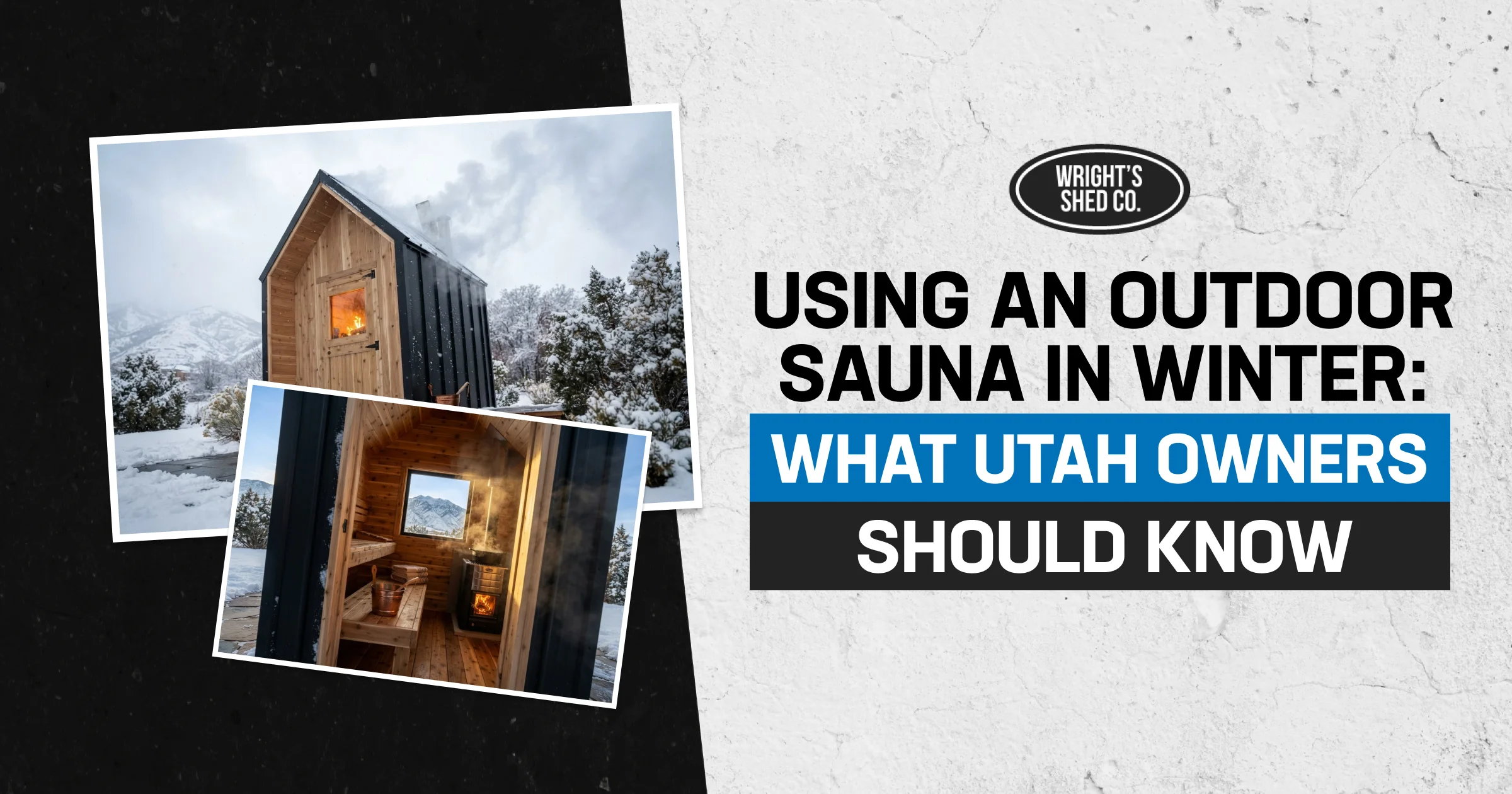
An outdoor sauna in winter is not a fair-weather purchase you put away in October. For Utah owners, winter can be one of the best times to use a backyard sauna because the contrast between the heated room and the cold outdoors is part of the experience. The bigger question is not whether a sauna can operate through a Utah winter, but what changes when the temperature drops: heat-up time, snow on the roof, the path from the house, and the small details that can make winter use easier.
Yes, a custom backyard sauna can be used through a Utah winter. Wright’s describes its sauna builds as designed for Utah weather, including heavy snow, hard freezes, and dry summer heat. The structure does not need to be treated like a seasonal water system that has to be drained for winter. Instead, winter use comes down to practical considerations: the heater may need more time to bring the room up to temperature, the roof has to be framed for the snow load at the site, and the route between the house and sauna needs to stay clear and safe.
A few things are worth knowing before the first cold snap.
- A sauna built with a standing-seam metal roof and cedar walls does not need to be winterized or drained, because there is no plumbing inside it to freeze.
- Heat-up time stretches on the coldest days, and how much depends on your heater, not on the season alone.
- Utah’s snow load numbers are not the same from one address to the next, so roof framing matters more here than in a milder state.
- The path from the house to the sauna door usually breaks down before the sauna itself has any trouble with the cold.
Can You Use an Outdoor Sauna in Winter?
Yes, you can use an outdoor sauna in Utah every month of the year, and winter is when most owners get the most out of it.
Stepping from a 180-degree room into freezing air is the traditional finish, and it is a big part of why people buy a sauna in the first place. A sauna built for the Wasatch Front does not go into storage mode when the temperature drops. We frame, side, and roof every sauna to the same construction standard we have used on outbuildings since 1997, which means double top plates, trusses joined with steel plates, and wall framing set on 16-inch centers. None of that changes because the calendar flips to December, and none of it needs a seasonal shutdown checklist the way a swimming pool or an irrigation system does.
What actually changes in the cold:
- The heater runs longer to reach temperature and to hold it.
- The roof carries real snow weight, and Utah’s snow load figures vary by elevation and location.
- Water left inside, in a bucket or a ladle, can freeze if the sauna sits unused for a stretch.
- Wood movement in the cedar slows down in the cold and picks back up with the spring swing.
We build the structure. That includes the framing, the cedar inside and out, the roof, the door, the benches, the lighting, and the hardware. The heater and all of the wiring are handled by your own licensed electrician, and that does not change with the season.
How Long It Takes to Heat When It Is Below Freezing
A sauna takes longer to reach temperature on a below-freezing day than it does on a warm one, and how much longer depends on your heater, your room’s volume, and how well the walls hold heat.
Three things drive the difference. A bigger room has more air to bring up to temperature. A heater sized close to the room’s minimum needs will lag further behind in the cold than one with headroom to spare. And how the walls are built plays a real part, since a room that loses heat quickly asks the heater to work harder just to stand still.
As a practical winter routine, expect the coldest days to require more preparation than a mild summer evening. There is no single heat-up time that applies to every outdoor sauna because heater output, room volume, starting temperature, insulation, and the construction of the room all affect how quickly the space reaches the desired temperature. A smaller room with an appropriately sized heater can behave very differently from a larger room using a heater near the lower end of its recommended capacity. For that reason, the heater manufacturer’s instructions are the right source for the expected heat-up range and pre-heating guidance for a specific unit. Rather than publishing a number that could be mistaken for a performance guarantee, give the sauna extra lead time on particularly cold days and adjust your routine once you know how your specific heater performs.
A useful habit for winter is starting the heater on a timer or before you leave for work, rather than treating it as a same-hour decision the way you might in July. That single change does more for a consistent winter routine than any tweak to the room itself. If the heat-up time on the coldest nights still feels longer than you expected after checking the manual, that is usually a sign to talk to your electrician about the circuit or your heater’s dealer about the unit, not a sign the structure is underperforming.
Snow Load and Why the Roof System Matters
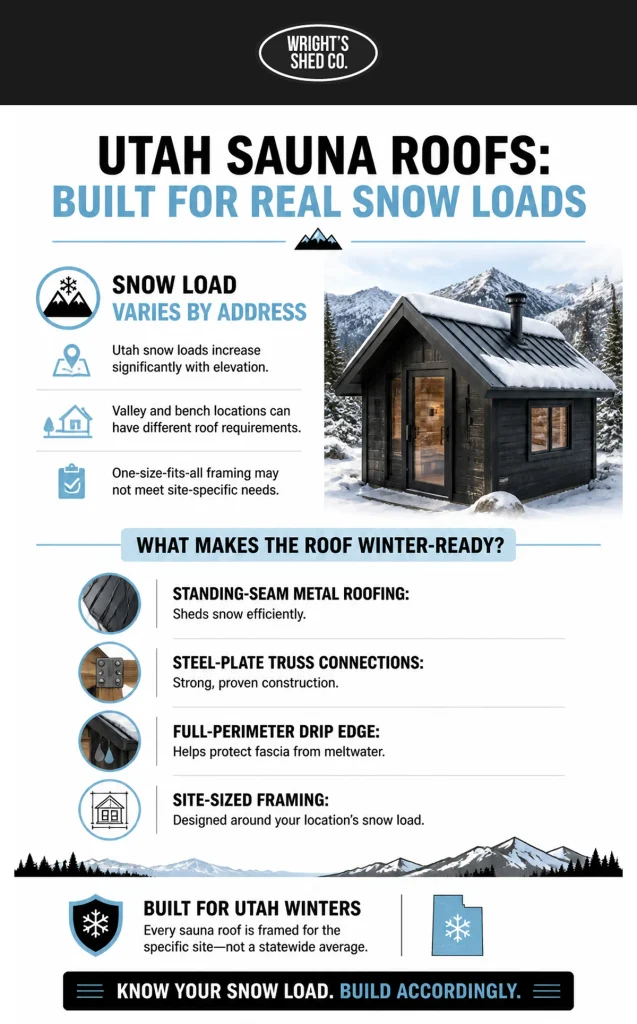
The roof on an outdoor sauna has to carry real snow weight, and in Utah that weight is not one number for the whole state.
Why Snow Load Varies by Address
Utah’s design ground snow loads come from the Utah Snow Load Study at Utah State University, and the state construction code references it directly. Loads climb fast with elevation, so a backyard in the valley and a backyard a few hundred feet up a bench can carry meaningfully different requirements. A roof framed to a generic, one-size-fits-all catalog spec is not the same as one framed for a specific Utah address.
We build every sauna roof the way we build a shed roof, using framing standards refined over nearly thirty Utah winters: trusses joined with steel plates, drip edges around the full perimeter, and a structure sized to the site rather than to a national average. Our Design a long-lasting Utah shed page walks through that same reasoning in more detail. It is also worth reading how a Barrel sauna vs. custom-built sauna handles snow differently, since a curved barrel shell and a framed roof system are not solving the same problem. For more on how the frame comes together, see How a custom sauna is built.
| Roof Feature | Why It Matters in a Utah Winter |
| Standing-seam metal roofing | Sheds snow cleanly instead of holding it in valleys or seams |
| Steel-plate truss connections | Same connection method used on our shed roofs since 1997 |
| Drip edge, full perimeter | Keeps meltwater off the fascia instead of running behind it |
| Framing sized to the site | Accounts for elevation-driven snow load rather than a single statewide figure |
We frame every sauna for the site it goes on. Tell us your address and we will size the roof and the build around it.
The Path From the House
The walk from your back door to the sauna door decides how often you actually use it, more than the sauna itself does.
A sauna forty steps away across an icy lawn in February gets used less than one fifteen steps away with a clear path. That is not a design opinion; it is just how habits work in the cold. Where you put the sauna, which way the door faces, and what the ground between the house and the door looks like in January are decisions worth making before the order goes in, not after the first snow. Our Where to put a sauna in your backyard walks through door orientation, sight lines, and delivery access if you are still choosing a spot.
Shovel a real path, not just a suggestion of one. Lighting along that path matters as much in January as the lighting inside the sauna does, since most winter sessions happen after dark. A handrail or a simple grab point at the door is worth adding if the ground between the house and the sauna has any slope to it, since bare feet and icy steps are a bad combination. Small details like these are the difference between a sauna that gets used all winter and one that quietly turns into a summer-only fixture.
What Can Freeze and What Cannot
There is no plumbing inside our sauna, so the freeze risk that worries most new owners is not actually a risk to the structure itself.
What Can Actually Freeze
- Water left in a bucket or ladle if the sauna sits unused for a stretch of cold weather
- Condensation on door hardware if wet gear is left inside with the door shut
- Standing water on the path or steps leading up to the door
- Hinges and the door latch, if they go unused for weeks and pick up moisture before a freeze
What Cannot Freeze, and Why
- Interior plumbing, since a sauna does not carry water lines
- A heater tank, since traditional sauna heaters do not hold water the way a water heater does
The cedar itself is not bothered by cold. Wood movement, the small seasonal expansion and contraction that happens in any solid wood structure, simply slows down in freezing temperatures and picks back up with the spring swing. That is a normal part of owning a wood building, not a defect. The heater and every electrical connection are handled by your own licensed electrician, in every season.
Snow Shedding and Where It Lands
A metal roof sheds snow cleanly, and where it lands is worth planning for before you decide where the door and the path go.
Standing-seam metal roofing can allow accumulated snow to slide from the roof, so the important question is where that snow will land. The eave area can become a slide zone during periods of sun, warming, or changing weather, particularly on the side of the building that receives more direct sunlight. That makes door placement, the walking path, and any area where you expect to stand outside important parts of the layout. Plan those areas before the sauna is placed rather than discovering the problem after the first major snowfall.
Stepping Out Into the Cold
Moving from a hot sauna into cold air is the traditional finish, and it is fine for most healthy adults when done sensibly.
Keep it simple: step out, cool off at your own pace, and go back in for another round if you want one. This is not the place for a specific protocol, a target duration, or a temperature to aim for, because that depends on the person and the day. Cold exposure right after heat is not right for everyone. If you have a heart condition, high or low blood pressure, or you are pregnant, talk to your doctor before making cold exposure a regular habit. If you want the general research picture rather than marketing claims, this peer-reviewed review in Mayo Clinic Proceedings covers sauna bathing broadly. This section is general information, not medical guidance.
What It Costs to Run in Winter
Running a sauna costs more per session in winter than in summer, because a longer heat-up and a colder starting room both ask more of the heater.
The direction is simple even without a single dollar figure: colder outside air pulls more heat out of the room while the heater works, which is a longer draw on the circuit for the same session length. Utah utility rates and heater sizes vary enough across yards that one number would not be honest for every build. Our Backyard sauna cost in Utah page breaks the real cost buckets down: structure, base, heater, and electrical, and the electrical section covers what actually drives your running cost.
| Season | What Changes | Cost Direction |
| Summer | Shorter heat-up, warmer starting room temperature | Lower cost per session |
| Winter | Longer heat-up, colder starting room temperature | Higher cost per session |
| Coldest stretches | Longer pre-heat, more frequent short cycles | Highest cost per session |
The Other Extreme: Dry Summer Heat
Utah’s winter is not the only weather a sauna has to handle, since the same climate that freezes in January bakes and dries out by July.
UV exposure, low humidity, and the wide daily temperature swing common along the Wasatch Front all move wood in ways a milder, wetter climate does not. Cedar handles that better than most softwoods, and our Why a cedar sauna holds up page covers the material reasoning in full. The short version: a building framed and sided for Utah winters is generally framed and sided for Utah summers too. It is the same climate problem from the other direction.
Frequently Asked Questions About Winter Sauna Use
Can you leave an outdoor sauna all winter?
Running the heater continuously is a decision for your heater’s manufacturer’s manual and your own utility cost tolerance, not a structural limitation. Most owners heat up before a session rather than run continuously, since a preheat-and-use pattern is both cheaper and easier on the equipment over a full season. Check your specific heater’s guidance and talk to your electrician about what a continuous cycle means for your circuit.
Does snow damage a sauna roof?
Not when the roof is framed for the site’s actual snow load. A metal roof sheds snow rather than holding it, which reduces the standing load compared to some other roofing materials, and it also avoids the freeze-thaw cycling that can work at shingles over repeated winters. Snow load figures vary by elevation and location, so the framing has to match the address, not a generic figure.
How long does a sauna take to heat in winter?
Longer than in summer, and the exact difference depends on your heater’s output, the room’s volume, and the wall construction. There is a real, noticeable gap on the coldest days, and it tends to be most pronounced on the first cold snap of the season before you have adjusted your routine to it. Your heater’s manual is the accurate source for your specific model’s heat-up range.
Do I need to insulate an outdoor sauna for Utah?
Wall assembly details are part of the conversation we have during a quote, since the right approach depends on the build and how you plan to use it. Rather than guess at a spec here, ask us directly when you request a quote, and we will walk through what your specific build includes and how it holds heat through a Utah winter.
Is it safe to go from a hot sauna into the snow?
For most healthy adults, yes, done at a comfortable pace and without pushing past what feels reasonable. It is not right for everyone. Anyone with a heart condition, blood pressure concerns, or who is pregnant should talk to a doctor before making cold exposure a habit. This is general information, not medical advice.
Getting the Most From an Outdoor Sauna in Winter
An outdoor sauna in winter rewards a little planning: a cleared path, a roof built for your actual snow load, and a heater run by someone licensed to do it.
None of that is complicated once it is set up right. We build the structure, the framing, the cedar, the roof, the door, the benches, the lighting, and the hardware, using the same construction standard we have applied to Utah outbuildings since 1997. Your electrician handles the heater and every connection. You handle the base and the path. Get those three pieces right once, and the sauna itself takes care of the rest for every winter after.
If you are ready to plan an outdoor sauna for your Utah yard, request a quote. A quote gives you a starting point for discussing the sauna size, placement, roof requirements, and the details your specific site may need before winter arrives.