

If you are planning a backyard sauna in Utah, sauna electrical requirements are the one part of the project you cannot design around after the fact. The heater needs real power, and that power comes from a licensed electrician, not from the crew that frames your sauna.
A backyard sauna heater often requires a dedicated circuit, and many traditional heaters use 240V power. The exact circuit, disconnect, grounding, and GFCI requirements depend on the heater, installation, location, adopted code, and manufacturer instructions. We build the custom backyard sauna structure, including the framing, cedar, roof, and lighting fixtures. Your licensed electrician handles the heater connection, wiring, and electrical permit.
A few things tend to surprise homeowners once they start pricing this out:
- Most traditional sauna heaters run on 240V, not the 120V already sitting in your garage outlet.
- Trenching from the panel to the sauna, not the heater itself, is usually the biggest swing in the electrical budget.
- The circuit gets sized above the heater’s rated draw, not to match it exactly, because a sauna heater runs continuously for hours at a stretch.
- The structure and its electrical work can have different permit requirements, so confirm both with the local building department before work begins.
- Calling the electrician after the base is poured is the most common and most expensive scheduling mistake we see.
- A sauna asks more of a circuit than almost anything else in a typical backyard, more than a hot tub pump and closer to a small electric range.
Sauna Electrical Requirements at a Glance
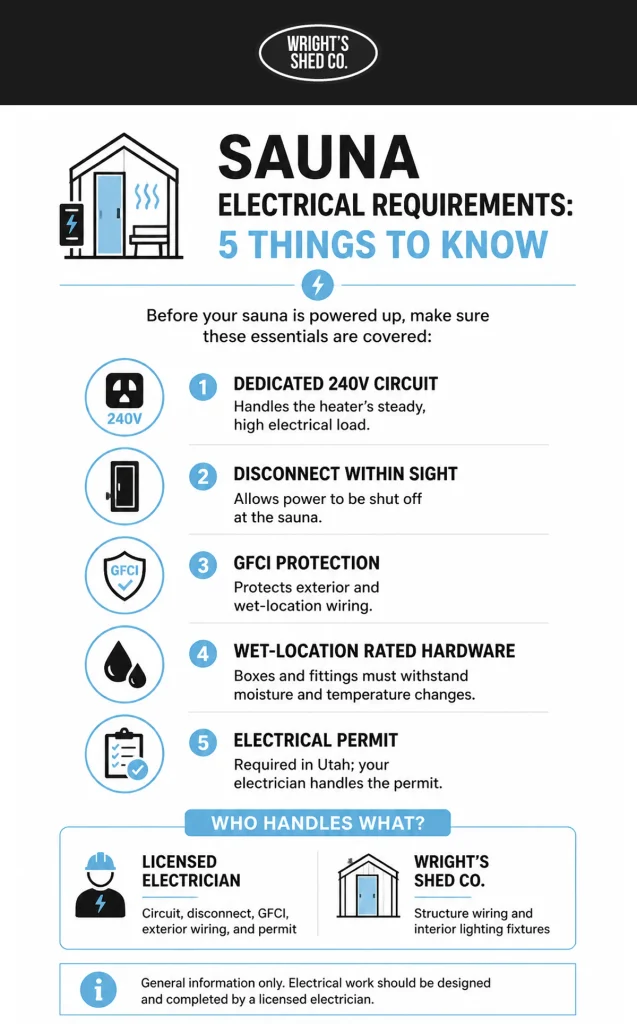
Sauna electrical requirements come down to five things: a dedicated circuit, correct voltage, a disconnect, GFCI and wet-location protection, and a permit. Here is who is responsible for each one.
| Requirement | Why It Matters | Who Handles It |
| Dedicated 240V circuit | Sauna heaters draw a steady, high load for the length of a session | Your licensed electrician |
| Disconnect within sight of the heater | Lets you cut power at the unit without walking back to the panel | Your licensed electrician |
| GFCI protection on exterior wiring | Required for outdoor and wet-location circuits | Your licensed electrician |
| Wet-location rated boxes and fittings | Every exterior connection sits through moisture and temperature swings | Your licensed electrician |
| Structure wiring and interior lighting fixtures | Framing, hardware, and light fixtures are part of the build | We handle the structure and lighting fixtures |
| Electrical permit | Required in Utah regardless of the structure’s permit exemption status | Your electrician filed with your city |
We are a builder, not an electrical contractor. This page is general information to help you have an informed conversation with your electrician. It is not an electrical design.
Why a Sauna Needs Its Own Dedicated Circuit
A sauna needs its own dedicated circuit because the heater draws a steady, high load for the entire length of a session, and no other appliance can safely share that load.
A refrigerator cycles on and off. A sauna heater does not. Once it reaches temperature, it keeps drawing power to hold that temperature for as long as the room is in use, sometimes forty-five minutes or more at a stretch. Sharing a circuit with anything else risks nuisance tripping at best and overheated wiring at worst. That is why a dedicated circuit, sized and installed by a licensed electrician, is treated as a baseline requirement rather than an upgrade.
A window air conditioner or a clothes dryer runs the same way, drawing steady current for a stretch of time rather than a quick burst. Codes treat those continuous loads differently than a toaster or a drill, which draw hard for a few minutes and stop. An undersized circuit on a continuous load does not usually fail all at once. It runs hot, trips more often as the wiring ages, and shortens the life of everything connected to it. That slow failure pattern is part of why the sizing rule exists in the first place.
Why Most Traditional Heaters Are 240V
Most traditional sauna heaters run on 240V because getting a full room to sauna temperature takes more sustained power than a standard household outlet can deliver.
- Small infrared panel units sometimes run on a standard 120V circuit, similar to a space heater.
- Traditional heaters that warm the air and rocks in a 6×6, 7×8, or 8×12 room generally need a 240V circuit to reach and hold temperature in a reasonable time.
- Heater voltage is set by the manufacturer’s nameplate, not by preference, so the specific model you choose determines what your electrician wires for.
Room volume is what drives heater size, and heater size is what drives the circuit of your electrical wires. A larger room simply needs a bigger heater to reach temperature in a reasonable time, which is one more reason to settle on a size before you talk to an electrician. See what size sauna you need before you get a heater quote.
This is context for the conversation with your electrician, not a substitute for it. Bring the heater’s nameplate specs to that conversation and let the electrician confirm the circuit.
The Continuous-Load Rule
What Counts as a Dedicated Circuit
A dedicated circuit is intended to serve the sauna equipment without sharing the load with unrelated appliances or outlets. Because sauna heaters can operate for an extended period, the applicable electrical code treats sustained loads differently from short-duration loads. NFPA 70, the National Electrical Code, includes requirements for continuous loads, but the applicable edition and local amendments matter. We won’t get into sizing calculations here. Your licensed electrician will determine the required circuit based on the heater’s nameplate, the adopted code, and the manufacturer’s installation instructions.
Disconnect, GFCI, and Wet-Location Fittings
A sauna circuit needs a disconnecting means within sight of the heater, GFCI protection on exterior wiring, and wet-location rated fittings throughout.
Wet-Location Fittings Explained
- A disconnecting means within sight of the appliance lets you cut power at the unit itself, which NFPA 70 Article 422.31 addresses for fixed appliances.
- GFCI protection applies to outdoor and wet-location receptacles under NFPA 70 Article 210.8, and your electrician will determine exactly where it applies based on your layout and the heater manufacturer’s instructions.
- Every exterior box, connector, and fitting between the panel and the sauna needs a wet-location rating, since it sits outside year-round through rain, sprinklers, and snow.
Whether GFCI protection is required at a specific point in your circuit depends on the equipment, the location, and the manufacturer’s installation instructions. We are not going to give a blanket yes or no here. That call belongs to your electrician and the inspector.
Running Power From the Panel to the Sauna
Trenching is priced per linear foot, and it is usually the largest variable in the electrical portion of a sauna project. A panel on the far side of the house adds distance, and distance adds cost. This is one reason why where to put a sauna in your backyard is as much a budget decision as a design one. Moving the sauna closer to the panel, when the yard allows it, can be one of the cheapest changes you make in the whole project.
Panel capacity is the other variable. If your existing panel is already near full, a service upgrade may be needed before the new circuit can go in at all. Neither trenching nor panel work is something we price or perform. See the full cost picture, including what drives the electrical portion, in backyard sauna cost in Utah.
Spring is our busiest season for sauna builds along the Wasatch Front, and electricians book up the same way. If you know you want a sauna for summer, line up your electrician as soon as you have a build date rather than waiting for the delivery week. An electrician who already has your yard measurements and panel photos can often quote faster than one starting from scratch.
Another detail to settle early is where the electrician will need access to the panel and where the sauna controls will sit. The shorter and simpler the route from the panel to the sauna, the easier it is to plan the installation. Giving your electrician the sauna location, heater specifications, panel photos, and delivery schedule upfront gives them the information they need to identify potential issues before installation day.
Ask your electrician whether they plan to run conduit or direct-burial cable for your yard. Both are common approaches, and the right one depends on soil, landscaping, and whether you might ever want to move or extend the run later. We are not going to weigh in on trench depth or burial method here. That decision, and the digging that goes with it, belongs to your electrician and your local code.
Permits: What Triggers One in Utah
The structure itself is usually under Utah’s typical residential permit exemption at the sizes we build, but the electrical work requires a permit regardless of the structure’s size. That distinction trips people up. A sauna small enough to skip a structural permit still needs an electrical permit for the circuit, because the permit is tied to the electrical work, not to the square footage of the room it feeds. Requirements are set and enforced locally, so confirm the specifics with your own city or county before you schedule anything. Our Utah building code for sheds covers the structural side of that threshold in more depth.
A permitted electrical job also means an inspection before the circuit is energized and used. The inspector checks that the work matches what was permitted, that the wiring and fittings are rated for the location, and that grounding and connections meet code. Skipping the permit to save time is a real risk, not just a paperwork issue. It can complicate a home sale later, and it removes the safety check the process is there to provide.
What Your Electrician Needs From You
The electrician cannot finalize the sauna circuit from the sauna dimensions alone. The heater model matters just as much. Different heaters can have different voltage, wattage, amperage, controls, and installation requirements, even when they are intended for rooms of a similar size. That is why choosing the heater before the electrical quote gives your electrician something specific to work from instead of requiring them to estimate from the room size.
Your yard layout matters too. The electrician needs to know where the sauna will sit, where the electrical panel is located, and what the planned route between those two points looks like. A short, accessible route can be much simpler than a run that crosses a driveway, concrete walkway, retaining wall, or established landscaping. Sharing photos and measurements ahead of time gives the electrician a chance to identify those conditions before the work is scheduled.
The same applies to the sauna’s controls and lighting. If the heater has a separate control panel, timer, or other required equipment, its location should be established before wiring begins. Giving the electrician the heater manual along with your sauna layout helps them account for those requirements during planning rather than trying to solve them after the sauna is already delivered.
What to Have Ready Before the Electrician Quotes
Before you call an electrician for a quote, put these together so the sauna electrical requirements conversation stays short and the number you get back is accurate.
- The heater’s model number and nameplate specs (voltage, amperage, wattage), since the specific model determines the circuit
- The straight-line distance from your electrical panel to where the sauna will sit, which drives the trenching estimate
- A photo of your current panel, including open breaker slots, so the electrician can tell early if a service upgrade is likely
- Your planned trench route, and whether it crosses concrete, a driveway, or landscaping
- Where the heater’s control panel will be mounted inside the sauna
- Your target delivery date, so the electrician can plan conduit and trenching before the structure arrives
What We Handle and What You Handle
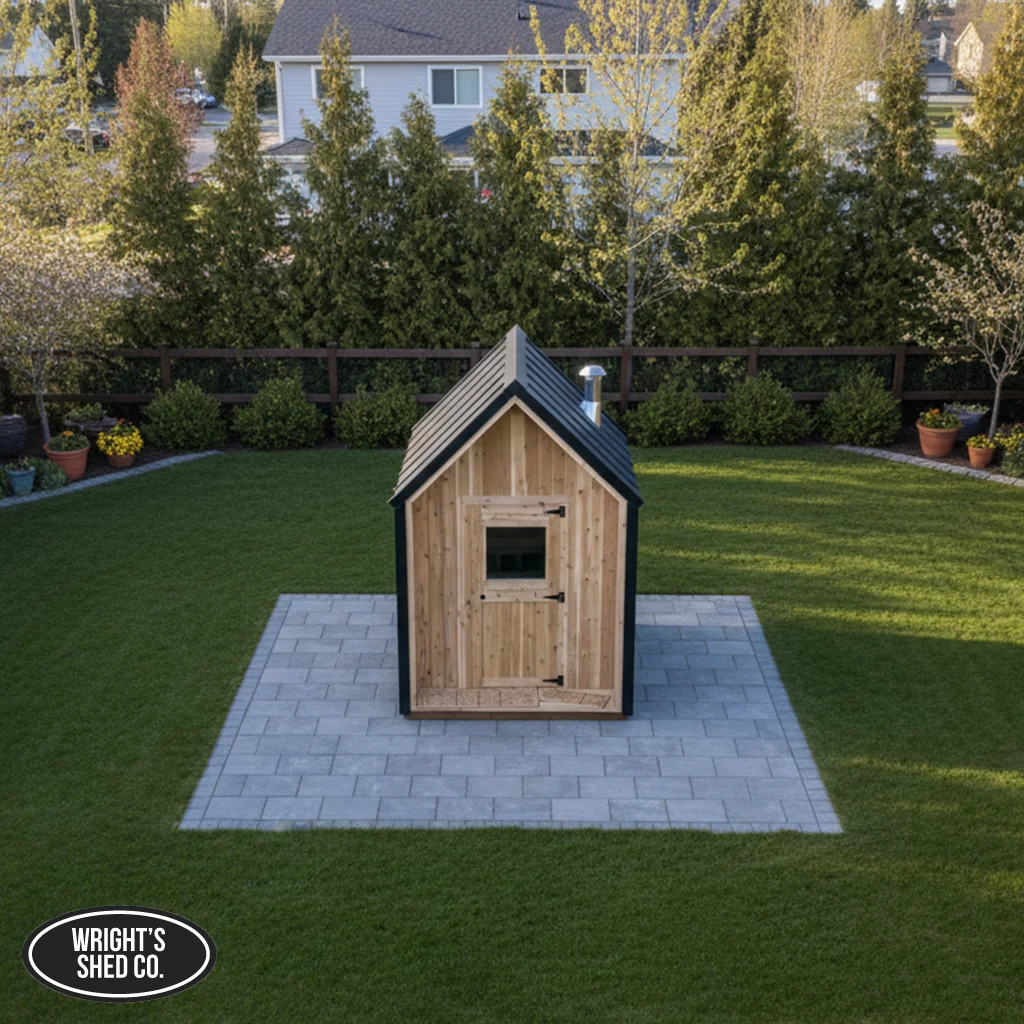
The line is simple: we build the structure, including the lighting fixtures, and your licensed electrician handles the heater, all wiring, and every connection. For the full sequence from quote to first session, see our backyard sauna installation process, and check our frequently asked questions for more on what we include.
| What We Handle | What You and Your Electrician Handle |
| Framing, cedar interior and exterior, roof system | Selecting and purchasing the heater |
| Door, hardware, and benches | The dedicated 240V circuit and wiring |
| Interior lighting fixtures | Trenching, conduit, and connection to your panel |
| Structural specifications and warranty on the build | The electrical permit and inspection |
Questions to Ask Before You Hire
A few questions up front separate a sauna-ready electrician from a generalist who has never wired one.
- Have you wired a sauna heater before, and can you describe the circuit you would run?
- Will you pull the permit, or is that on me?
- Does your quote include trenching and conduit, or is that priced separately?
- How will you coordinate with the heater manufacturer’s installation manual?
- What is your timeline, and can you work before the sauna is delivered so conduit is already in place?

Frequently Asked Questions About Sauna Electrical Requirements
Can I wire a sauna myself?
No. This is licensed electrical work and permitted work in Utah. We are not going to walk through how to do it yourself, and we would not recommend it even if it were legal in your jurisdiction. Hire a licensed electrician and pull the permit.
Can a sauna run on a regular outlet?
Some small infrared units are designed for a standard 120V circuit. Most traditional heaters that bring a full room up to sauna temperature need a dedicated 240V circuit. Your heater’s nameplate will state which one it needs.
Does a sauna need GFCI protection?
GFCI requirements depend on the equipment, location, configuration, adopted electrical code, and manufacturer instructions. Your licensed electrician and local inspector should determine where GFCI protection is required for your specific installation.
How much does the sauna electrical work cost?
It depends mainly on trenching distance and whether your panel has open capacity, and we do not set or quote that price since it is third-party electrical work. See the trenching and cost section above for what drives the total.
When should I call the electrician?
Before delivery, and ideally before your base goes in, conduit can be run first. Calling after the pad is poured is the single most common scheduling mistake we see, and it can mean cutting into a finished base to fix it.
Getting Your Sauna Electrical Requirements Sorted
Sauna electrical requirements come down to one dividing line: we build the structure, and a licensed electrician handles the heater and every connection to it. Since 1997, we have been an owner-operated building company out of Kaysville, Utah, and we stay inside that line on purpose, because it is the honest way to do this work. The one action to take now is to line up your electrician early, ideally before your base goes in, so conduit is already in place when we deliver. Request a quote, and we will walk you through what to hand your electrician for your specific yard. It takes just a few minutes.